
Parliament is Central in democratic dispensation
System of Government
With the onset of human life on earth, divergent views and liking/disliking led to the conflicts among this superior creature. Bloodshed and damage to property became a quotidian exercise. The disputes were resolved through the intervention of some mighty authority. That time was the real depiction of “might is right”. All people were busy in amassing maximum resources to express their strength in terms of material and human power. Evolution of human civilization was not of the level to establish some rules and regulations for smooth conduct of day to day activities.
Soon, these sanguine clashes compelled the tribes to devise a few rules which could put an end to the issues erupting on regular basis. The absence of some coercive power to enforce obedience to the set standards of morality turned it into a futile exercise. It was felt severely to have some mediating institution with ultimate power to implement its decisions. It carved out the design of reconciliatory commission which proved to be the first political institution of the world as its structure was based on people’s representation. With the operationalization of this mechanism of working out the weeks long tribal wrangling, the reduced frequency of disputes was noticed.
Evolutionary process continued for centuries and humans learnt how to lead a prosperous life. With a view to fix different issues being faced by the humanity as a whole, a number of institutions came into being. The prevailing justice and social systems may trace out their roots from the ancient civilizations which flourished in the Sumerian era. As the institution of family paved the way for establishment of societies, villages, towns, cities; ultimately states. All the political institutions were regularized and state was declared responsible for maintenance of peace and order. For discharging the duties assigned to the state, it was provided with necessary legislative, political and economic powers.
The political power led to the establishment of government to carry out the routine activities in a state. However, there was a huge dispute over the type of government required to be adopted. In the pre-historic era, monarchy was the most cherished form of government and even in the medieval ages, prominent political scholars advocated that monarchy was the best form of government. From 5th to 15th century, Europe remained a battleground of different empires in their struggle to capture political power. In British history, Magna Carta served as a milestone towards establishment of parliamentary form of government and upholding the supremacy of parliament. Although, there were several onslaughts to squeeze its sphere of influence, British parliament fend off all the attacks of non-democratic forces successfully and proved its mettle by transferring power from British monarch to elected representatives of the people through its enactments.
The government model adopted by the British enticed many other nations and eventually they got rid of their despotic rulers by empowering their legislators. It was the in the 19th and 20th centuries when the wave of the supremacy of parliament swept across the world. Dictators were ostracized and elected representatives rose to the power in most parts of the world, significantly in Germany, Italy, Japan, Turkey, Iran etc. With the establishment of democratic governments, the role of parliament increased manifold.
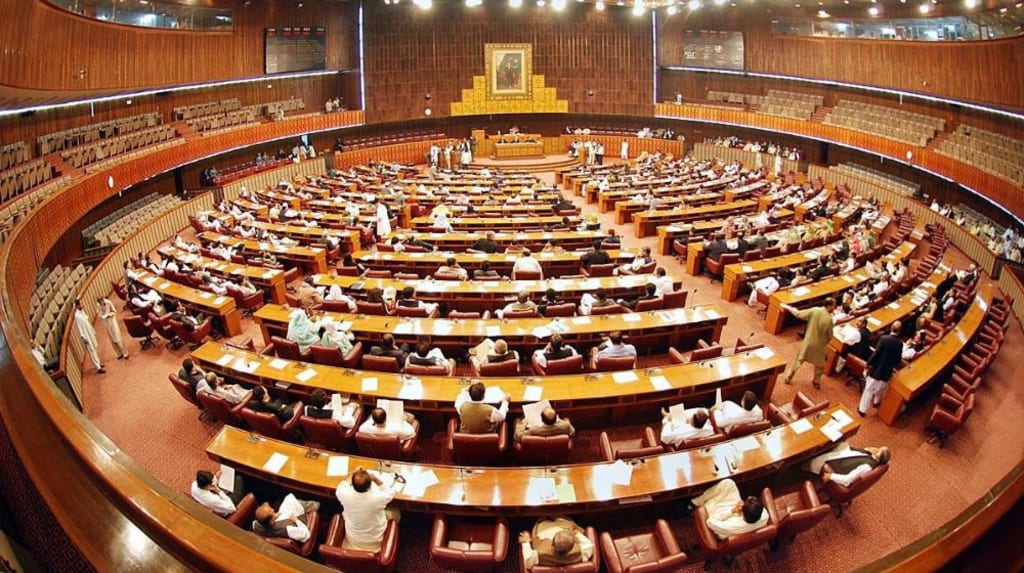
Here we take Pakistan as a case study. Since its inception in 1947, there existed incessant struggle between parliament and non-democratic actors to take over the political power. A number of coups had been staged to alter the democratic fabric of the Pakistani society. The dictators imposed their own rules in the form of LFOs to run the business of the state. Ah! Multiple times parliament was kept in abeyance and supremacy of the constitution was subverted just to perpetuate the rule of dictators who dismissed the elected government for the fulfillment of their own vested interests. Their insatiable desire for power put the country under presidential form of government where absolute power was entrusted to the dictator. Out of 75 years, multiple times country was put under the dictatorship: 30 years dictatorship and 45 years direct or indirect democracy.
In 1997, general elections were held in the country and as a result of these elections, PML (N) emerged as the single largest party in the National Assembly of Pakistan with 137 seats. Mr. Nawaz Sharif was sworn in as a heavy mandated Prime Minister of Pakistan. His whimsical use of authority soon undermined the supremacy of parliament as he did not use to attend the sessions regularly rather liked to dictate the lawmaking process. Parliament, from which he derived his power, became the only instrument to pass the bills tabled by the ruling party. Elected representatives of the people, through which people express their will, were kept at length and not given due attention in getting their issues resolved.
During that tenure Kargil conflict attracted the attention of international community and put Pakistan and India on the verge of full-fledge war. As per Pakistan side version, Kargil peak was captured by the “Mujahaideen” who were not under the control of Pakistani authorities. On the other side, India was claiming on international platforms that it was Pakistan’s Army which had captured the Kargil peak. With the intervention of the US president Bill Clinton, the Kargil conflict came to an end. Meanwhile the rift between military and civilian government widened to the extent that it ousted the elected prime minister of Pakistan. Mr. Muhammad Nawaz Sharif was put behind the bars and the National Assembly was dissolved. From 1988 to 1999, four successive democratic governments were dismissed on either corruption charges or others. Each time, National Assembly was dissolved by the president through 58 2b and Parliament despite being the highest lawmaking body could not save itself from the mischievous use of authority by the president and dictators.
Political parties in Pakistan have a huge say in legislative process. The fact is that the most consensus based constitution of Pakistan (1973) was formulated by the lawmakers elected in 1970 through first direct elections. In spite of these lawmaking powers, parliament has failed miserably to frame such laws which can be instrumental in thriving the democratic norms in the country and serve as a bulwark against those who want to derail the entire democratic process. The major reason which can be attributed to this failure is lack of political will and feudal mindset of the members of parliament who themselves owe the desires to be the rulers for indefinite period and with unlimited authority. Low education level of some of the members can also be included in the reasons for low profile performance of the parliament.
From aforementioned facts, it can be deduced that people’s role in running business of the state is vital that can be best expressed through their elected representatives. Democratic governments are meant for fulfilling the people desires through rightful utilization of available resources. In case of Pakistan, it appears that people elect their representatives only to rule them and not for carrying out the business of the state as per will of the people. Laws are made contrary to the ground realties that further aggravate the already dismal situation. Finance bill is debated in both the houses of the parliament but it never dares to address the economic problems being faced by the general masses.
In a democratic system, parliament occupies central place and is the main source of laws. Ordinances are issued off and on by the presidents to address any issue of emergent nature but finally they are required to be passed by the parliament to become an act otherwise they expire after stipulated time period. The only thing required is to respect this status of parliament and elect the persons who deserve to be elected. However, it is disquieting to observe that cast system plays a major role in voting for the candidates. As a result of such practices, Pakistan still has an inchoate democratic system which is not able to withstand the challenges being put forward by the power-seekers. Resultantly, parliament which should be the mother of all laws and authority, is often bypassed which in turn means that will of the people is ignored in one way or the other.
References:
1. The Development of Political Institutions (Book by Federico Ferrara).
2. Economist Intelligence Unit (EIU).
3. FAFEN report on 1997 General Elections.
About the Creator
Azhar Abbas
I am blog writer with vast experience. I use to write about social, political and economic issues more precisely. My writings are full of knowledge, ground realities and English learning skills.
Keep reading
More stories from Azhar Abbas and writers in Education and other communities.
Coronavirus: A real monster or hoax
With the onset of 21st century, the world fell prey to the clutches of many horrible diseases, but when it comes to pervasiveness and lethality, Covid19 tops the chart. With its prevalence on almost all the habitable continents, it has affected all sectors of human life. The most under pressure sector appears to be the medical field. Health professionals are more prone to the contagion as they directly deal with the patients who are suffering from Covid19 and serve as carriers. They also have to witness the horrendous scenes of people dying of this monster. It has, to the larger extent, changed the entire lifestyle of the people all over the world.
By Azhar Abbas4 years ago in Psyche
How to Make Money Online
A few years ago, earning money meant waking up early, traveling long distances, and working long hours for someone else’s dream. Today, the internet has changed everything. Content creation has opened a new digital path to freedom, allowing people to earn money online by sharing their ideas, skills, and creativity with the world.
By Bilal Mohammadi4 days ago in Education
Best Hunting Destinations in America Every Hunter Should Visit
Hunting has deep roots in American culture. It connects people to the land and to a long outdoor tradition. From vast plains to deep forests, the country offers many places where hunters can test their skills and enjoy nature. This guide explores America’s Best Hunting Destinations clearly and straightforwardly. Each place provides rich wildlife, strong traditions, and unforgettable landscapes. If you love the outdoors, these destinations deserve a spot on your travel list.
By Joe Sottolano3 days ago in Education



Comments
There are no comments for this story
Be the first to respond and start the conversation.