
Note-Taking Methods That Actually Work
Proven Note-Taking Methods That Make Studying Easier
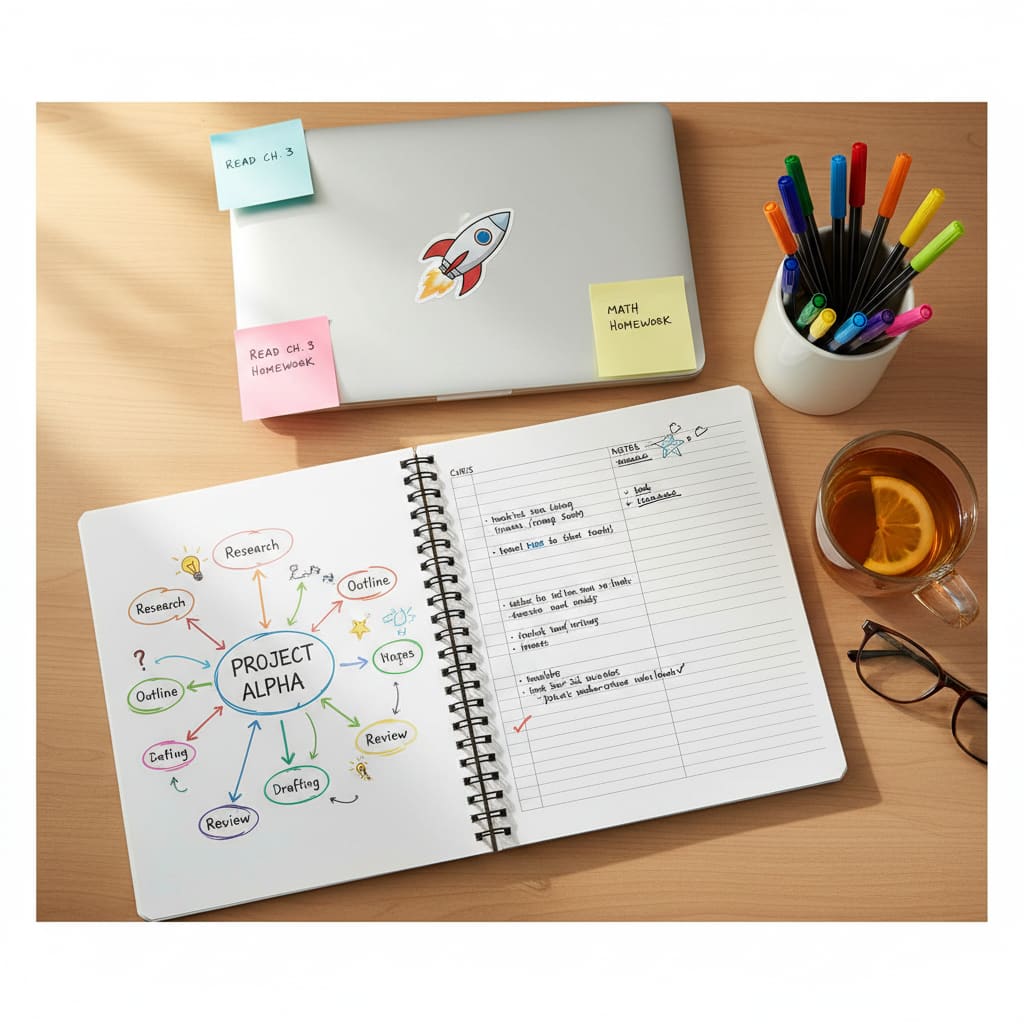
Let’s be honest—taking notes can be a pain. Sometimes you write everything down, your hand cramps, and a week later, you can’t even read what you wrote. Other times, you barely jot anything and then wonder, “What did the teacher even say?” The truth is, note-taking isn’t about how much you write. It’s about how smartly you write.
If you want your notes to actually help you—not just sit there collecting dust—then you need a method that sticks. And yes, there are plenty of ways to do this. Some might work better for you than others. So let’s look at a few that really do.
1. The Cornell Method
The Cornell Method is kind of a classic. You divide your page into three parts: one side for cues, a bigger section for your notes, and a small section at the bottom for a quick summary.
Here’s how it works: While the lecture is going on, you write the main points in the big section. After class, jot down questions or keywords in the cue column. Then, at the end, write a small summary at the bottom in your own words.
Why it works? Well, when you review later, you can cover the notes part and test yourself with the cue column. And that summary at the bottom? It makes your brain go, “Ah, I get this now.” Honestly, it’s more about understanding than memorizing.
2. Mind Mapping
Mind maps are like the doodle version of notes—but in a good way. Start with a central idea in the middle, then branch out into related points. You can even use colors, icons, or tiny sketches—whatever helps you remember.
For example, if you’re studying biology, you might write “Cell Structure” in the middle. Branch out to “Nucleus,” “Mitochondria,” and “Cell Membrane.” You could even doodle a tiny mitochondrion if you’re feeling artsy.
It works because our brains are visual creatures. Seeing how ideas connect helps more than just memorizing isolated facts. And honestly, it’s kind of fun too.
3. The Outline Method
You probably know this one—headings, subheadings, bullet points.
- Main Topic
- Subtopic
- Details
It’s straightforward and works well for lectures that have a clear structure. And here’s a tip: don’t worry about making it too neat. Use numbers, dashes, arrows—whatever keeps your brain tracking the flow of information.
4. The Charting Method
Charts are a lifesaver when you need to compare things. Historical events, scientific processes, differences between theories—you name it.
Set up a table with columns like “Event,” “Date,” “Impact.” Fill it in as you go.
Why it works? Your brain loves order. Seeing everything side by side makes patterns and connections obvious. And honestly, it’s a lot easier than trying to cram paragraphs of notes.
5. The Sentence Method
This is as simple as it sounds. Write each new thought on its own line. Number them if it helps.
It’s fast and works when the lecture moves in all directions. Later, you can organize those sentences into charts, outlines, or summaries.
6. Digital Notes
Typing notes on your laptop or tablet is super common now. Apps like OneNote, Evernote, or Notion can store everything—typed notes, images, audio recordings, PDFs.
The good part: you can search through everything later. Reorganizing is a breeze. And yes, attaching slides or pictures makes it even more useful.
But—and this is a big but—typing mindlessly won’t help. You still need to process the info as you go, not just copy-paste.
7. Symbols and Abbreviations
No matter which method you use, abbreviations save time.
- “w/” for “with”
- “b/c” for “because”
- Arrows to show cause → effect
You’ll develop your own shorthand over time. Trust me, it’s liberating. And it keeps your notes fast and readable.
8. Review and Revise
Notes alone don’t do the work—you do. Reviewing them regularly is key.
- Right after class: glance through and fill gaps.
- Daily: spend 5–10 minutes on key points.
- Weekly: summarize everything in your own words.
Why bother? Because reviewing moves info from short-term memory to long-term memory. And rewriting, even a little, helps you actually understand rather than just memorize.
9. Mix Methods
No one method fits all subjects. Mind mapping might be great for biology but not for history. Outlines work for history, but maybe not for brainstorming essays.
And that’s okay. Mix methods. Start with a mind map, then turn it into a Cornell summary. Or make a chart and add doodles. The point is to make your notes actually usable.
10. Stay Organized
Finally—organization matters. Keep notes in one notebook or one folder digitally. Tabs, labels, or color codes help.
Messy notes = wasted time. And trust me, there’s nothing more stressful than flipping through five notebooks trying to find that one formula or date. Stay organized, and studying becomes way less painful.
- Key Takeaways
- Pick a method that suits the subject.
- Visuals, colors, charts—they help memory.
- Summarize in your own words.
- Review regularly.
- Stay organized.
Notes aren’t about copying everything. They’re about understanding, remembering, and reviewing. Use the right method for your style and subject. Over time, you’ll notice a difference.
And remember, it’s okay if your notes look messy. What matters is that they help you. And honestly, a little creativity never hurt anyone.
About the Creator
Lisa Ray
Lisa Ray is a seasoned academic and career guidance expert who shares her wealth of knowledge through her blog at https://careersaid.com/. With a strong academic background and extensive experience in the field, she offers practical advice.
The Role of Clear Communication in Strengthening Financial Client Relationships
In the world of finance, clear communication is not just helpful; it is essential. Whether discussing investment options, setting future goals, or explaining financial risks, professionals must convey information in a way that clients understand and trust. The strength of any long-term financial relationship depends heavily on how well both parties can communicate expectations, progress, and concerns.
By Michael Christopher Venturino7 days ago in Education
Teaching Beyond Limits
Innovative teaching methods in resource-limited settings are changing how learning happens worldwide. In many communities, schools lack books, technology, trained staff, and even proper classrooms. These limits can slow learning and reduce student confidence. Still, strong teaching does not depend only on money or tools. It depends on creativity, care, and clear goals.
By Baitulmaal7 days ago in Education
Writing About Writing: The Rainbow Trap
The good thing about living in modern times is that LGBTQ representation in media is increasing. Not just in niche and Independant media, either, but also in mainstream media. Books, movies, TV shows, comics... they're finally catching on that LGBTQ+ people form a significant part of their audience, and deserve to see themselves on screen and in fiction, not just as victims in documentaries and true crime shows.
By Natasja Rose5 days ago in Writers



Comments
There are no comments for this story
Be the first to respond and start the conversation.