
Next.js vs. Astro vs. SvelteKit: Which Framework Wins in 2025?
Introduction to Modern Web Frameworks in 2025

Choosing the right frontend framework has always been a heated debate in the web development community. With the rise of new technologies, developers in 2025 face an even bigger challenge: should they continue building with Next.js, explore the lightweight and SEO-friendly Astro, or shift towards the growing momentum of SvelteKit?
This article dives deep into the Next.js vs Astro vs SvelteKit debate, analyzing performance, developer experience, ecosystem, and use cases. Whether you’re building a static site, a full-stack web application, or the next enterprise SaaS platform, this comparison will help you decide which framework best fits your needs in 2025.
Next.js vs. Astro vs. SvelteKit: Core Variations Explained
Before comparing features, let’s quickly define each framework:
Next.js: Next.js, backed by Vercel, enhances React with features like server-side rendering, static generation, and incremental updates through ISR. It’s the go-to choice for large-scale apps and enterprise-level solutions.
Astro: Known as the “content-first” framework, Astro focuses on static site generation and ships zero JavaScript by default, making it incredibly fast and SEO-friendly.
SvelteKit: Built on top of the Svelte compiler, it prioritizes developer experience with minimal boilerplate, lightning-fast performance, and a growing ecosystem for modern web apps.
In short: Next.js = full-stack power, Astro = content/SEO focus, SvelteKit = developer simplicity.
Next.js vs. Astro vs. SvelteKit: Key Features Every Developer Should Know
When analyzing Next.js, Astro, and SvelteKit in 2025, their fundamental features become the deciding factor.
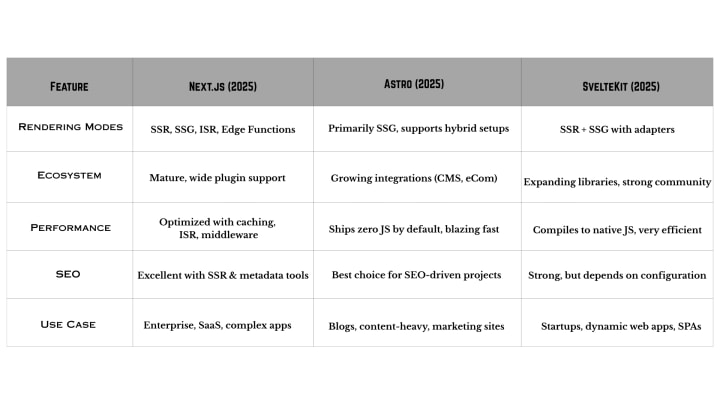
Performance & Optimization in 2025
One of the hottest questions is: Which is better in 2025: Next.js or Astro, or SvelteKit?
Next.js Performance: With capabilities such as ISR, edge rendering, and optimized images, Next.js is well-equipped to manage demanding, high-traffic applications. Its balance of SSR and static generation makes it ideal for scaling.
Astro Performance: Astro dominates static content performance. By shipping minimal JavaScript, it often achieves the best Core Web Vitals scores. If SEO optimization is your priority, Astro vs Next.js SEO comparisons usually show Astro on top for static projects.
SvelteKit Performance: The Svelte compiler enables SvelteKit to produce lean, lightweight applications with excellent performance. Benchmarks in 2025 show SvelteKit vs Next.js performance to be competitive, with SvelteKit often outperforming in smaller apps.
Ecosystem & Developer Experience
Framework adoption depends not only on performance but also on the ecosystem.
Next.js Ecosystem: With its long history, React foundation, and enterprise adoption, Next.js remains the most widely used. The plugin ecosystem, CMS integrations, and full-stack capabilities make it a safe choice for companies.
Astro Developer Experience: Astro is adored by developers building content-heavy projects. Its integrations with headless CMS tools like Contentful, Sanity, and Strapi make it a top choice for marketing teams.
SvelteKit Ecosystem: While younger, SvelteKit’s ecosystem is rapidly growing. Developers love its minimal boilerplate, modern syntax, and seamless transitions. For startups, the productivity boost is hard to ignore.
Use Cases: When to Choose Each Framework
- Choose Next.js if you’re building enterprise apps, SaaS platforms, or scalable e-commerce solutions.
- Choose Astro if your priority is SEO, fast static sites, or content-focused blogs.
- Choose SvelteKit if you want a modern, lightweight framework for dynamic web apps or when developer experience is the top priority.
A growing number of companies now hire Next.js developers for building scalable, production-ready applications that require both frontend and backend integrations. For rapid experimentation, startups often lean on SvelteKit’s lightweight framework.
Common Questions Developers Ask in 2025
Is SvelteKit better than Next.js?
For smaller apps and rapid development, yes. But Next.js still leads in enterprise adoption.
Will Astro replace Next.js for static sites?
Astro often proves to be the most suitable framework for building static-focused sites. Next.js remains the preferred option for developers tackling hybrid rendering and large-scale, intricate apps.
Which framework is best for SEO: Astro, SvelteKit, or Next.js?
Astro takes the crown for static SEO. Next.js is excellent for dynamic SEO with SSR. SvelteKit is competitive but still maturing in SEO tooling.
Which framework makes the most sense to learn in 2025: Next.js, Astro, or SvelteKit?
Learn Next.js for enterprise opportunities, Astro for SEO/content, and SvelteKit for cutting-edge developer experience.
Which frontend framework will dominate in 2025?
Next.js still leads in enterprise use, but SvelteKit is gaining adoption fast. In the space of SEO-optimized static sites, Astro continues to secure its niche.
The Future of Frontend Frameworks
Looking ahead, it’s clear that no single framework will dominate all use cases. Next.js continues to evolve as the powerhouse for enterprise-grade apps. Astro thrives in content-driven projects. SvelteKit wins developer hearts with simplicity and performance.
For businesses, the decision often comes down to resources. Enterprises frequently choose to hire Next.js developers because of its robust ecosystem and proven track record. Meanwhile, small teams and startups may prefer the flexibility of Astro or SvelteKit.
Final Thoughts
So, Next.js vs. Astro vs. SvelteKit: Which framework wins in 2025? The answer is: it depends on your project needs.
- Next.js wins for scalability, ecosystem, and enterprise adoption.
- Astro wins for static content and SEO.
- SvelteKit wins for developer productivity and modern simplicity.
The best choice isn’t about picking a single winner, but about aligning the framework with your goals, team skills, and project requirements.
As web development moves forward, one thing is certain: 2025 is not about “one framework to rule them all,” but about leveraging the right tool for the right job.
About the Creator
Lucas Wade
I’m Lucas Wade, a software developer with 10 years of experience in full-stack development, cloud solutions, and building scalable, high-performance applications.
Keep reading
More stories from Lucas Wade and writers in Education and other communities.
Why .NET 9 Is a Game-Changer for Enterprise Software
The launch of .NET 9 by Microsoft in 2025 represents a pivotal advancement in the evolution of enterprise software development. Packed with performance upgrades, architectural flexibility, and a more powerful C# 13, this release is not just another version bump—it’s a major shift in how large-scale applications are built and deployed.
By Lucas Wade6 months ago in Education




Comments
There are no comments for this story
Be the first to respond and start the conversation.