
New Horizons in Terraforming Mars: Can Trees Survive in Space
The Concept of Terraforming Mars

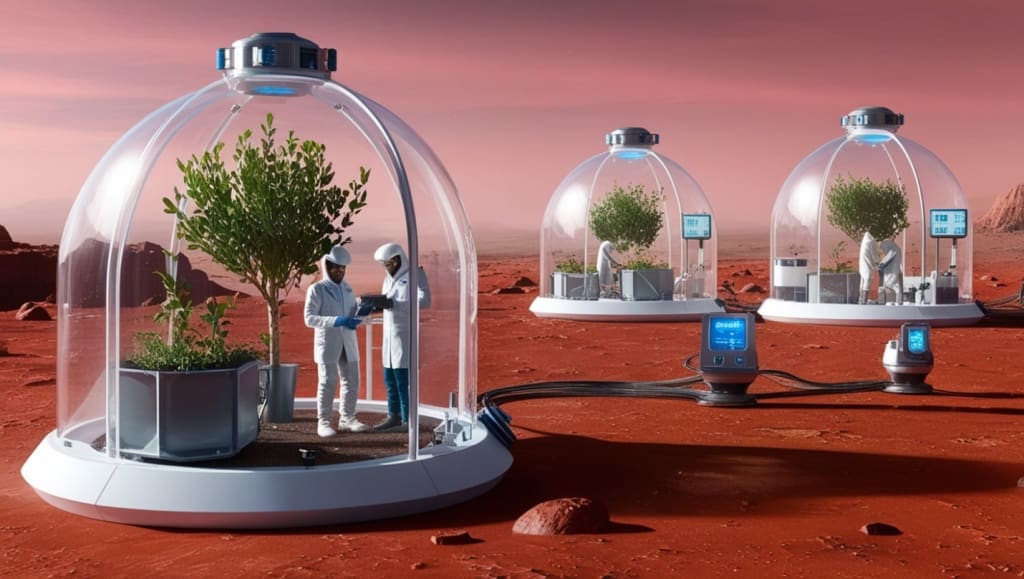
New Horizons in Terraforming Mars: Can Trees Survive in Space?
As man continues to expand his horizons of space exploration, the idea of terraforming Mars into an earth-like planet has caused a buzz among the people and the scientists. And the first setting to this thought would indeed be terraforming—that is, modifying the environment of Mars to include life as we know it. Recently, such areas on the planet Mars have been found that could support vegetation in the future, including trees. This paper discusses whether Mars is able to host trees and presents the limits of planetary terraforming, along with the quest for available technologies to make this vision a reality.
The Concept of Terraforming Mars
It would require the atmosphere and temperature of Mars to be just like on Earth. It would theoretically support human life and development of agriculture on the planet. The scientists imagine using a combination of means: greenhouse gas production, pulling of water from the ground, and photosynthetic organisms, in order to make an atmosphere that would be terrestrial-friendly for plant life.
But the task is Herculean. Martian atmospheric constitution has carbon dioxide levels above 95 percent and trace oxygen levels; the average surface temperature of Mars is approximately -80 degrees Fahrenheit (-60 degrees Celsius). Researchers will face these issues to grow Earth-like vegetation on Mars by altering the atmosphere, enriching soil, and probably inside man-made biospheres.
Important Regions for Possible Tree Growth in Mars
That is why some areas on Mars have been recognized to be safe and most ideal for possible plant life because of relatively warm temperatures, reasonable amounts of sunlight, and usable soil.
Some areas close to the equator of Mars and also a few places along ancient river valleys where frozen deposits are assumed to continue to be full of water are among those in this list.
Selection Criteria on Regions on Mars
Sunlight Exposure: The trees require a lot of sunlight for photosynthesis, and there are equatorial regions on Mars that can replace polar regions.
Temperature: Even though the entire planet may be cold, the temperature difference from being hot to cold that may be prevailing in an equatorial region, although extreme for the Earth, would be relatively less extreme compared to other regions on the planet.
Composition of Soil: The regolith of Mars does not have organic matter on the earth. However, some parts have minerals that can be fertilized if introduced with fertilizer.
These possible areas would be mapped to aid future missions that will venture and, if possible, make the surface of Mars ready for terraforming programs.
Challenges in Planting Trees on Mars
Although planting trees on Mars seems pretty promising, there are still numerous scientific and technological problems associated with this mission. In the absence of a thick atmosphere, richness of soil with organic matter, and lack of climatic stability on Mars, it poses constraints in supporting big terrestrial plants like trees.
Limitation of Atmospheric Conditions
The thin Martian atmosphere has a high concentration of carbon dioxide that is not very favorable for plants since the oxygen level is very low. While trees would absorb the carbon dioxide, they would still need an oxygen atmosphere too in order to breathe.
The scientists are experimenting with some artificial habitats that could mimic the earth environment by maintaining air pressure and temperature and also the perfect level of gases in the air to overcome these problems.
Lack of soil
The soil on Mars is chemically sterile, nutrient-free, and toxic perchlorates that are lethal to most forms of Earth life. This would necessitate major enrichment with nutrients, probably artificial fertilizers, and the introduction of nitrogen-fixing bacteria before such soil could support trees.
The other challenge is the complete absence of water on Mars. Scientists could either find or produce large amounts of water to support any kind of vegetation.
Temperature Extremes
The temperature on Mars is very unstable, especially during nightfall. The temperature could be expected to drop dramatically. Trees need a relatively stable temperature, so artificial climate control or protective enclosures would be needed to make the environment livable for the trees.
Possible Solutions and Innovations in Terraforming
Scientists are now trying various technological and ecological solutions to overcome such hindrances, which would perhaps one day bring trees to grow on Mars. This, they feel, will be through biological engineering all the way to high-tech climate modification strategies.
1. Artificial Biospheres
One would be contained biospheres, sealed habitats modeling Earthlike conditions. Such structures would control temperature, provide a breathable atmosphere, and shield plants from radiation and extreme cold. Biospheres could also be an ideal controlled environment in which to study plant growth on Mars, with trees chosen with a view to their ability to survive in Martian conditions.
2. Genetic Engineering of Plants for Mars
Another potential approach may be genetic engineering of plant species so they can survive on the planet's diverse environment. Scientists have already exhibited genetic techniques that increase plants' tolerance to radiation, cold temperatures, and poor nutrients in soils. Thus, researchers hope that in the future, with such extreme conditions tolerated by forming Mars-adapted trees, they may introduce plant species that can thrive on Mars without exhausting human intervention.
3. Usage and Green House Gases Carbon Dioxide
Releasing greenhouse gases in order to trap heat in the Martian atmospheric layer would slowly warm the planet up, giving an atmosphere that would be thicker one.
This concept may make not only the climate friendly but also it will boost the pressure in the atmospheric layer so that plant life can thrive.
Fluorine-based compounds can be used for the production of greenhouse agents. Some researchers write about the methods on how to enhance the greenhouse effect on Mars.
Roadmap to Terraform Mars
Here is a very rough outline of what could perhaps illustrate the process to be used to make part of Mars habitable for trees in general and plants in general through gradual changes in environmental variables.
Environmental and Ethical Considerations on Terraforming Mars
Surely, the scientists would consider what was ethically right to do with another planet. Mars is also akin to Earth with its inimitable ecosystem, barren though it be. Bringing biological material from Earth on to Mars, they might kill some native microorganisms that could exist there. They would also change the environment of Mars permanently. That may affect the scientific interest in visiting the same place in the future with the pristine state of the Earth or even the early Mars.
All these factors will be balanced by the prospect of Mart colonization and further human penetration into space, all requiring prudent attention and international cooperation with respect for extraterrestrial environments.
Conclusion
The vision of tree planting on Mars is a new frontier that dares anyone, or anything, to go to space and study it in the context of climate study. Considerable challenges remain, but, to date, research on the habitability of Mars has already given promising insights. Artificial biospheres also indicate genetically engineered systems; scientists push the terraforming frontier up to what is feasible. Only in further missions and experiments will the red planet prove itself to be a home for Earth-based life forms and a significant leap toward humanity's expansion in the cosmos.
About the Creator
Shariq Mehmood Khan
My Name is Shariq Mehmood Khan Content writer specializes in developing efficient, well-researched, and reader-friendly content, Shariq has a knack for creating high-quality content that fits the needs of diverse clients.
Keep reading
More stories from Shariq Mehmood Khan and writers in Education and other communities.
Breakthrough in superfluidity: probing the hallmarks of quantum fluid dynamics
Breakthrough in superfluidity: probing the hallmarks of quantum fluid dynamics Superfluidity is probably the most exceptional quantum phenomenon in physics—one of those that have completely revolutionized fluid mechanics and quantum dynamics. In fact, it gives behavior far beyond what is usual for a fluid—once in this state, it offers frictionless flow, much more than predicted by the realm of classical physics. This article reviews recent work on superfluidity: breakthroughs, role of Bose-Einstein condensates, and outlook for quantum technology.
By Shariq Mehmood Khanabout a year ago in Education
The Digital Nomad Blueprint
In a not-so-distant future, where technology thrived and the world became increasingly connected, many people chose to break free from traditional lifestyles. Among them was a young woman named Mia. Mia was a digital nomad, traveling the globe with her laptop, working remotely while exploring new cultures. Her heart was set on living life to the fullest, but she was also searching for something greater—a sense of purpose.
By Hamad Afridi 2 days ago in Education



Comments
There are no comments for this story
Be the first to respond and start the conversation.