
Mysteries of Wormholes
Myth, Math, or the Future of Interstellar travel?
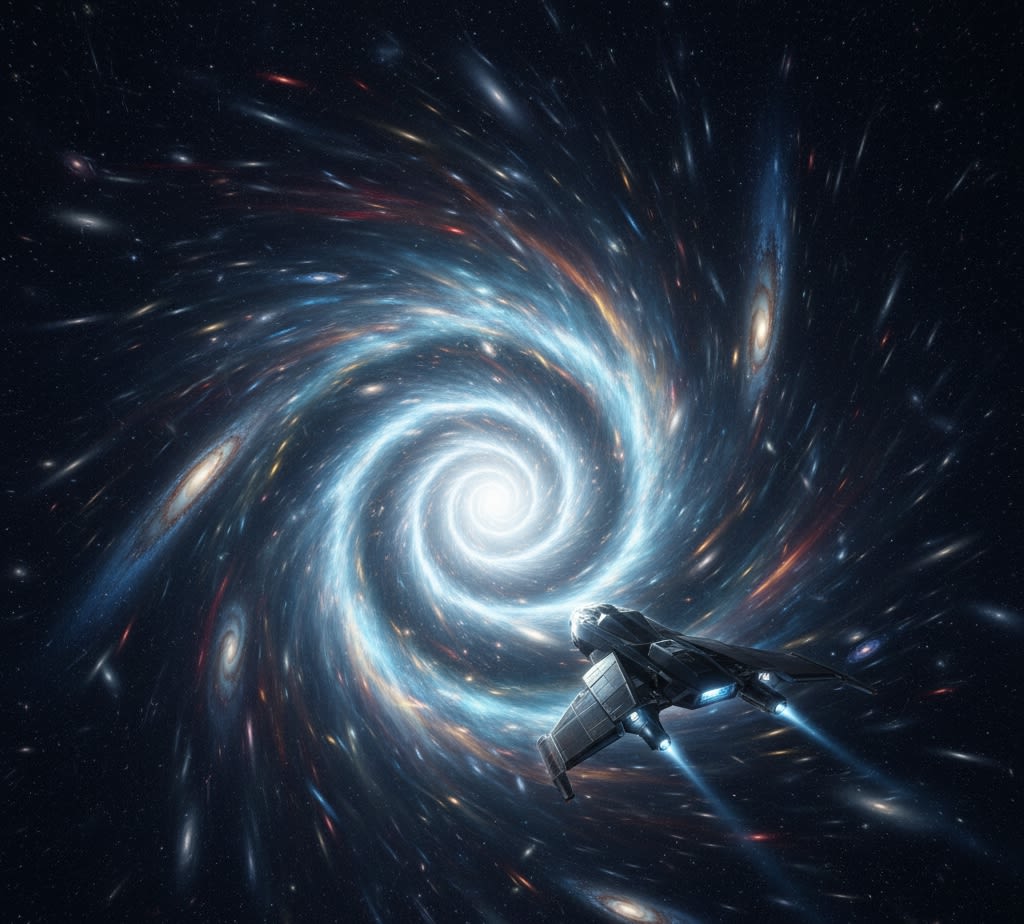
Wormholes: Myth, Math, or the Future of Interstellar Travel?
The universe is vast—so vast that even light, traveling at 300,000 kilometers per second, would take thousands of years to reach the nearest stars beyond our solar system. For decades, scientists and dreamers alike have searched for a way to bridge this cosmic distance. One idea that continues to capture imagination is the wormhole—a theoretical tunnel through space and time that could make interstellar travel almost instantaneous. But is it real science, a mathematical curiosity, or just science fiction?
---
What Is a Wormhole?
A wormhole, also known as an Einstein–Rosen bridge, is a concept that comes from Einstein’s theory of general relativity. It’s described as a tunnel-like shortcut that connects two distant points in space and time. Imagine folding a sheet of paper so that two dots on opposite ends touch—then poking a hole through them. That shortcut is what a wormhole would do in space.
If such a structure could exist, it could allow a spacecraft to travel across galaxies—or even to different times—without crossing the unimaginable distances in between. In theory, a wormhole could link two black holes or two regions of spacetime, providing a kind of cosmic highway.
---
The Science Behind the Idea
The concept of wormholes isn’t just a fantasy born from science fiction novels. It has deep roots in mathematical physics. In 1935, Albert Einstein and physicist Nathan Rosen first proposed the idea of these “bridges” connecting two points in the universe. They were trying to understand how gravity might bend space so extremely that it could connect separate regions of spacetime.
However, there’s a catch: Einstein’s equations allow wormholes to exist mathematically—but they don’t guarantee that they can be stable or usable in the real universe. The main problem is gravity. A natural wormhole, if it ever formed, would collapse instantly due to immense gravitational forces.
To keep a wormhole open, scientists theorize it would require exotic matter—a form of matter that has negative energy density and repulsive gravity. While no one has ever discovered such matter, quantum physics does suggest that tiny amounts might exist for very short periods, known as quantum fluctuations.
---
Wormholes in Science Fiction and Popular Culture
From Interstellar to Star Trek, wormholes have been a favorite tool for storytellers to explore deep space and time travel. They serve as convenient plot devices that allow humans to explore distant galaxies or alternate realities in seconds. While these portrayals are often exaggerated, they are usually inspired by real scientific theories.
In the movie Interstellar, physicists like Kip Thorne helped ensure the wormhole visualizations were based on actual equations. The film’s depiction of space warping around a wormhole was one of the most scientifically accurate in cinema history—and helped many people visualize what a real one might look like.
---
Could Wormholes Be the Future of Travel?
If wormholes exist, and if we can stabilize them, they could revolutionize space exploration. Imagine being able to travel from our solar system to another galaxy in seconds, communicate across the universe instantly, or even glimpse the far future or distant past.
But as of now, these ideas remain purely theoretical. The technology and materials needed to create or sustain a wormhole are far beyond our reach. Even detecting one—if they exist—would require tools and understanding far more advanced than what we currently possess.
---
The Mystery Remains
For now, wormholes sit at the intersection of myth and math—beautifully possible on paper but practically out of reach. They remind us how much we still don’t know about space, time, and the true nature of the universe.
Whether they turn out to be a doorway to other galaxies or remain a fascinating mathematical illusion, wormholes continue to inspire scientists, philosophers, and dreamers. After all, exploring the impossible is often how humanity discovers what’s truly possible.
About the Creator
Keep reading
More stories from Muhammad Shahram and writers in Education and other communities.
The Multiverse Hypothesis
The Multiverse Hypothesis: Are We Living in One of Infinite Realities? For centuries, humanity has looked up at the stars and wondered whether we are alone in the universe. But modern science has taken that curiosity to an entirely new level. Instead of asking whether life exists beyond Earth, physicists are now asking whether entire realities beyond our universe could exist. This idea, known as the Multiverse Hypothesis, suggests that our universe may be just one of countless others—each with its own laws of physics, histories, and even versions of ourselves.
By Muhammad Shahram5 months ago in Education
Smart Healthcare Systems: Transforming Medical Operations Through Digital Innovation
The healthcare industry is undergoing a profound transformation as digital technologies reshape the way medical organizations operate. Hospitals, clinics, and healthcare networks are increasingly adopting advanced technological solutions to enhance efficiency, improve patient outcomes, and reduce administrative burdens. As healthcare demands continue to rise globally, technology has become an essential tool for streamlining operations and supporting better coordination among healthcare professionals.
By Brady Beitlich5 days ago in Education
Atlas Aluminum Corp Parts Catalog: Aerospace Manufacturing, Aviation Hardware, and Industrial Aluminum Components
Introduction: My Research Into Atlas Aluminum Corp Parts Catalog While exploring aerospace hardware suppliers and industrial component manufacturers, I came across the Atlas Aluminum Corp Parts Catalog listed on the NSN platform. What fascinated me most was how manufacturers like Atlas contribute to the broader ecosystem of aerospace engineering, aviation structures, and industrial aluminum components.
By Beckett Dowhan4 days ago in Education


Comments
There are no comments for this story
Be the first to respond and start the conversation.