
Bioreactors for Space: Living Factories of the Future
Space

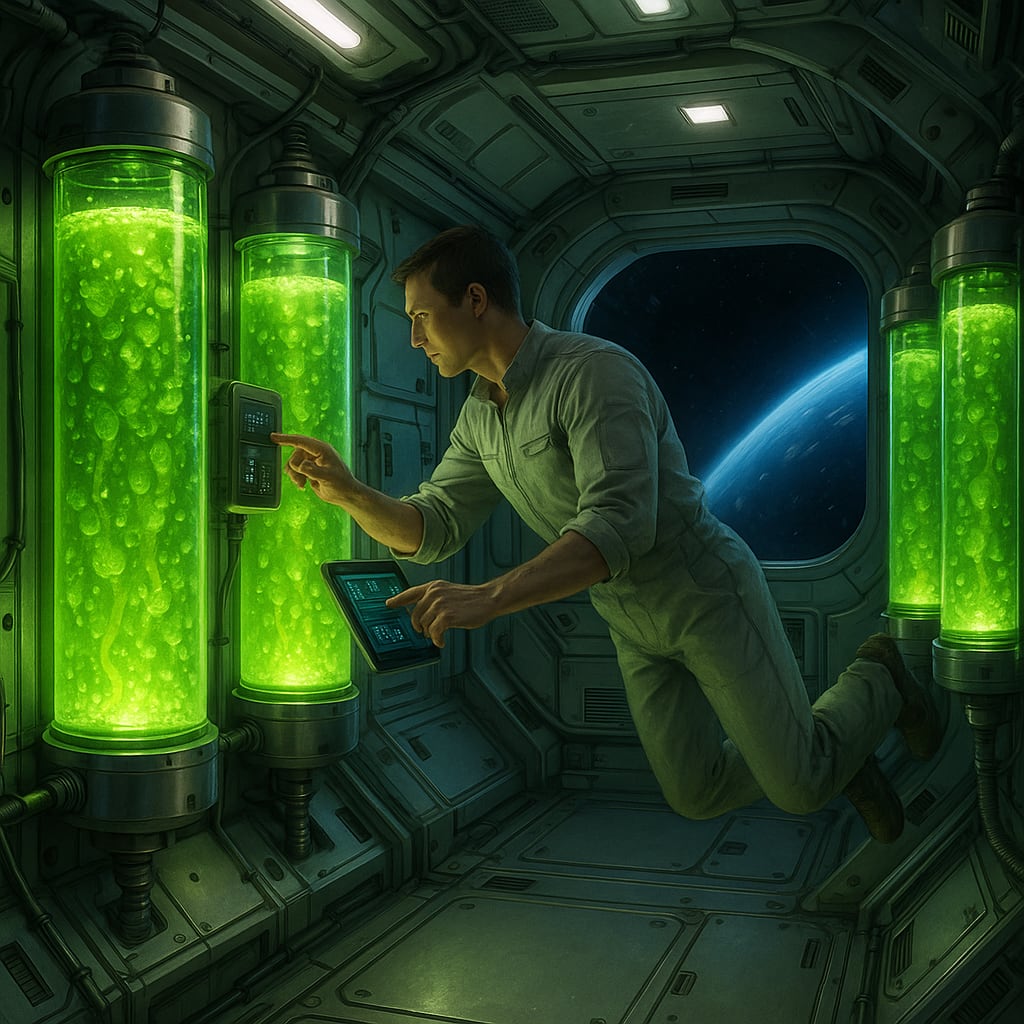
As humanity moves closer to the age of long-term space exploration and colonization, one practical challenge grows louder: how can we sustain life far from Earth? Rockets can’t simply carry endless supplies of food, oxygen, and clean water for astronauts heading to Mars or building habitats on the Moon. The solution may lie in an elegant fusion of biology and engineering — bioreactors, compact “living factories” designed to keep astronauts alive and thriving beyond our planet.
What Exactly Is a Bioreactor?
In the simplest terms, a bioreactor is a system that creates the perfect environment for living organisms — from algae to bacteria or even cultured animal cells — to grow and perform useful tasks. Unlike a greenhouse, which passively grows plants, a bioreactor is a carefully controlled machine. It can regulate light, temperature, nutrient flow, and sterility, while recycling waste products into something useful.
In space, where every drop of water and every breath of air counts, this efficiency is priceless.
One System, Multiple Benefits
Among the most promising candidates for space bioreactors are microscopic algae like spirulina and chlorella. Despite their size, these organisms are powerhouses:
- Through photosynthesis, they release oxygen — a vital resource for astronauts.
- They consume carbon dioxide and even metabolize some waste products.
- The resulting biomass is nutrient-rich and can be eaten as a dietary supplement, offering protein, vitamins, and minerals.
This creates a closed-loop system where astronauts breathe the oxygen algae produce, while the algae feed on the carbon dioxide exhaled by the crew. The cycle not only supports survival but also reduces dependence on constant resupply missions from Earth.
It’s the kind of elegant, self-sustaining design that space engineers dream of.
Experiments Already in Orbit
This idea isn’t just theory. On the International Space Station (ISS), the European Space Agency has tested bioreactor modules where algae are cultivated under microgravity conditions. To the scientists’ delight, the algae adapted remarkably well. Even without the familiar push and pull of Earth’s gravity, the organisms grew robustly and continued producing oxygen.
These early experiments show that bioreactors could become the backbone of life-support systems for long-duration missions, especially journeys to Mars that might last several years. Without such systems, astronauts would face the impossible task of transporting all their oxygen, food, and water from Earth — an unsustainable approach.
Beyond Algae: The Next Generation of Bioreactors
Although algae are a solid start, the future of space bioreactors could go far beyond green slime in a tank. Researchers are exploring ambitious possibilities such as:
- Cultured meat production: Growing animal muscle cells in a bioreactor could provide astronauts with fresh protein without needing livestock. Imagine eating a steak produced in orbit.
- Bacterial processing systems: Specialized bacteria could transform toxic by-products into harmless or even useful compounds, acting as a microscopic recycling crew.
- Hybrid ecosystems: Combining plants, microbes, and mechanical filters to create miniature biospheres capable of handling air, water, and food production all at once.
These innovations aim to create spacecraft and planetary bases that function more like Earth itself: interconnected, balanced, and regenerative.
Why This Matters
It’s not just about convenience; it’s about survival. If humanity truly intends to build colonies on Mars or establish permanent lunar outposts, resupplying them constantly from Earth would be impossible. Bioreactors offer a path to independence from Earth’s fragile supply chain. They promise resilience, sustainability, and the possibility of genuine permanence in space.
Furthermore, bioreactors aren’t just useful for astronauts. The technologies developed for space could revolutionize sustainability on Earth as well. Imagine urban systems where waste is continuously recycled into fresh food, water, or clean air, modeled on the same principles guiding space exploration.
A Glimpse Into the Future
Picture a Martian habitat, its walls glowing with bioluminescent green panels filled with living algae. These panels quietly recycle every breath of carbon dioxide, turning it into oxygen, while producing supplemental food. In another chamber, a bioreactor cultivates fresh meat from a few starter cells, while bacteria silently break down waste into clean water.
It might sound like science fiction, but the building blocks of this vision already exist. In many ways, the first true “colonists” of space won’t be human — they’ll be microbes, algae, and cultured cells, working tirelessly to ensure that people can survive and thrive beyond Earth.
Final Thoughts
For centuries, humanity has depended on partnerships with the natural world: crops to feed us, forests to clean our air, oceans to regulate our climate. Now, as we take our first steps into the solar system, it will once again be tiny living organisms that make our survival possible.
Bioreactors may not look glamorous, but they hold the key to unlocking a sustainable future among the stars. In their silent tanks of bubbling green, they carry humanity’s greatest hope — the chance to live, breathe, and eat on worlds far from home.
About the Creator
Keep reading
More stories from Holianyk Ihor and writers in Education and other communities.
Dark Exoplanets That Swallow Light
When we gaze at the night sky, we imagine planets as bright, reflective worlds glowing with the light of their parent stars. After all, that’s how we see Venus and Jupiter in our own solar system—by the sunlight bouncing off their clouds and surfaces. But astronomers have discovered a bizarre class of planets that defy this simple logic. These worlds are so dark that they reflect less light than coal or asphalt. They are known as dark exoplanets, and they are some of the strangest objects ever observed beyond our solar system.
By Holianyk Ihor5 months ago in Education
What is Affiliate Marketing: A Beginner's Step-by-Step Guide
Affiliate marketing is a performance-based online business model that generates over $12 billion annually in the U.S. alone and continues to grow as e-commerce expands. At its core, affiliate marketing allows individuals to earn commissions by promoting products or services created by other companies. Affiliates share unique tracking links through websites, blogs, social media, email lists, or videos, and earn a percentage of each sale or action completed through those links. Because affiliates don’t handle product creation, inventory, payment processing, or customer support, it’s one of the most accessible ways to monetize an online presence.
By Mohammad Sufyaan6 days ago in Education




Comments
There are no comments for this story
Be the first to respond and start the conversation.