
Medicine with Foundation Year: Your Pathway to a Medical Degree
Discover how a Medicine with Foundation Year in the UK can prepare you for a medical degree. Learn entry requirements, costs, and top universities offering this route.
A Medicine with Foundation Year course offers an alternative entry route for students who do not meet the standard qualifications for direct entry into medical school. This extra preparatory year is designed to build your academic knowledge, develop your practical skills, and give you the confidence to thrive in a medical degree programme. You will benefit from smaller classes, tailored support, and a smoother transition into the demanding environment of medical training. In this guide, you’ll learn who can apply, what the course covers, the costs involved, and which UK universities offer this pathway.
Who Can Benefit from a Medicine with Foundation Year?
This programme is ideal for:
- Students who missed standard entry grades – perhaps falling short in A levels or IB.
- Applicants without required science subjects – e.g., those who studied arts or humanities but now wish to study medicine.
- International students – needing academic preparation for UK medical standards.
- Applicants from underrepresented backgrounds – such as schools with limited resources or low university progression rates.
Many universities also use contextual admissions, recognising potential beyond exam results.
Course Structure and Content
The foundation year usually forms the first year of a six-year route to becoming a doctor. It is designed to strengthen the academic base needed for medical studies.
Common topics include:
- Biology, chemistry, and physics relevant to medicine
- Human anatomy and physiology
- Laboratory techniques and data analysis
- Communication skills and professional conduct
- Critical thinking and study skills
Assessment typically involves exams, coursework, lab reports, and practical evaluations. On successful completion, you progress directly into Year 1 of the medical degree.
Entry Requirements
Entry standards vary, but you will usually need:
- GCSE English and Mathematics (grade 4/C or above)
- Three A levels or equivalent qualifications (lower grades than standard entry)
- Strong academic potential demonstrated through references and interviews
- UCAT or BMAT results if required by the university
Some universities limit this pathway to UK students, while others, such as the University of Central Lancashire (UCLan), welcome international applicants.
Costs and Funding
Fees depend on your residency status and the university:
- Home students: ~£9,250 to £12,000 per year
- International students: ~£18,000 to £47,000 per year
Remember to budget for living expenses. Scholarships and bursaries are sometimes available, particularly for widening participation applicants. International students should check for both university and external funding.
Benefits Beyond Academics
Choosing a Medicine with Foundation Year brings more than academic preparation:
- Confidence in tackling degree-level content
- Personalised tutor support and feedback
- Early exposure to healthcare settings
- Strong friendships and peer networks
Students often find they perform better in later years because of the strong foundations built here.
UK Universities Offering Medicine with Foundation Year
Below is a comparison of universities currently offering this pathway:
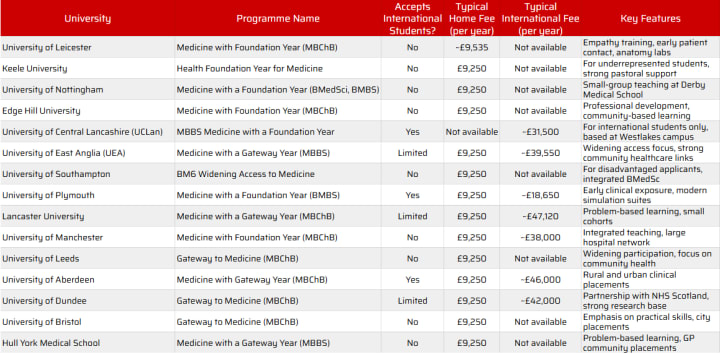
Note: “Limited” means international students are accepted under specific conditions. Fees are for 2025 entry and subject to change.
How to Choose the Right University
When deciding, consider:
- Whether you meet eligibility requirements
- Teaching style – problem-based learning or lectures
- Location and whether the foundation year is on the main campus
- Student support services
- Clinical exposure opportunities
- Progression rates into Year 1 of medicine
Application Process
Applications go through UCAS and involve:
- Researching eligible universities
- Preparing for UCAT or BMAT if needed
- Writing a focused personal statement
- Gathering academic or professional references
- Attending interviews or multiple mini interviews (MMIs)
- Meeting all deadlines
Top Tips for a Strong Application
- Gain healthcare-related experience
- Show evidence of resilience, teamwork, and communication
- Tailor your personal statement to each university’s values
- Prepare for admissions tests well in advance
- Keep a checklist of deadlines and requirements
Final Thoughts
A Medicine with Foundation Year offers a supported and structured route into one of the UK’s most competitive degree programmes. It is particularly valuable for students who need extra preparation, whether academically, scientifically, or personally. By choosing the right university, understanding the entry requirements, and preparing a strong application, you can set yourself on a clear path towards a career in medicine.
About the Creator
MIE Pathways
MIE Pathways offers academic foundation programs to help Bangladeshi students transition smoothly into universities in the UK, USA, Canada, Australia, and more.
Keep reading
More stories from MIE Pathways and writers in Education and other communities.
Top 15 Study Abroad Tips for International Students
Moving to another country for studies changes everything. Excitement and nerves come together as students start a new chapter. Getting lost in a city, tasting local food, or meeting new people all shape the experience. Study abroad tips help students feel ready and enjoy these moments. They turn this time into some of the most memorable years.
By MIE Pathways5 months ago in Education
How Learning About Global Health Gives Early Impacts to Medical Students
Medical students begin forming their professional identities long before they enter residency, and early exposure to global health giving plays a decisive role in shaping those identities. While traditional training emphasizes diagnostics and clinical precision, global learning encourages students to understand the broader human context behind every medical decision.
By Dr. Seth Eidemiller5 days ago in Education
Why Do We Dream?
In the third millenium BCE, Mesopotamian kings recorded and interpreted their dreams on wax tablets. A thousand years later, Ancient Egyptians wrote a dream book listing over a hundred common dreams and their meanings. And in the years since, we haven't paused in our quest to understand why we dream. So, after a great deal of scientific research, technological advancement, and persistence, we still don't have any definite answers, but we have some interesting theories. We dream to fulfill our wishes.
By Munesh Yadav2 days ago in Education
So You Decided To Become a Nurse Practitioner:
So you decided to become an "Advanced Practice" nurse. Congratulations!... is what I would say if this was a good idea. Grad school? In this economy? What were you thinking? Likely it was something along the lines of either 1) “I've seen these other chucklefucks do it— Why can't I?” or even 2) “I've got a nice career, I should shake it up. I miss feeling like I have no clue what I'm doing.”
By Sandor Szaboa day ago in Fiction


Comments
There are no comments for this story
Be the first to respond and start the conversation.