
Medicine vs. Natural Medicine: A Comprehensive Comparison Mode
Exploring the Benefits, Pros, and Cons of Each Approach

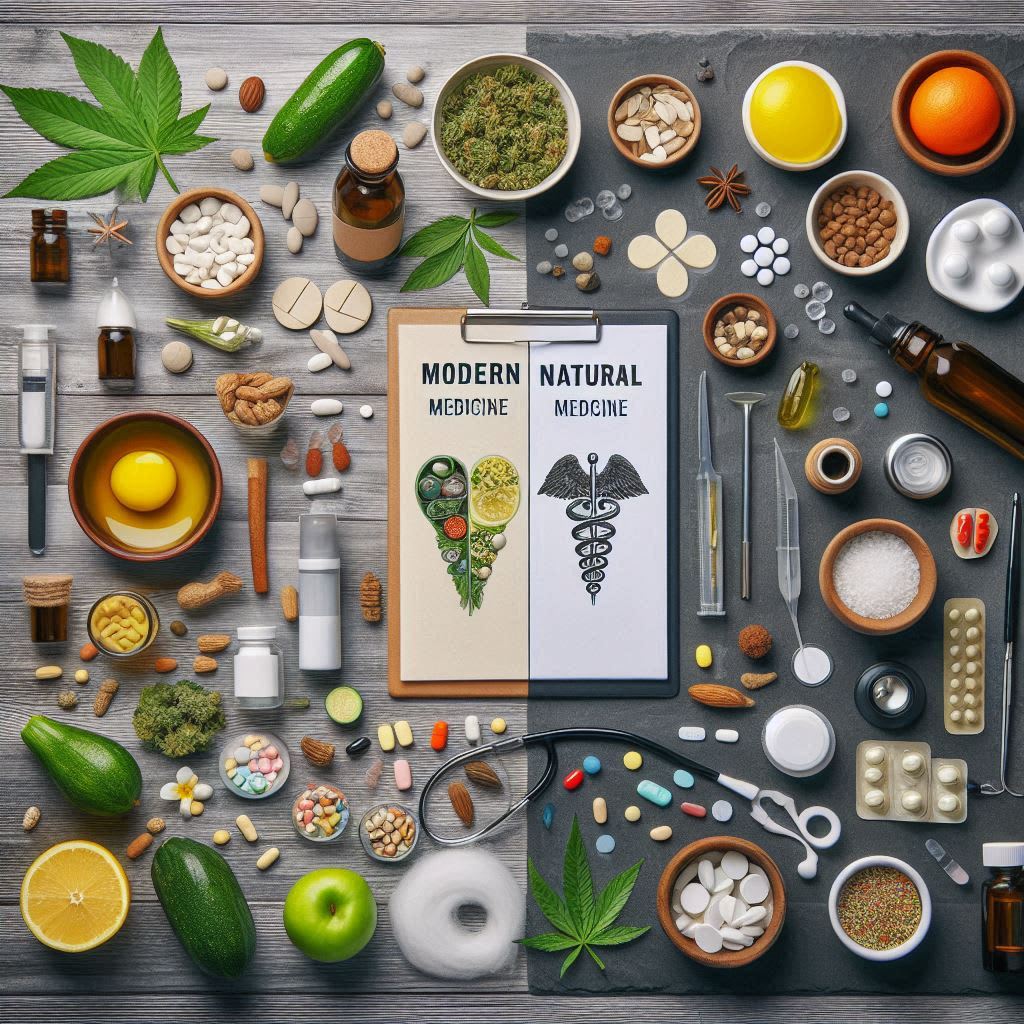
Modern Medicine
Scientifically Based: Modern medicine is based on thorough scientific research and clinical trials to ensure the effectiveness and safety of treatments.
Advanced Technology: We use cutting-edge technology for diagnosis and treatment, including MRI scans, robotic-assisted surgery, and personalized medicine.
Emergency Care: Highly effective in acute and emergencies.
Provides life-saving procedures such as surgery and critical care.
Standardization: Treatments are standardized, ensuring consistent care across different healthcare providers.
Pros:
Fast Relief: Often provides quick relief from symptoms and discomfort.
Regulation: Strict regulation ensures the safety and effectiveness of medicines and treatments.
Overall: Covers various diseases and conditions, from infectious to chronic diseases.
Cons:
Side Effects: Medications and treatments can cause side effects, sometimes serious.
Cost: This can be expensive, especially in countries without universal health care.
Over-reliance on medications: may focus on treating symptoms rather than the underlying cause.
Natural(Naturopathy) Advantages:
Holistic Approach: Focuses on the whole person, including physical, mental, and emotional health.
Fewer Side Effects: Generally uses natural substances, which tend to have fewer side effects than synthetic medicines.
Preventive Care: Emphasis on preventing and maintaining overall health through lifestyle changes and natural therapies.
Accessibility: Often more accessible and affordable, especially in areas with limited access to modern medical care.
Pros:
Natural Ingredients: Uses herbs, plants, and other natural substances that are less likely to cause side effects.
Individualized Care: Treatment is often tailored to an individual's needs and condition.
Complementary Use: Can be used in conjunction with modern medicine to improve overall treatment and health.
Cons:
Lack of Regulation: It is not as strictly regulated, which can lead to variation in quality and effectiveness.
Slow Results: It may take longer to see results compared to modern medicine.
Limited Evidence: Some treatments lack comprehensive scientific studies and clinical trials to support their effectiveness.
Finding a balance between modern and natural medicine can be a rewarding approach to achieving optimal health.
Here are some steps to help you integrate both:
Learn more
Research: Find out about the benefits and limitations of both modern and natural medicine. Reliable sources include medical journals, books by reputable authors, and trusted websites.
Consult an Expert:
Talk to a healthcare provider who is knowledgeable in both fields. Integrative medicine practitioners can offer valuable insight.
Talk to your doctor:
Full disclosure, Tell your doctor about any natural remedies or supplements you use. This will help avoid possible interactions with prescription medications. Collaborative approach: Look for a doctor who is open to combining both areas of treatment.
Individualized Care
Tailored Treatment: Work with your doctor to create a treatment plan that addresses your specific health needs.
This may include a combination of medications, lifestyle changes, and natural therapies.
Progress Monitoring: Your treatment plan will be reviewed regularly and adjusted as needed based on your progress or the development of new health conditions.
Focus on Prevention and Wellness
Healthy Lifestyle: Adopt healthy habits such as a balanced diet, regular exercise, adequate sleep, and stress management techniques.
Preventive Measures: Rely on modern medicine for acute and serious illnesses, while using natural therapies for prevention and maintaining overall health.
Stay informed and flexible
Stay Updated: Stay up to date on the latest research and developments in both modern and natural therapies.
Be Open to Change: Be willing to adjust your approach as new information and treatments become available.
Consider Integrative Medicine
Integrative Clinics: Look for a clinic or doctor that specializes in integrative medicine that combines the best of both worlds.
Holistic Approach: Take a holistic approach that takes into account your physical, mental, and emotional health.
Example Scenario If you suffer from a chronic condition such as arthritis, you could use modern medicine to manage pain and control inflammation, while incorporating natural therapies like turmeric supplements, acupuncture, and yoga to improve overall joint health and mobility.
A balanced combination of modern and natural medicine can provide you with a comprehensive approach to health that utilizes the best of both worlds to achieve the best results.
Do you have a specific health concern or symptom you’d like addressed with this balanced approach?
There are many natural remedies that people use to support their health and well-being.
Here are some of the most common and their benefits:
Turmeric Benefits: Turmeric is known for its anti-inflammatory and antioxidant properties and is often used to treat conditions such as arthritis and digestive disorders.
The active ingredient curcumin gives turmeric its powerful health benefits.
Ginger
- Benefits:
Ginger is often used to treat nausea, digestive problems, and inflammation. It also helps relieve muscle aches and pains. Garlic is known for its immune-boosting properties. It can help reduce the severity of colds and improve heart health by lowering blood pressure and cholesterol levels.
Echinacea
– Benefits:
Echinacea is often used to prevent and treat colds and is said to boost the immune system.
It may also help reduce the duration and severity of cold symptoms².
Chamomile
– Benefits:
Chamomile is usually used to promote relaxation and enhance sleep.
It also has anti-inflammatory properties, which can help with digestive issues and skin conditions¹.
Lavender
- Benefits:
Lavender is known for its calming effects and is often used in aromatherapy to reduce stress and anxiety.
It also helps improve sleep quality and relieve headaches.
Peppermint
- Benefits:
Peppermint is used to relieve digestive problems such as irritable bowel syndrome (IBS) and indigestion. It also has a cooling effect that helps relieve headaches and muscle pain.
Aloe Vera
- Benefits:
Aloe vera is known for its soothing properties, especially for burns, cuts, and skin conditions such as eczema.
It can also be taken internally to support digestive health.
Ginseng
- Benefits:
Ginseng is used to increase energy, reduce stress, and improve cognitive function.
It also has anti-inflammatory properties and helps regulate blood sugar levels².
Benefits of Tea Tree Oil:
Tea tree oil has antibacterial and anti-inflammatory properties, making it effective in treating acne, fungal infections, and minor cuts and scrapes.
These natural remedies can be a great addition to your health regimen, but they should be used with caution and in consultation with your doctor, especially if you are taking other medications or have underlying medical conditions.
Conclusion
Both modern and natural medicine have their pros and cons. While modern medicine is characterized by acute care and advanced diagnostics, naturopathic medicine offers a holistic, preventative approach. The best choice often depends on an individual's specific health needs, preferences, and type of condition. A combination of both approaches, called integrative medicine, may provide the most comprehensive care. Which approach do you prefer, or are you considering a combination of both?
About the Creator
THE SPHERICAL SPACETIME - ALEXIS KARPOUZOS
I. The Question of a Spacetime without Centre From Aristotle to Kant, Western philosophy approached space and time primarily as conditions of the possibility of experience or as properties of reality. In the Aristotelian tradition, space is defined topologically — as the place of bodies — and time arithmetically — as 'the number of motions with respect to before and after'. In Kantian critical philosophy, space and time become a priori forms of intuition, transcendental conditions of all phenomenal experience. Yet in both traditions a common assumption is preserved: space and time are structures that organise phenomena from a — however implicit — centre of reference. Alexis Karpouzos radically challenges this assumption. The Spherical Spacetime he introduces is neither place nor intuition; it is a dynamic ontological structure that refuses every privileged point of reference, every external centre, every principle that precedes the very movement of the world. The question posed from the outset is this: what does it mean to think a spacetime that does not 'contain' beings but is the very manner in which beings are? And what ontological consequences does this displacement carry for the understanding of existence, consciousness, and truth?
By alexis karpouzosa day ago in Education
Natural Ways to Clear Blackheads and Whiteheads
Blackheads and whiteheads are very common skin problems that affect people of all ages. They usually appear on the nose, chin, forehead, and sometimes on the cheeks. These small bumps form when the pores of the skin become clogged with oil, dead skin cells, and dirt. Blackheads appear dark because the clogged material inside the pore reacts with air and becomes oxidized, while whiteheads remain covered by skin, giving them a white or flesh-colored appearance.
By DigitalAddi7 days ago in Education
Why Didn't Anyone Tell Us
Men, move along. This is not for you. This is for the women. I was forty-five when I began menopause. It is pretty young for that to be going on in a woman’s life, but I had undiagnosed PCOS, my entire life. Thank you to all the gynecologists I had seen my entire life. That in itself should encourage women to keep seeking second opinions, especially when you are not getting correct answers or any at all.
By Alexandra Grant5 days ago in Humans



Comments
There are no comments for this story
Be the first to respond and start the conversation.