
Math with 2D Shapes
Mental Math Mastering Mental Math with 2D Shapes: A Quick Guide
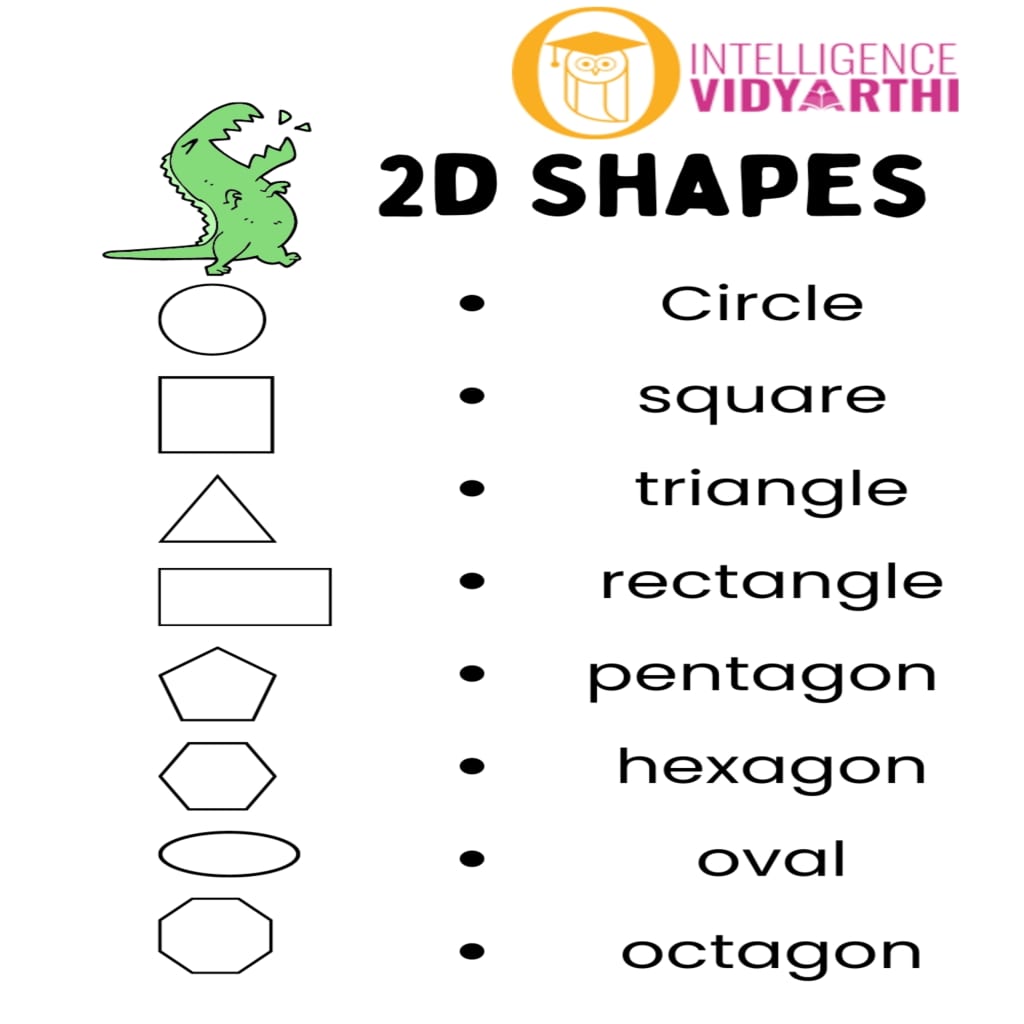
Mental math is a valuable skill that enhances our ability to solve problems quickly and efficiently. When it comes to 2D shapes, mastering mental math can simplify many everyday calculations and deepen your understanding of geometry. Let’s explore how you can sharpen your mental math skills with 2D shapes.
2D shapes, or two-dimensional shapes, are flat figures with only length and width. Common examples include squares, rectangles, triangles, and circles. Each shape has its own set of properties and formulas that are essential for calculating various attributes like area, perimeter, and angles.
Square: All four sides are equal. To find the perimeter, multiply the length of one side by 4. For example, if each side of the square is 5 units, the perimeter is 4×5=204 \times 5 = 204×5=20 units.
Rectangle: The perimeter is calculated by adding twice the length and twice the width. For instance, if the length is 8 units and the width is 3 units, the perimeter is 2×(8+3)=222 \times (8 + 3) = 222×(8+3)=22 units.
Triangle: Add the lengths of all three sides. For a triangle with sides 5, 6, and 7 units, the perimeter is 5+6+7=185 + 6 + 7 = 185+6+7=18 units.
Circle: The perimeter (or circumference) is found using the formula 2πr2 \pi r2πr, where rrr is the radius. For a circle with a radius of 4 units, the circumference is 2×π×4≈25.122 \times \pi \times 4 \approx 25.122×π×4≈25.12 units.
Square: Multiply the length of one side by itself. For a square with side length 5 units, the area is 52=255² = 2552=25 square units.
Rectangle: Multiply the length by the width. For a rectangle that is 8 units long and 3 units wide, the area is 8×3=248 \times 3 = 248×3=24 square units.
Triangle: Use the formula 12×base×height\frac{1}{2} \times \text{base} \times \text{height}21×base×height. For a triangle with a base of 6 units and a height of 4 units, the area is 12×6×4=12\frac{1}{2} \times 6 \times 4 = 1221×6×4=12 square units.
Circle: The area is calculated using πr2\pi r²πr2. For a circle with a radius of 4 units, the area is π×42≈50.27\pi \times 4² \approx 50.27π×42≈50.27 square units.
Practice Basic Arithmetic: Quick addition, subtraction, multiplication, and division are crucial for mental math. Regularly practicing these skills helps speed up calculations involving 2D shapes.
Visualize the Shape: Being able to visualize the shape in your mind makes it easier to apply the appropriate formulas and understand the problem better.
Break Down Complex Problems: For more complex shapes, break them down into simpler shapes whose properties you know well. For instance, if you need to find the area of an L-shaped figure, divide it into rectangles and calculate each area separately before summing them up.
Memorize Key Formulas: Having formulas at your fingertips speeds up your calculations. Regularly review and practice these formulas to keep them fresh in your memory.
Use Estimation: Sometimes, exact numbers aren’t necessary. Estimating can be a quick way to get a reasonable answer without precise calculations.
Mastering mental math with 2D shapes not only boosts your problem-solving skills but also enhances your spatial reasoning abilities. By understanding key formulas and practicing regularly, you can efficiently tackle various geometric problems and apply this knowledge in real-life scenarios. Whether you’re calculating the area of a garden or figuring out the perimeter of a picture frame, strong mental math skills with 2D shapes are an invaluable asset. Happy calculating!
About the Creator
SAKSHEE SHUKLA
https://intelligencevidyarthi.in/course_details?table_manners_&_etiquettes&cm=MTc=
Keep reading
More stories from SAKSHEE SHUKLA and writers in Education and other communities.
Understanding Conjunctions and Prepositions
In the world of grammar, conjunctions and prepositions play crucial roles in connecting words, phrases, and clauses, creating coherence and clarity in writing. Though often overlooked, understanding these parts of speech is fundamental for effective communication. Let’s delve into their definitions, functions, and examples to enhance your grasp of these essential elements.
By SAKSHEE SHUKLA2 years ago in Education
The Impact of Virtual Reality on Healthcare Innovation and Medical Practice
Virtual reality is steadily transforming the healthcare industry by offering immersive digital environments that support medical education, treatment planning, and patient care. Unlike traditional tools, VR allows healthcare professionals to interact with highly detailed simulations that replicate real medical situations. These interactive experiences provide opportunities for learning and preparation that were previously difficult to achieve through conventional training methods.
By Alex Kipman4 days ago in Education
Why the Sun Will Become a Red Giant: The Future of Our Solar System Explained
Every morning, the Sun rises as it has for billions of years, bathing Earth in light and warmth. To us, it feels permanent and unchanging. Yet in the vast timeline of the universe, the Sun is only halfway through its life.
By shahkar jalal2 days ago in Education




Comments (2)
Thanks for sharing
Well written