
"Mastering Active and Passive Voice"
"Learn to identify and use active and passive voice correctly."
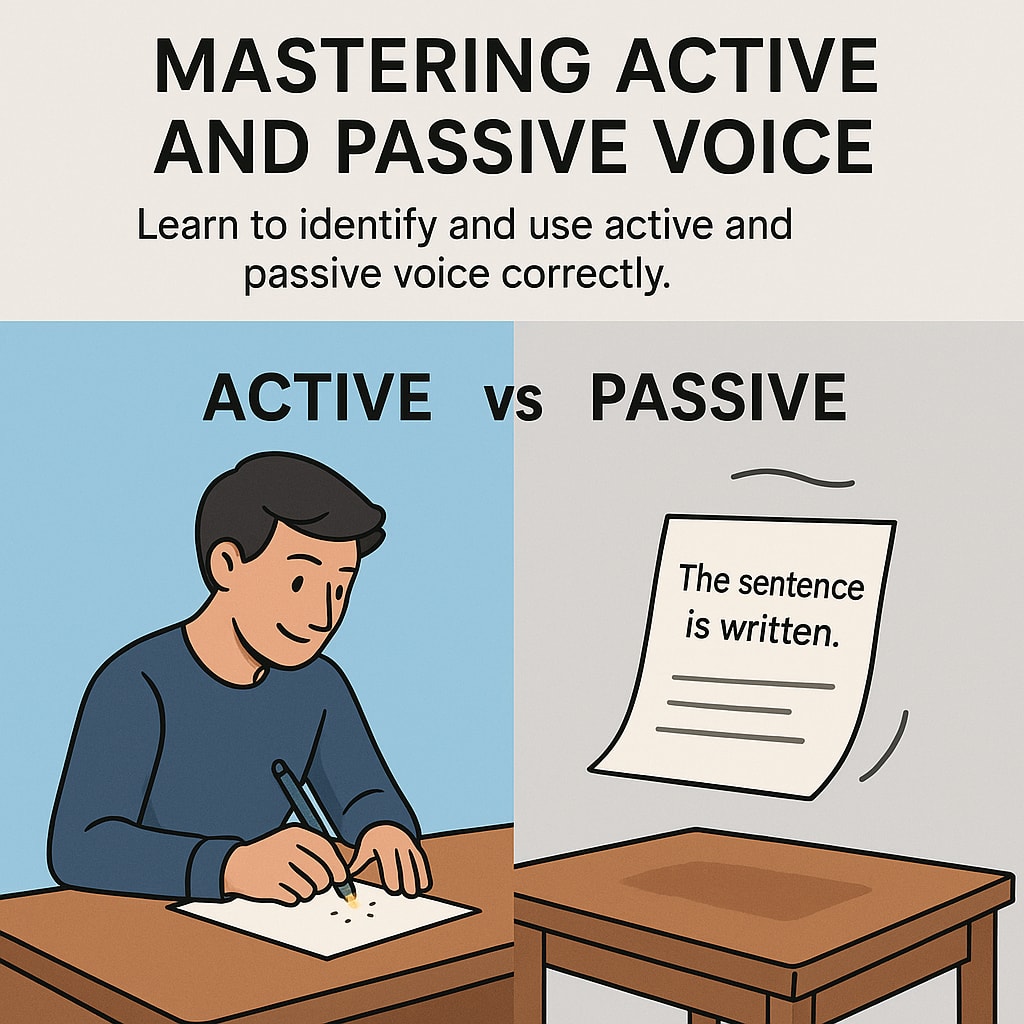
In English grammar, one of the most important distinctions in sentence structure is between active voice and passive voice. Understanding the difference not only enhances your writing style but also helps you express thoughts more clearly and effectively. Whether you’re writing an academic paper, business email, or creative story, knowing when and how to use each voice can make a big difference.
What is Active Voice?
In active voice, the subject of the sentence performs the action. This structure is straightforward and usually results in clearer, more direct sentences. It follows the basic formula:
Subject + Verb + Object
Examples:
The teacher explained the lesson.
The dog chased the cat.
She wrote a letter.
In each of these examples, the subject (teacher, dog, she) is doing the action (explained, chased, wrote) directly to the object (lesson, cat, letter). This clarity is why active voice is generally preferred in most types of writing.
What is Passive Voice?
In passive voice, the subject of the sentence receives the action rather than doing it. The formula is slightly different:
Object + Form of “to be” + Past Participle + (by Subject
Examples
The lesson was explained by the teacher
The cat was chased by the dog
A letter was written by her.
Notice how these sentences are less direct. The focus has shifted from who is doing the action to what is being acted upon. Passive voice is useful when the doer is unknown, unimportant, or you want to emphasize the action itself rather than the subject.
When to Use Active Voice
Active voice is ideal when:
1. Clarity is important – It makes your meaning clear and easy to follow.
2. You want to sound confident – Active voice gives your writing energy and strength.
3. You’re writing for general audiences – It keeps sentences concise and easy to understand.
Example:
Instead of writing:
“The report was completed by the team.”
Write:
“The team completed the report.”
When to Use Passive Voice
While active voice is usually preferred, passive voice has its place. Use passive voice when:
1. The actor is unknown or irrelevant – “The window was broken last night.”
2. You want to emphasize the object or action – “The law was passed unanimously.”
3. It’s more appropriate in formal or scientific writing – “The experiment was conducted in controlled conditions.”
In scientific writing, for instance, the focus is often on the process or result rather than the person who did it.
Example:
“The chemicals were mixed and heated to 80°C.”
How to Identify Passive Voice
To spot passive voice in your writing:
Look for a form of the verb “to be” (is, was, were, are, etc.) followed by a past participle (usually ending in -ed or -en).
Check if the subject is receiving the action instead of doing it.
Example:
“The cake was eaten.”
Ask yourself: Who ate the cake? If the sentence doesn’t clearly say, it’s passive.
How to Change Passive to Active Voice
1. Identify the actor (doer of the action).
2. Reorganize the sentence so the actor is the subject.
3. Remove unnecessary forms of “to be.”
Passive: The book was read by the student.
Active: The student read the book.
Benefits of Using Active Voice
Improves readability – Sentences are shorter and easier to digest.
Engages the reader – Creates a stronger connection with your message.
Enhances authority – Sounds more confident and purposeful.
Final Thoughts
Both active and passive voice are essential tools in writing. While active voice is often more powerful and clearer, passive voice can be useful when used thoughtfully. The key is knowing when each is appropriate.
Think of it like this:
Use active voice to highlight the doer.
Use passive voice to emphasize the action or outcome.
By mastering both, you can fine-tune your communication skills, making your writing not just grammatically correct but also impactful and engaging.
About the Creator
Keep reading
More stories from Mukhtiar Ahmad and writers in Education and other communities.
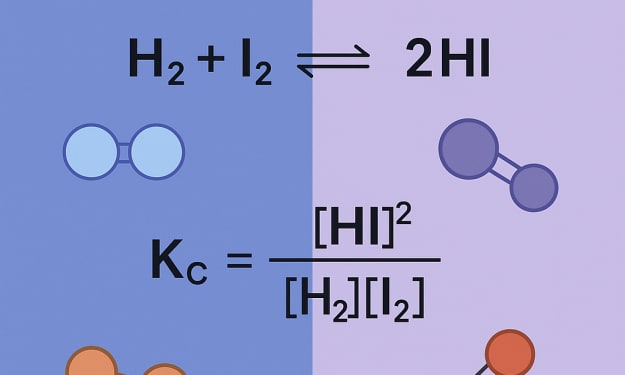
Understanding Chemical Equilibrium and Constants
In chemical reactions, especially reversible ones, a state of balance is often reached where the concentrations of reactants and products no longer change with time. This state is called chemical equilibrium. To describe this balance mathematically, scientists use a term called the equilibrium constant, denoted as K or more specifically as Kc when dealing with concentration.
By Mukhtiar Ahmad10 months ago in Education
Top Website Monetization Platforms to Maximize Your Revenue in 2026
Website monetization platforms are tools that help website owners generate revenue from their traffic. These platforms support different monetization models, including programmatic advertising, affiliate marketing, sponsored content, and performance-based ads.
By Iryna Podliesna3 days ago in Education



Comments
There are no comments for this story
Be the first to respond and start the conversation.