
Master The T-Chart Method: Proven Exam Help For Top Scores
What is the T Note-Taking Method?

A T-note method is a strategic note-taking method that is a simple and powerful tool for exam success. It is similar to the Cornell notes method but is used in a different context. Students should learn about different note-taking methods and implement them to excel in academics. However, if you have no time to study for exams and want help, you can download free exam help PDF by experts.
In this article, you will learn about the T-chart method of notes, which will help you build critical thinking skills and prepare for exams holistically, especially for subjects like science and mathematics. Also, you will get step-by-step instructions to use these methods for more efficiency.
What is the T Note-Taking Method?
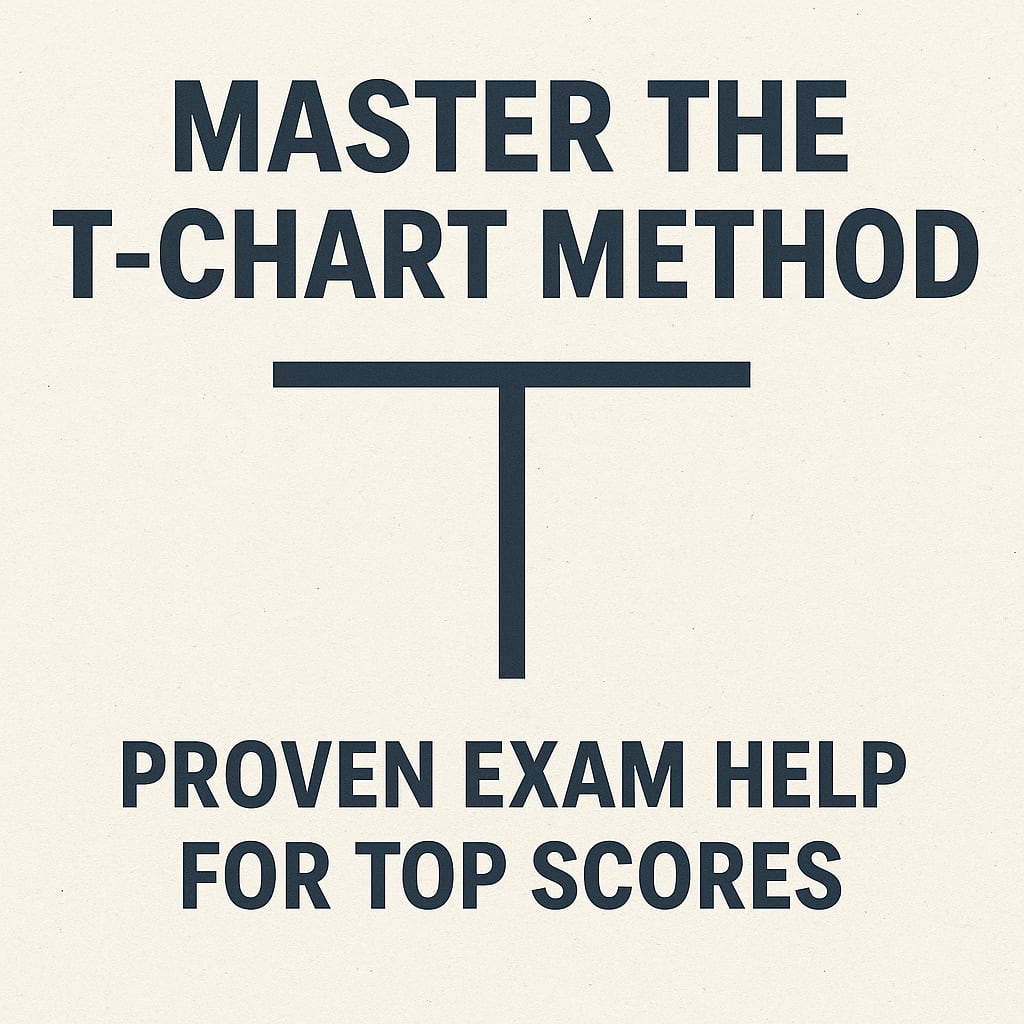
The note-taking method is an effective way to organise notes during lectures. In this approach, you divide your paper into two columns in a 'T' shape. Then, you use the left side for key ideas, questions or topics. The right side is for answers, detailed explanations or notes.
This structure is valuable as it helps you to review crucial points and understand how details relate to key concepts. The T note-taking method promotes active engagement and gives you a good knowledge of any topic.
Benefits of the T-Note-Taking Method for Exams?
The T-notes method is helpful for exams. Not only does it help with complex subjects and offer self-testing, but it also facilitates active engagement with the material. It makes the learning comprehensive and more enjoyable.
Moreover, this structured way of taking notes helps you revise the key concepts easily and boosts memory retention. Let's explore the benefits of this method in detail.
Promotes Self-Testing
The most valuable element in this method is that it allows self-testing through active recall. In this, you write key points or questions on one side and answers on the other. First, you see the questions and try to recall the answer. If you cannot, then you see the answer and explanation. This method reinforces learning and also improves memory, which is critical for exams.
Facilitates Active Recall
Active recall is a powerful study technique where you derive information from your memory without looking at your notes. The T chart method supports it by separating key ideas from details.
Also, it prompts you to remember facts or concepts. Also, you can practice recall with a chart. Overall, it helps you shift from passive review to an interactive process.
Helps Identify Gaps
This method gives you an idea of where you are weak. It is because when you are filling in the chart, you may struggle to complete one side or realise that you lack details to explain the key points. These gaps highlight topics that need extra work. Also, it helps you prioritise study time effectively, which improves your exam performance.
Breaks Down Information
It helps you break down topics into simple parts as it categorises information into two clear columns. You can arrange your ideas like pros and cons, cause and effect, etc. It helps you digest difficult material into manageable parts and also interlink concepts. Also, it reduces the overload of data and makes studying more enjoyable.
Suitable For Various Exam Types
The T chart provides versatility across various subjects. It works well for exams that require essay writing or analysis, as it provides a clear framework. Also, it allows you to customise it to fit your needs. All these elements make it a universal tool for better exam results.
But if you are struggling to keep up with complex subjects, then do not fret. The experts at the Assignment Desk can provide you with personalised assistance with academic papers.
Step-by-Step Guide to Using the T Method for Exams
Now that you know about the T-chart method in a detailed way and its benefits, let's look at how to use it for exam success. These steps do not require anything new, and this method can be adapted easily to your study routine. Moreover, using them efficiently will fetch you brilliant grades in your exams.
Step 1: Gather study materials
The first step is to gather your study materials such as textbooks, lecture notes or handouts. When you have everything in one place, you do miss critical information. Then, organise materials by topic or subject to streamline your study session. Also, it saves your time and helps create more effective and comprehensive content that boosts comprehension.
Step 2: Create your T-Chart on paper or digitally
Now, you need to draw a large T on a sheet to divide the left and right sides. Also, you can use digital tools to create your chart. However, you need to ensure that your columns are wide enough for detailed explanations.
Step 3: Key terms in the left column
In this T method, the left column of your chart is reserved for key terms, queries and concepts. These are short and concise prompts, such as vocabulary words and formulas, that are hard to remember. It creates a system that ensures better recall during revision. Also, when you see the left column, your brain tries to recall the answers.
Step 4: Detailed notes in the right column
The right side of your t-chart is where you write detailed notes. It is an addition of the left side questions and includes definitions, answers, etc. When you are unable to recall answers, you refer to this side. Also, it is vital to use bullet points and flowcharts to be concise.
Academic life can be hard if you cannot submit projects on time. So, you can seek nursing assignment help from seasoned experts and get excellently crafted documents on time.
Step 5: Review & revise notes regularly
It is the most vital part: only writing notes doesn't guarantee an A score in exams. You need to review and revise them at regular intervals. You may know that the human brain forgets half of the information after twenty minutes. So, keep revising your notes for longer retention. Frequent revisions also reduce the stress of last-minute cramming.
Step 6: Customise the T-chart to fit different exam formats
Every exam pattern is different, so your t-chart should reflect that. For essay-based subjects, you can include question prompts and thesis outlines.
For multiple choice, you can focus on dates, definitions, and key terms.
Moreover, you can adjust the format with colours and mind maps to suit your style. Customising your T chart also makes you well-prepared for any type of exam.
Common Mistakes to Avoid
- These are common mistakes that you must avoid in a T-chart.
- If you put too much content on either side of the chart, it can be hard for you to review it at the last minute. Also, it defeats the whole purpose of note-taking.
- You do not have to copy-paste the content from the textbook.
- The purpose of notes is to help you remember data for a more extended period of time.
- You should avoid vague terms and instead write clearly to prompt active recall.
- A one-size-fits-all chart may not work for every exam format. So, customise it for better results.
Conclusion
To sum up, the T-note method is a strategic yet simple method that divides a sheet of paper into two sides. The left side contains things like questions, key terms, and the right side includes definitions and answers. Note-taking is a good approach to scoring an A+ in exams. However, you may not find adequate time to make notes, so you can download free exam help PDF that is crafted by experts online.
This article aims to explore the T note-taking method, which is an efficient learning approach used by many students. You learnt about its benefits, steps to use it and mistakes that one must avoid.
About the Creator
Personal Statement Writer
Get the best personal statement writing service in UK from professional writer and express your skills and qualities. Order now and get on-time delivery & 24/7 support.
Keep reading
More stories from Personal Statement Writer and writers in Education and other communities.
Systematic Literature Review for Exams | Step-by-Step Guide
In academics, a systematic literature review is a postgraduate research method. However, it also becomes equally relevant for the students preparing for the exams for their higher education. When you conduct a systematic review, it not only helps you expand your knowledge but also helps you engage with the evidence-based arguments. Sometimes students ask Can I pay someone to take my online exam? But you do not have to practice for the exams like this. These are the practical skills that help you to write strong answers in exams. With the help of this guide, you can structure your review efficiently.
By Personal Statement Writer6 months ago in Education
The “Slave Bible”: The Controversial Holy Book Designed to Prevent Rebellion
In the early nineteenth century, a heavily edited version of the Bible was printed with a singular and deeply troubling purpose: to control enslaved Africans and discourage rebellion. Today, this rare publication—commonly known as the “Slave Bible”—is one of the most controversial religious texts in history. Only four copies are known to exist in the world.
By Irshad Abbasi 7 days ago in Education
Metaverse in Education Market Expected to Expand Significantly, Reaching USD 99.8 Billion by 2033
Metaverse in Education Market Overview The Metaverse in Education market refers to the use of immersive virtual environments, 3D digital campuses, and interactive simulations to deliver structured learning experiences. It combines virtual reality, augmented reality, digital avatars, blockchain-based credentials, and cloud platforms to create persistent and collaborative education spaces. The global market is expected to reach USD 99.8 billion by 2033, rising from USD 3.1 billion in 2023, reflecting a strong CAGR of 41.5% from 2024 to 2033.
By Roberto Crum7 days ago in Education



Comments
There are no comments for this story
Be the first to respond and start the conversation.