
MAN AND EMBRIOLOGY;A DEVINE INSIGHT VERIFIED BY MODERN SCIENCE
THE QURANIC VERSE ON HUMAN DEVLOPMENT ASTONISHED SCIENTEST AND MATCHED MODERN EMBRIOLOGICAL DISCOVERIES

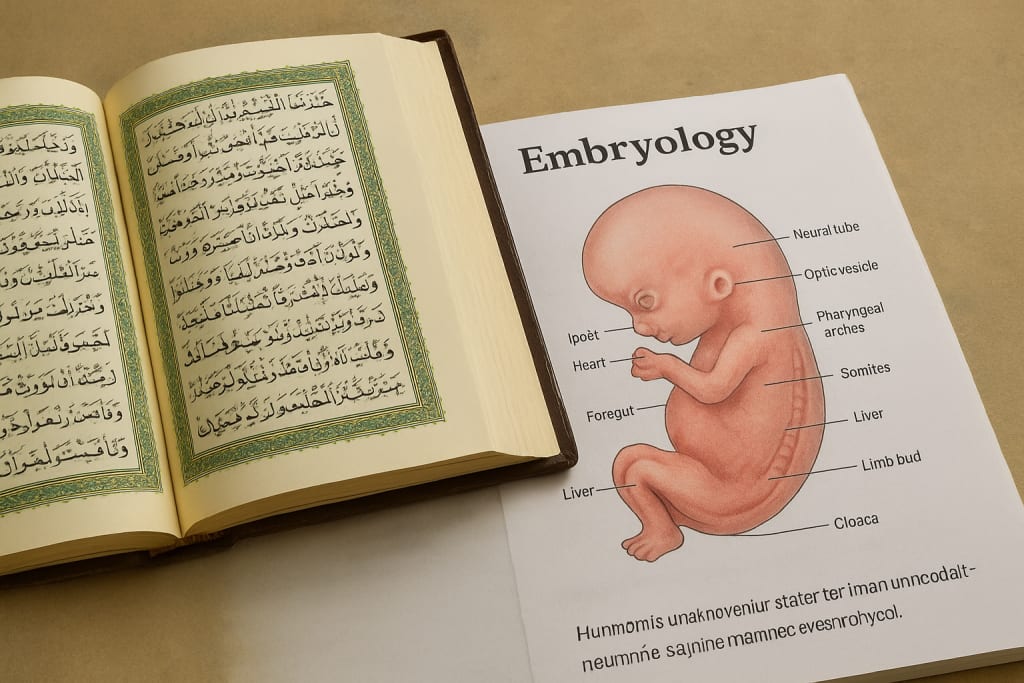
Introduction
The relationship between science and religion has often been one of debate and curiosity. One of the most fascinating intersections between the two lies in the field of embryology—the study of human development in the womb—and its correlation with verses found in the Holy Quran, revealed over 1,400 years ago. What makes this subject even more remarkable is that several renowned scientists, particularly in the field of embryology, have acknowledged the accuracy of these Quranic statements long before the invention of modern imaging tools.
This article explores the Quranic description of embryology, highlighting its alignment with contemporary scientific knowledge, along with scholarly opinions from world-renowned embryologists.
Quranic Verses on Embryology
Among the most quoted Quranic verses on human development are:
"We created man from an extract of clay. Then We placed him as a drop in a place of settlement, firmly fixed. Then We made the drop into an alaqah (leech-like substance), then We made the alaqah into a mudghah (chewed-like lump)..."
*Surah Al-Mu’minun (23:12–14)*
These verses outline several stages of human development:
*Nutfah (drop of fluid)** — sperm or zygote stage
* Alaqah (a clinging/leech-like thing)** — implantation phase, when the embryo clings to the uterine wall
*Mudghah (chewed-like substance)** — somite stage, where the embryo resembles something chewed with teeth marks
The terminology used in these verses closely mirrors the descriptions used in modern embryology, leading scientists to marvel at the knowledge conveyed in a 7th-century scripture.
Scientific Verification by Dith L. Moorer. Ke
One of the most prominent scientists to study the Quran’s statements on embryology was Dr. Keith L. Moore, a world-renowned embryologist and professor of anatomy. He authored the widely used textbook The Developing Human, considered a leading source in the field of human embryology.
After studying the Quranic verses, Dr. Moore stated:
"It is clear to me that these statements must have come to Muhammad from God, or Allah, because most of this knowledge was not discovered until many centuries later. This proves to me that Muhammad must have been a messenger of God."
Dr. Keith Moore, “The Developing Human” (3rd Edition), 1982
Dr. Moore was so impressed by the Quranic description that he included references to Islamic scripture in later editions of his textbook, aligning it with modern embryological knowledge.
Stages of Development According to Science and the Quran
| Quranic Term | Modern Scientific Term | Stage Description
| Nutfah | Zygote/Sperm + Egg Union | Fertilization stage
| Alaqah | Implanted Embryo | Clings to uterus wall, resembles a leech both physically and functionally
| Mudghah | Somite Stage | Appearance of segments like chewed flesh
These comparisons reveal an uncanny resemblance between the Quranic descriptions and current scientific understanding, surprising many researchers with their precision and accuracy.
Other Scientists' Views
Apart from Dr. Moore, other scientists have also acknowledged the accuracy of the Quran’s embryological references:
Dr. T.V.N. Persaud, Professor of Anatomy and Pediatrics at the University of Manitoba, stated:
"There is no such distinct and complete record of human development, such as the one in the Quran, anywhere in human history... it must be divinely reveled
Dr. Joe Leigh Simpson, Chairman of the Department of Obstetrics and Gynecology at Baylor College of Medicine, confirmed:
"These Quranic descriptions can not be based on the scientific knowledge of the 7th century."
These statements further solidify the idea that the knowledge in the Quran goes beyond human capability at the time of its revelation.
---
### Conclusion
The Quran’s verses on embryology stand as powerful signs of divine knowledge. Revealed at a time when scientific understanding of human development was virtually non-existent, the Quran presents a sequence of embryological stages that modern science has only recently confirmed.
With renowned scientists such as Dr. Keith Moore and others acknowledging the scientific accuracy of these verses, it becomes evident that the Quran contains knowledge far ahead of its time—pointing to its divine origin and offering a bridge between faith and reason.
References
1. The Holy Quran, Surah Al-Mu’minun (23:12–14)
2. Moore, K. L. (1982). The Developing Human: Clinically Oriented Embryology, 3rd Edition.
3. T.V.N. Persaud, statements in video interviews and academic conferences on Quran and science.
4. Joe Leigh Simpson, participation in the conference “Scientific Miracles in the Quran & Sunnah” (Saudi Arabia, 1980s).
5. Harun Yahya (2003).The Miracles of the Quran.
6. Bucaille, M. (1976). The Bible, The Quran and Science.
''moral '' quran is devine book
About the Creator
Keep reading
More stories from Muhammad Yaseen and writers in Education and other communities.
Greenland, the United States, and the New Arctic Power Game
For much of modern history, Greenland was viewed as a remote stretch of ice, distant from global decision-making and international power struggles. But that has changed. As the Arctic warms and world powers turn their attention northward, Greenland has become a central figure in a rapidly shifting geopolitical landscape.
By Muhammad Islam khan swati4 days ago in Education
How I Discovered Evan Roderick and Why His Work Stood Out
Sometimes, discovering a new actor feels like stumbling upon a hidden gem. That’s exactly how I felt when I first came across Evan Roderick. I wasn’t looking for anyone new to follow, and I had no idea who he was at the time. But as soon as I saw him perform, something clicked. His presence was different. His style was subtle but powerful. And as I explored more of his work, it became clear that Evan Roderick wasn’t just another rising actor—he was someone who brought something unique to the screen.
By Evan Roderick3 days ago in Education



Comments
There are no comments for this story
Be the first to respond and start the conversation.