

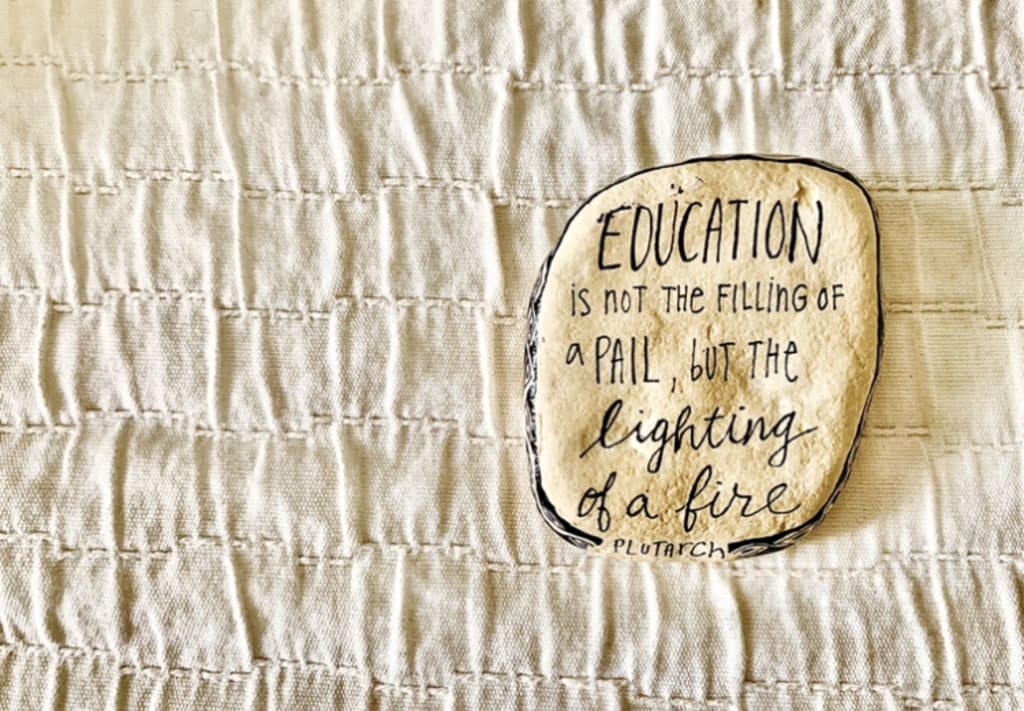
The writing on the stone is the powerful philosophy by which I find myself guided as a teacher. This stone was a gift to me from a student and it is something I keep close so that I don't ever lose my way in the plethora of pedagogical approaches that teachers have. You see, Plutarch's philosophical definition of education is something I am very passionate about because when it comes to teaching, I don't teach... I light fires.
In order to make sense of what I mean when I say that I light fires, I have to first explain pail filling. When you think of teaching in its first forms and even in some of its modern forms today, teaching is simply pail filling. Pail filling is where teachers 'teach' and students 'learn'. The classroom motto is 'I give and you take.' Pail filling is your standard university lecture. The professor speaks and shares their knowledge. Students take what is shared and put it into their pail and call it their own. They fill their pails through listening, note-taking, and voice-recording. What ends up happening though is that even though that knowledge is now in their pail, a lot of students don't really know how to make sense of it. Pail filling requires learners to be responsible for creating meaning and understanding without the guidance, support, and mentorship of their teachers. There is a disconnect and distance between students and their teacher. A lot of teachers are pail fillers because it is the easiest and most convenient form of education. Teachers can simply stand and deliver what students need to know, and then students have the obligation to somehow make sense of it on their own. Pail filling is most conventional form of teaching and it is the traditional road of learning. That said, it's definitely not what I do.
What do I do then?
Like I said, I light fires.
Lighting fires is rooted in constructivism. Pedagogical constructivism for teachers is, in short, the act of guiding students through learning experiences that allow them to drawn their own conclusions. So instead of telling students what they need to know, I guide them with questions through carefully crafted learning experiences until they can reach their own understanding. When I taught grade 2, part of the curriculum required us to teach about three different Canadian communities so that students could understand the culture, society, landscape, resources, languages, lifestyles, needs, weather, etc. Instead of telling my students the information, having them read from a book, or do research to find the answers... I transformed our space into that particular community of study and created carefully planned lessons to cultivate their understandings of that area. For example, when beginning to learn about Iqaluit, which is a northern Arctic community in the province of Nunavut, I wore a noteworthy family heirloom into class one day after lunch. You'll see in the picture below me donning a jacket and mittens handcrafted by the Indigenous of the region. It was hand sewn decades ago for my grandmother who lived up north. The jacket and mittens are mostly made of spotted seal skin fur and then lined with extra fluffy wolf fur.
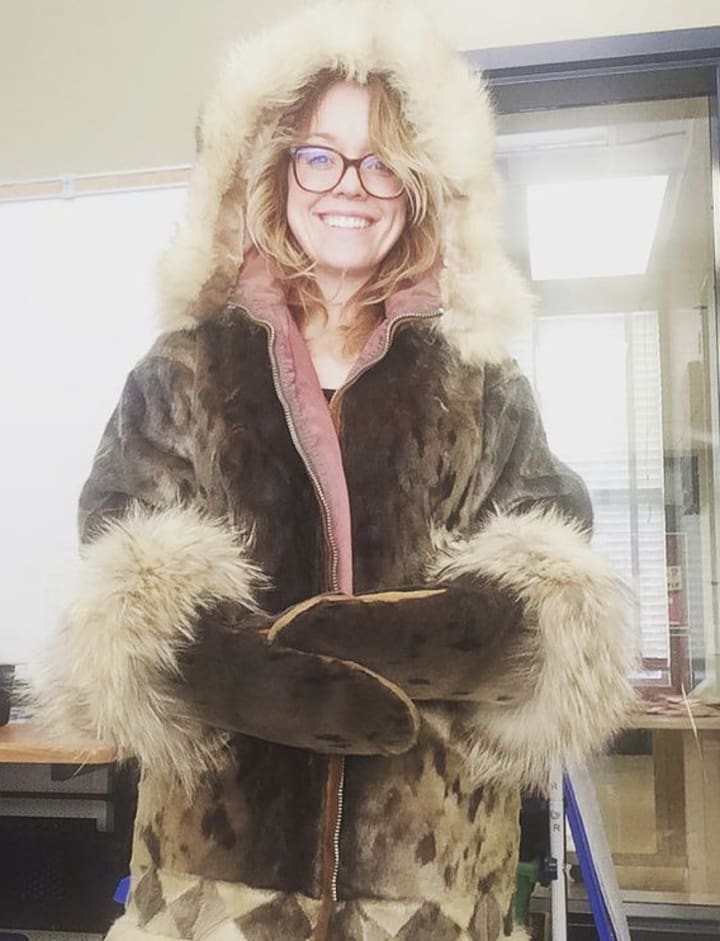
My students were used to this kind of teaching from me so upon witnessing me in this attire, they instantly they got excited about it.
"What are you wearing?"
"What are we learning about?"
"Is this for Iqaluit?"
With a rapt set of students, totally captivated by my coat, I took it off. I then asked my students to try it on one by one and make one statement about something they noticed or observed about it. They noted things like it's weight, the greasiness of the seal skin fur, the way they started to feel hot after wearing it only for a few moments, and how the fluffy fur was really soft. I then sat down with them and explained that I would probably wear something like this if I was living or travelling to a place like Iqaluit, the place we are studying. From there, we did a deep dive discussion...
"Why would I need to wear something like this if I lived in Iqaluit?"
"What do you think the weather might be like so far north?"
"How would someone have access to fur like this? Where does it come from? How do they get it?"
With every question comes an answer from a student. Another question would follow either from me or from another student and through this question and answer approach, you can believe by the end of our talk, students were able to draw their own conclusions about the weather and some of the natural resources, traditions and lifestyles in this Arctic community.
What makes lighting fires every day in the classroom worth it for me, is their excitement. Especially when they make connections on their own. My favourite example of this comes from the same Iqaluit lesson with the coat. My favourite question to ask is always:
"Why do you think they used seal skin for this coat?"
Students can sometimes take a while to get to the big answer on this one... they say things like:
Because it's warm. (True!)
Because they have seals there. (Also true!)
Because they like it. (Probably true!)
But the big answer is because it's waterproof! Hence the greasiness of the coat. For them to get to this answer though, I have to be mindful of their prior knowledge. So I always make sure to have completed an experiment for our science lessons well before I bring the coat in. Student have to have experimented with both water and oil and drawn the conclusion that they do not mix together. The experiment centers around how water will bead on an oily surface and run, rather than mix together or be absorbed. Of course all of this is also done constructivist style with questions and experiences. When students have grasped this concept fully, that is when the coat can finally make its appearance. So when this question about why the seal skin was the preferred fur comes along, the students can apply their knowledge and create cross-curricular connections. The key with constructivism (or lighting fires) is that I don't point it out or just tell them. I guide them to the answer and sometimes the guiding takes a really long time. Sometimes it requires waiting. Sometimes it requires intentional gravitation towards to the answer with... you guessed it! More questions!
I might ask,
"Why do you think the seal fur is greasy?" *but only if someone has pointed the greasiness out already. If not, I start there by asking someone to describe how the seal fur feels or looks.
Then I would probably jump to,
"How would the greasiness help a seal survive in its habitat?"
and if they dont get it there, I take a step back.
"Where does a seal live?"
"What do we know about grease (oil) and water?"
See how we got there? The arrival at the big answer is always met with exuberation and celebration. For me, there is nothing better than watching the gears of tiny minds turning and turning to finally click into place with ultimate knowing. The jumping up and down, wide eyes, big smiles and the wiggling hands in the air that scream 'I KNOW IT! I'VE GOT IT!" from my students makes it so rewarding for me to be in that classroom with them.
Lighting fires can be tedious and time consuming and is certainly not for the impatient. Coming up with questions and flying by the seat of your pants is exhausting at minimum but again, for me, the fanning their flames is so worth it! There is a perfect feedback loop between teacher and students where the teacher and students are responding authentically to each other and moving interconnectedly towards building understanding together. It is in this teaching fashion, that I find students are ablaze with curiousity and eagerness to learn. I find that students come to class anticipating something new and are excited to try it! I find that students naturally become questioners themselves. This approach fosters an appreciation for the learning process and a thirst for more. It leaves students with an unquenchable desire for knowledge and understanding, essentially a fire within them that forever burns.
Plutarch describes my job as an educator best. I do indeed light fires and I absolutely love it.
About the Creator
Ashley Hansen
Just a Jesus-loving former teacher turned homeschool mama of 2 precious girls who writes stuff sometimes.
My near-death experience story (A Moment with God) is pinned below.
My educational content and other stories follow thereafter.
Keep reading
More stories from Ashley Hansen and writers in Education and other communities.
Window Hearts
When COVID-19 took the world hostage at the start of 2020, it took me a long time to register that life was going to be very different for a long time. Everything felt heavy. Getting out of bed to go no where was heavy. Eating breakfast made from the groceries we had delivered was heavy. Walking my dog down the deserted pathways was heavy. None of it was normal and it all left me feeling exhausted. Not to mention I had just become a brand new mom weeks earlier and so my exhaustion was next level with a newborn.
By Ashley Hansen 5 years ago in Education
Physical Grit at Work: How Strength and Endurance Shape Lasting Career Success
Professional success often connects to skills, education, and experience. These qualities are important for career development and long-term achievement. However, another factor also supports strong professional growth over time. That factor is physical grit, which many successful professionals develop through discipline and consistent effort.
By Richard Ceffalio Jr.a day ago in Education
TUS NUA - ch 53
TUS NUA – ch 53 New Beginnings – Mia and Midnight (*)(*)(*) Finola knew Ali’s brother-in-law needed to put his mind at rest. She fed her arm through his and led him outside. “We’ll sit here. If you like, I can put a block around us so our conversation will be private.”
By Margaret Brennan3 days ago in Fiction


Comments
There are no comments for this story
Be the first to respond and start the conversation.