
Layer 2 projects on Ethereum
Why does it matter to Ethereum?
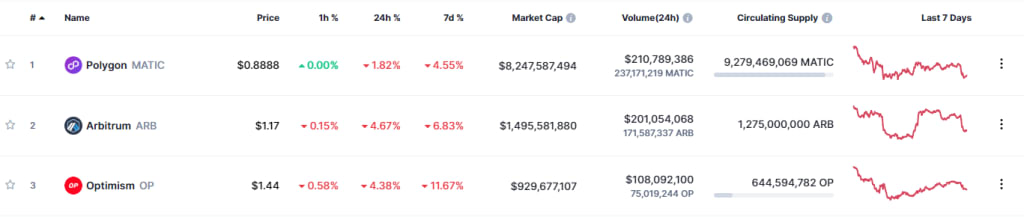
Layer 2 solutions have gained significant attention within the Ethereum community as a means to address the scalability limitations of the Ethereum network. These projects aim to improve transaction throughput, reduce fees, and enhance the overall efficiency of Ethereum, enabling it to handle a larger volume of transactions. By utilizing off-chain solutions, Layer 2 projects alleviate congestion on the main Ethereum network and provide faster and more cost-effective alternatives for users and developers. In this article, we will explore some examples of Layer 2 projects on Ethereum and discuss their impact on scalability and usability.
Optimistic Rollups: Optimistic Rollups are one of the most promising Layer 2 solutions for Ethereum. They work by processing transactions off-chain and submitting a summary of these transactions to the Ethereum mainnet. Optimistic Rollups leverage the Ethereum network's security guarantees and only resort to the mainnet if there is a dispute. This approach significantly reduces transaction fees and increases scalability by bundling multiple transactions into a single batch. Several projects, such as Optimism and Arbitrum, are building Optimistic Rollup solutions, which are already being adopted by decentralized exchanges (DEXs), gaming platforms, and other dApps.
ZK Rollups: Zero-Knowledge (ZK) Rollups are another popular Layer 2 solution for Ethereum. They utilize zero-knowledge proofs to bundle transactions and submit a succinct proof to the Ethereum mainnet, ensuring the validity of these transactions. ZK Rollups provide enhanced privacy and scalability by compressing multiple transactions into a single proof, reducing gas fees and improving transaction throughput. Projects like Loopring and StarkWare are actively developing ZK Rollup solutions that are being utilized by decentralized exchanges and other applications.
Plasma: Plasma is a Layer 2 framework that enables the creation of child chains, also known as Plasma chains, which operate alongside the Ethereum mainnet. These child chains can process a high volume of transactions and only periodically submit a summary of these transactions to the Ethereum mainnet. By reducing the burden on the mainnet, Plasma enhances scalability and enables faster and cheaper transactions. Projects like OMG Network have implemented Plasma solutions, offering scalable and secure payment processing for Ethereum-based applications.
State Channels: State channels are a Layer 2 solution that allows for off-chain interactions between two parties. They enable users to conduct multiple transactions off-chain and only settle the final outcome on the Ethereum mainnet. State channels are particularly useful for applications that involve frequent interactions, such as gaming or microtransactions, as they reduce the need for on-chain validations and significantly improve transaction speed. Projects like Connext and Raiden Network have implemented state channel solutions, providing efficient and scalable payment channels for Ethereum applications.
Sidechains: Sidechains are independent blockchains that run parallel to the Ethereum mainnet but remain interoperable with it. These sidechains can have their own consensus mechanisms, transaction rules, and economic models, enabling specific use cases and customized functionalities. Sidechains provide scalability by processing transactions off-chain and settling the final state on the Ethereum mainnet when necessary. Projects like Polygon (formerly Matic Network) have implemented sidechain solutions, offering high-speed and low-cost transactions for Ethereum-based applications.
These are just a few examples of Layer 2 projects on Ethereum, each utilizing different approaches to improve scalability and usability. These projects are actively being developed and adopted within the Ethereum ecosystem, with many dApps and platforms already integrating these Layer 2 solutions to provide better user experiences and reduce transaction costs.
The implementation of Layer 2 projects has the potential to unlock the full potential of Ethereum by enabling it to handle a significantly larger number of transactions and supporting more complex decentralized applications. With reduced fees, faster transaction confirmations, and improved scalability, Layer 2 solutions make Ethereum more practical for everyday use cases such as payments, gaming, decentralized finance (DeFi), and more.
As the Ethereum ecosystem continues to evolve, Layer 2 solutions will play a crucial role in ensuring the network's scalability and usability. Developers and users alike can look forward to a more efficient and accessible Ethereum network, thanks to the innovation happening within the Layer 2 space. With ongoing research and development, we can expect further advancements in Layer 2 projects, ultimately contributing to the mainstream adoption of Ethereum and blockchain technology as a whole.
About the Creator
Keep reading
More stories from Yixian Lim and writers in Education and other communities.
Layer 2 project & why does it matter?
Layer 2 projects have emerged as a crucial solution to address the scalability limitations of Layer 1 blockchain networks. These projects aim to improve transaction throughput, reduce fees, and enhance the overall performance of blockchain platforms, making them more scalable and efficient. By implementing off-chain solutions, Layer 2 projects can process a larger number of transactions without burdening the main blockchain network.
By Yixian Lim3 years ago in Education
Professors Are Being Watched: ‘We’ve Never Seen This Much Surveillance’
University professors across several countries are reporting an unprecedented rise in monitoring of their teaching, research, and public speech, raising concerns about academic freedom and the future of open inquiry. From recorded lectures and classroom informants to digital tracking and social media scrutiny, faculty members say the level of surveillance they now face is unlike anything seen in modern higher education. Civil liberties groups warn that the trend reflects a broader climate of political polarization, national security anxiety, and ideological conflict that is reshaping universities into contested spaces where professors are increasingly treated as potential risks rather than independent scholars. “We’ve never seen this much surveillance of faculty,” said a senior researcher at an academic freedom watchdog organization. “What used to be isolated incidents are now becoming systematic.” Monitoring Inside the Classroom In several recent cases, students have recorded lectures without professors’ knowledge and submitted clips to outside advocacy groups or government agencies, accusing instructors of political bias or inappropriate speech. Some professors say administrators have quietly installed additional classroom recording systems or requested access to lecture content in advance. At a large public university in the United States, a history professor described receiving an email from administrators informing him that his lectures would be reviewed after complaints from anonymous sources. “It felt like I was being interrogated rather than evaluated,” he said. “My course is about political movements. That alone seems to make it suspicious now.” Universities defend some monitoring as part of quality control or compliance with harassment and discrimination policies. But faculty unions argue that the line between oversight and surveillance is being crossed. Digital Surveillance and Social Media Scrutiny Beyond the classroom, professors say their online lives are increasingly under watch. Academic tweets, blog posts, and even private comments in virtual classrooms have been flagged and forwarded to employers or politicians. In one case, a professor specializing in Middle Eastern politics faced an internal investigation after screenshots of a social media post criticizing a foreign government were circulated by a political group. Although no formal wrongdoing was found, the professor said the experience was chilling. “You start thinking twice before speaking,” she said. “That’s the point of surveillance—it creates fear.” Cybersecurity experts note that universities now use software that can track email communications, monitor internal messaging platforms, and analyze lecture recordings for “compliance risks.” While such tools were initially designed for data protection and campus safety, they are increasingly applied to content and behavior. Political Pressure and National Security Concerns Governments in several countries have expanded scrutiny of academic institutions in the name of national security. Laws requiring disclosure of foreign research funding, collaborations, and travel have grown stricter, particularly for scientists and political scholars working on China, Russia, the Middle East, and emerging technologies. In some regions, faculty members must report contacts with overseas colleagues or face penalties. Critics argue these measures blur the line between legitimate security concerns and ideological policing. “Universities are becoming extensions of the security state,” said a legal scholar who studies higher education policy. “That fundamentally changes what universities are supposed to be.” The pressure is not limited to authoritarian countries. Democratic nations have also seen increased political involvement in curriculum decisions and research agendas, especially on topics such as race, gender, war, and foreign policy. Impact on Teaching and Research Many professors report self-censorship as a result of constant scrutiny. Sensitive topics are avoided, controversial authors removed from syllabi, and classroom debates tightly controlled to prevent misunderstandings. A sociology professor said she now records every lecture herself for legal protection. “I need proof of what I actually said,” she explained. “It’s defensive teaching.” Graduate students and junior faculty are especially vulnerable. Without tenure protections, they risk losing jobs or funding if accused of violating vague conduct rules. Some universities have also introduced anonymous reporting systems that allow students or staff to flag instructors for “concerning behavior.” While intended to promote inclusion, faculty groups warn these systems can be weaponized for political or personal grievances. Universities Defend Policies University administrators insist that surveillance measures are not meant to suppress ideas but to ensure safety and accountability. Many point to rising threats, online harassment, and campus tensions as reasons for stronger monitoring systems. “We are responsible for protecting students and staff,” said a university spokesperson. “That includes responding to complaints and maintaining respectful learning environments.” However, transparency remains a key concern. Faculty members often do not know when they are being monitored, how data is used, or who has access to recordings and reports. A Global Trend International academic organizations say the problem is growing worldwide. In Europe, new laws regulating “political neutrality” in classrooms have raised alarms. In parts of Asia and the Middle East, surveillance of professors has long been common, but digital tools have made it far more pervasive. “What’s new is the scale and technology,” said an official from a global education group. “Surveillance used to be physical. Now it’s constant and invisible.” The Future of Academic Freedom Legal challenges are beginning to emerge. Faculty unions and civil rights groups are pushing for clearer boundaries between legitimate oversight and intrusive monitoring. Some courts have ruled that academic speech deserves strong protection, but enforcement remains uneven. For many professors, the fear is not just disciplinary action but the erosion of trust between teachers and students. “The classroom should be a place of curiosity and disagreement,” one professor said. “If everyone is watching everyone else, that disappears.” As universities balance safety, politics, and technology, the question remains whether higher education can preserve its core mission: fostering independent thought in an age of constant observation. The answer may determine not only the future of academia, but the health of democratic debate itself.
By Fiaz Ahmed about 10 hours ago in Education
The Overlooked Intersections of Education, Cultural Heritage, and Public Service in Society
Education, cultural heritage, and public service often appear as separate fields. Schools focus on learning. Heritage focuses on history and tradition. Public service focuses on helping people. Yet these areas are deeply connected. They shape values, guide behavior, and support communities. When viewed together, their shared purpose becomes clear. At the center of this connection is education, cultural heritage, and public service, a relationship that quietly shapes how societies grow, remember, and care for people. These intersections are often overlooked because they work in subtle ways. They appear in classrooms, museums, libraries, and community programs. They influence how people learn about the past, understand the present, and act for the future. When combined, they create stronger and more informed communities.
By Carmen Reidabout 19 hours ago in Education
Not Just For Clean Up: A History Of The MCU's Department of Damage Control
Initially an organisation that seemed to exist to help the heroes of the Marvel Cinematic Universe, from Phase Four onwards, the Department of Damage Control has shifted into a more antagonistic role. Most recently seen in the Wonder Man series, the current incarnation of Damage Control seems to target superpowered individuals, regardless of whether that person poses an active or intentional threat.
By Kristy Anderson4 days ago in Geeks



Comments
There are no comments for this story
Be the first to respond and start the conversation.