
LAUSD Candidate John Brasfield on Student Safety
He responds to questions about the safety of students including one about the risk of having charter schools co-locate on District campuses.


“This perspective challenges the reliance on law enforcement and highlights the importance of holistic measures to address the well-being of students.”
– BD1 candidate John Brasfield
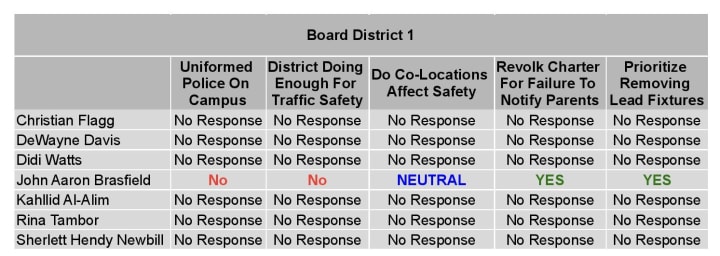
John Brasfield is one of seven candidates who is running to succeed the retiring George McKenna in the LAUSD’s Board District 1. So far he is the only one of them to answer all of the questions including those about PROP-39 co-locations, Special Education policies, and District Governance.
For the December edition of the series, the questions focus on student safety issues. For background information about the questions, please see the introductory article: LAUSD Candidate Forum: Student Safety.
The following are Brasfield’s responses, published as provided with only minor formatting changes:
- In non-emergency situations, should uniformed police officers be operating on LAUSD campuses? NO
The School police department is capable of handling all situations on campus. The presence of uniformed police officers on LAUSD campuses is a multifaceted issue.
On one hand, proponents argue that the school police department is well-equipped to handle various situations, providing a sense of security and order. They emphasize the department's capability and the accountability for safety, which may fluctuate based on the number of students in different areas.
On the other hand, critics of uniformed police on campuses advocate for alternative approaches. They contend that focusing on mental health support, counseling, and restorative justice might be more effective in creating a positive and supportive school environment. This perspective challenges the reliance on law enforcement and highlights the importance of holistic measures to address the well-being of students.
- The Superintendent has commented “that unacceptable and preventable frequency of vehicular incidents are impacting the health, well-being and safety of our children.” Is the District doing enough to prevent these incidents? NO
I think the school district has been focused on educating children and working to increase the quality and standards of education in the district. Some people within the district have been focused on safety but community safety encompasses knowledge of all aspects for the whole person's development.
The Superintendent's concern about the impact of vehicular incidents on the health, well-being, and safety of children is significant. Assessing whether the District is doing enough to prevent these incidents would require a closer look at current safety measures, policies, and ongoing efforts.
Factors such as traffic management around schools, safety education initiatives, and collaboration with local authorities could play a role. If there are specific details or areas of focus you're interested in, it would help provide a more tailored assessment.
Ultimately, finding a balance that ensures safety while fostering a positive educational environment may involve careful consideration of both perspectives in extreme cases, however, taking into account the specific needs and dynamics of the school community is vital. Educating youth in the severity of certain matters is the best approach.
- Last year an LAUSD student overdosed on fentanyl that was provided to her by a student at a co-located charter school. Do multiple schools that do not share a common leadership structure increase the possibility that hazards will not be fully mitigated? NEUTRAL
In situations like these, communication gaps may exist, potentially hindering the ability to share information about emerging risks or respond promptly to incidents. Collaborative efforts, clear protocols, and coordinated strategies between co-located schools can enhance the overall safety and well-being of students. A unified approach ensures that hazards are identified, communicated, and mitigated in a comprehensive manner across all educational institutions in the same location.
- While charter schools are required by policy to notify parents when the district issues a Notice of Violation, families at Granada Hills Charter High School were not specifically told that construction projects had endangered “the health and safety of students, staff, and other individuals.” Should the refusal of a charter school to keep parents informed of these types of hazards result in the revocation of the charter? YES
If students are endangered, and the community and parents are not aware of the construction projects. With the addition of virtual learning the district has an opportunity to revamp older buildings and improve the foundation of all facilities in a safe manner.
Every contractor has to get the approval of the city before building. It's no excuse not to have parents informed and create a contingency plan so students who miss out on education.
Absolutely, the safety and well-being of students should be a top priority. Communication with parents and the community about construction projects is crucial. Establishing transparency, sharing project details, and ensuring that safety measures are in place are essential aspects of responsible governance.
Additionally, leveraging the opportunity presented by virtual learning to revamp older buildings is a strategic approach. Implementing a contingency plan for students affected by construction disruptions ensures that their education remains a priority, even amidst renovations.
Coordination with contractors and city approvals should be part of a comprehensive strategy to enhance facilities while minimizing any potential risks to students and their learning experiences.
- After a 2008 NBC 4 report exposed the existence of lead In LAUSD Facilities, the District instituted a "stop-gap measure" requiring schools to run “every fountain ‘a minimum of 30 seconds’ before school each day.’” Fifteen years later, the district still warns users of these fixtures to "flush cold water for 30 Seconds prior to use.” As a Board Member would you prioritize removing old fixtures containing lead from all school facilities? YES
As a Board Member, my priority would be the health and safety of students and staff. Given the prolonged existence of lead-related concerns, I would advocate for a comprehensive plan to address the issue.
This may include prioritizing the removal of old fixtures containing lead from all school facilities, along with implementing regular testing and preventive measures to ensure the water quality meets safety standards. It's essential to create a long-term strategy that not only addresses the immediate concerns but also establishes sustainable practices for ongoing safety and well-being within the district.
___________________________
Carl Petersen is a parent advocate for public education, particularly for students with special education needs, who serves as the Education Chair for the Northridge East Neighborhood Council. As a Green Party candidate in LAUSD’s District 2 School Board race, he was endorsed by Network for Public Education (NPE) Action. Dr. Diane Ravitch has called him “a valiant fighter for public schools in Los Angeles.” For links to his blogs, please visit www.ChangeTheLAUSD.com. Opinions are his own.
About the Creator
Carl J. Petersen
Carl Petersen is a parent advocate for students with SpEd needs and public education. As a Green Party candidate in LAUSD’s District 2 School Board race, he was endorsed by Network for Public Education (NPE) Action. Opinions are his own.
Keep reading
More stories from Carl J. Petersen and writers in Education and other communities.
LAUSD Candidate Andreas Farmakalidis on Student Safety
Granada “clearly withheld information about the violations from parents until notified by LAUSD. This lack of transparency, especially regarding potential safety hazards, is a major breach of trust and undermines parental right to informed decision-making.” – BD3 candidate Andreas Farmakalidis
By Carl J. Petersen2 years ago in Education
The Energy Pivot The State of Russia’s Oil and Gas in 2026
For decades, this was the "world's gas station": Russia's pipeline network to Europe was the veins of the world economy. By 2026, that aura is dull and those veins are rerouted out of Europe. Since the collapse of the Soviet Union, the Russian oil and gas sector is facing the largest structural change.
By Neeraj kumarabout 2 hours ago in Education
How a Bowl of Noodles Became a Global Phenomenon That Crossed Borders
A bowl of noodles is one of the most familiar meals in the world. It appears in many cultures, served in different ways, yet always recognizable. The path of how a bowl of noodles became a global phenomenon is tied to human movement, simple cooking methods, and the need for comfort food. This story explains how a basic dish grew into a worldwide favorite.
By Table to Stix Ramen2 days ago in Education
📢 Raise Your Voice Thread: 01/08/2026
Our “Raise Your Voice Threads” are hosted most alternating Thursdays at 12PM ET to offer creators more avenues to uncover exceptional stories on Vocal. As we are continuously searching for fresh creators and inspiring stories, this thread provides an opportunity to exchange and discuss the stories that have moved and motivated us on Vocal.
By Raise Your Voice by Vocal6 days ago in Resources



Comments
There are no comments for this story
Be the first to respond and start the conversation.