Latest Stories
Most recently published stories in Education.
What is MVP Programming in Software Development
Consider the following scenario. You have an idea for an app. You get the funds to put it into action. You put all your money into developing the app and release it to the public. Only to discover that users don't really need your product.
By Deepesh kushwaha4 years ago in Education
No, Social Emotional Learning isn’t a “Trojan Horse” for CRT.
May 2021. My boss answered a Zoom call with his familiar “Eureka!” smile. His face lit up with the glow of a fresh idea bouncing about behind his eyes. Today, he’d discovered the perfect new project to occupy my newly-acquired full-time hours.
By Olivia L. Dobbs4 years ago in Education
Violence and Humanity
Characters within Invisible Man by Ellison and Beloved by Toni Morrison, the amount of violence and challenges the characters face force them to reevaluate their humanity in the face of the White majority that constantly dehumanizes and compares the Black characters to animals. They defend their humanity by experiencing the cruelest and most horrifying bits of life offered to them and still coming out and reflecting upon it.
By Miss Ghoul4 years ago in Education
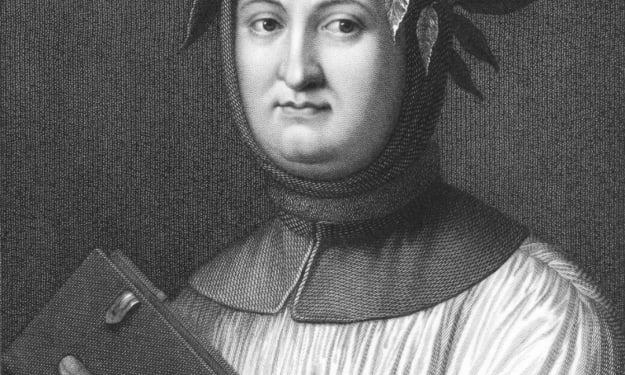
Petrarch was Humanist before it was Mainstream
Franceso Petrarca's favorite sonnet topics maybe are himself or his love for Laura, which translates into bringing the topic back to himself. His letters, however, mimic Cicero's humanism and rival Erasmus's humanism. Despite the narrative set out by his poems, he inspired humanist works by other authors, including Laura Cereta (King, 2). Petrarch's seemingly self-centered love fits the definition of Renaissance Humanism as "focusing on being human" (Cartwright) instead of focusing on religion.
By Miss Ghoul4 years ago in Education
The Importance of Math Games for Children
Why Is It So Important for Kids to Play Math Games? puzzles for 4 year olds online can help youngsters acquire the muscle memory necessary for the development of more complicated skills later on, in addition to supporting them in learning those fundamental concepts from the start. The practice of counting and the learning of numbers are the initial steps in a child's educational path. Mathematical talents in children begin to develop at a young age, and natural practice introduces them to the ideas of addition and subtraction early on.
By skidos20214 years ago in Education
Children's Math Games: How Important is education for them?
Educational Games: math learning game can aid in the development of muscle memory, which is required for the development of more complex abilities later on, as well as assisting children in learning the essential principles right away. Counting practice and number recognition are the first steps in a child's educational journey. Children's mathematical abilities emerge early in life, and natural practice introduces them to the concepts of addition and subtraction.
By skidos20214 years ago in Education
The Pampered Opposite: How to Raise Thoughtful, Generous, and Smart Children When It Comes to Money by Ron Lieber - book review
Because it was June 1, International Children's Day, I'm giving you a summary of Ron Lieber's book "The Pampered Opposite: How to Raise Thoughtful, Generous, and Smart Children When It Comes to Money."
By Sebastian Voice4 years ago in Education
Understanding Infinity
One of the more prominent themes behind Jorge Luis Borges’ anthological series Labyrinths is the idea of infinity. In “The Circular Ruins” infinity is a dreamscape thought into existence by men who dream of other men’s reality, endlessly creating worlds and universes for each other, and idea also discussed in “The Garden of Forking Paths” also shows the existence of infinite number of realities. The short story “The Library of Babel” also flirts with the theme of endless possibilities in an infinite world, as does the protagonist state, but shows that “The Library of Babel” gives the reader an exact record of all things it calls infinite in its hollows, therein indicating a finite integer in the process quantifiable by its inhabitants, indicating in an end to the architectural design of the Library itself, but what does the structure itself look like? Many scholars, architects, artists, and mathematicians of “The Library of Babel” have produced many blueprints of the design of the hexagonal space filling the short tale’s universe but cannot seem to agree on a specific shape to this marvel of architecture. But what if one could infer, from the reading of the story, that the Library may be conceptualized as a tower that spirals upwards and downwards for an exceptionally long time, too long, in fact, for one person to traverse the entirety of the structure? Does such a design hold up with the language Borges uses in his own conceptualizing of the Library, also?
By Omar Al-Mahmeed4 years ago in Education