
Kotlin in the Age of Cloud-Native Development: What You Need to Know
The Role of Kotlin in Microservices, CI/CD, and Container-Based Architecture


The evolution of modern software architecture has reached a point where cloud-native development is no longer just a buzzword—it’s the standard. To meet the growing demand for scalable, resilient, and modular applications, development teams need tools that are concise, reliable, and capable of handling distributed environments. Kotlin, originally recognized for its role in Android app development, is now gaining traction in cloud-native development.
As we explore what makes Kotlin fit for this paradigm, we’ll uncover its alignment with microservices, containerization, asynchronous programming, and server-side performance.
Kotlin’s Expanding Role in Cloud-Native Environments
Kotlin is a statically typed, JVM-based language that offers modern syntax and safety features, including null safety and smart type inference. These features streamline development without compromising on performance or reliability—two essential pillars in cloud-native architectures.
Its growing popularity in server-side development is backed by tooling, native support for modern build systems, and seamless integration with cloud environments. With Kotlin, teams can write cleaner code, reduce technical debt, and improve maintainability across services.
Core Pillars of Cloud-Native Development and Kotlin’s Fit
Cloud-native development revolves around specific design principles. Let’s examine how Kotlin addresses these core areas:
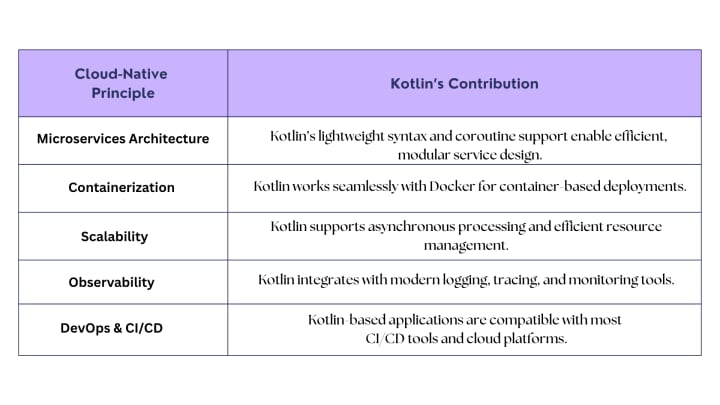
By aligning with these principles, Kotlin cloud-native development becomes a powerful strategy for building scalable systems.
Kotlin Microservices: Lightweight and Modular by Design
Microservices require speed, independence, and separation of concerns. Kotlin offers all three through its expressive syntax, minimal boilerplate, and coroutine-based concurrency.
Rather than relying on heavy frameworks, developers can use Ktor, a lightweight framework developed specifically for Kotlin. Ktor enables you to create RESTful APIs and services with modular plugins and native coroutine support, making it ideal for Kotlin microservices.
In environments where responsiveness and efficiency matter, Kotlin’s asynchronous capabilities outperform traditional thread-based models. Developers can handle multiple concurrent requests without spawning heavyweight threads, reducing memory usage and increasing performance.
Developing Cloud-Ready Services Using Kotlin and Ktor
At the heart of Kotlin’s backend capabilities lies the Ktor framework. Built from scratch using Kotlin and designed for extensibility, Ktor is optimized for asynchronous cloud applications. Its flexibility allows developers to construct APIs, backend services, and even full-stack applications with clean separation of concerns.
Ktor offers features such as:
- Asynchronous I/O with coroutines
- Built-in support for HTTP/2 and WebSockets
- Structured request handling via pipelines
- Integration with serialization libraries like kotlinx.serialization
When combined with other Kotlin tools, Ktor forms a cohesive backend stack that’s highly suited to cloud-native deployment models.
Containerizing Kotlin Applications with Docker
To enable Kotlin cloud deployment, containerization is key. Docker provides a consistent environment for packaging Kotlin applications and deploying them across environments.
By writing a simple Dockerfile, Kotlin apps can be containerized with the JVM and required dependencies. By doing so, it standardizes the application environment across all stages. Combined with orchestration tools, Kotlin applications become portable, scalable, and resilient to failure.
Containerized Kotlin apps also integrate smoothly into CI/CD pipelines, enabling continuous testing, delivery, and monitoring—fundamental components of cloud-native success.
Orchestrating Kotlin Services with Kubernetes
While Docker handles container packaging, Kubernetes orchestrates those containers in the cloud. Kotlin-based microservices, especially those built using Ktor or Spring Boot, are well-suited for Kubernetes deployments.
Kubernetes allows you to:
- Scale Kotlin microservices horizontally
- Handle failover and service discovery
- Manage updates with zero downtime
- Define declarative configurations using YAML or Helm
With infrastructure defined as code, Kotlin services gain predictability, reproducibility, and automation—all of which are critical in distributed cloud-native systems.
Building Scalable APIs with Kotlin
Kotlin’s simplicity and precision make it ideal for building APIs that need to scale across environments. It naturally promotes clean code practices and supports serialization libraries for structured data communication.
Developers can expose endpoints using Ktor, validate data using extension functions, and structure applications into maintainable modules. In high-traffic environments, Kotlin for scalable APIs ensures consistency without sacrificing speed or flexibility.
Moreover, the use of coroutines in these APIs helps avoid callback hell and simplifies asynchronous workflows—improving both developer experience and runtime performance.
Kotlin in DevOps and CI/CD Workflows
Modern DevOps pipelines rely on repeatability and automation. Kotlin applications integrate seamlessly with popular CI/CD tools such as GitHub Actions, GitLab CI, and Jenkins. Kotlin’s use of DSL in Gradle enables developers to write build scripts that are both type-safe and more readable, simplifying the setup of CI/CD pipelines.
Testing is also well-supported in Kotlin through libraries like:
- Kotest for unit and property-based testing
- MockK for mocking dependencies
- TestContainers for integration testing with databases or message brokers
All of this fits into a mature and testable DevOps cycle that ensures stability, confidence, and rapid delivery.
For organizations aiming to shorten time-to-market and improve code reliability, the decision to hire Kotlin developers with experience in CI/CD pipelines and DevOps becomes a strategic advantage.
Kotlin vs. Java for Backend Cloud Services
While Java remains a strong choice in enterprise environments, Kotlin brings modernization without sacrificing compatibility. Thanks to its compatibility with Java, Kotlin can be safely integrated into legacy systems without major changes.
Key Kotlin advantages include:
- Reduced verbosity for faster development
- Native support for coroutines (vs. using reactive libraries in Java)
- Improved readability and maintainability
Enhanced DSL support makes Kotlin ideal for writing clear and flexible configuration and scripting logic.
In performance terms, Kotlin matches Java but improves developer productivity and reduces bugs—a significant consideration when building or scaling cloud-native systems.
This is why many forward-thinking tech leads and architects choose to hire Kotlin developers who understand both modern language paradigms and enterprise backend challenges.
Conclusion
Developing cloud-native applications requires tools that offer scalability, flexibility, reliability, and long-term viability. Kotlin, with its expressive syntax, coroutine-based concurrency model, and robust tooling, is a perfect fit for the cloud-native world.
Whether you're building microservices, deploying containerized APIs, or integrating services into a DevOps pipeline, Kotlin offers the right blend of flexibility, performance, and developer ergonomics. Supported by frameworks like Ktor and ecosystems designed for modern deployment models, Kotlin is no longer just an alternative—it’s becoming the standard for scalable, cloud-ready development.
About the Creator
Lucas Wade
I’m Lucas Wade, a software developer with 10 years of experience in full-stack development, cloud solutions, and building scalable, high-performance applications.
Keep reading
More stories from Lucas Wade and writers in Education and other communities.
Integrating Shopify with Next.js: A Modern Approach to Storefronts
In the fast-moving world of e-commerce, building fast, scalable, and user-friendly storefronts is no longer optional—it’s a necessity. Shopify has long been a favorite for businesses looking to launch online stores quickly, while Next.js has become one of the most powerful React frameworks for building performant web applications. When you combine Shopify’s robust commerce capabilities with Next.js’s modern frontend architecture, you get a flexible and future-proof solution for headless commerce.
By Lucas Wade4 months ago in Education
The Role of Families and Parents Towards Children in the Era of Digital Education
Given the shift in educational models, the responsibility of families and parents has become just as important—if not more so—than that of teachers and educational institutions. In today’s information age, technology has become an integral part of our daily lives, with education being one of the most significantly affected sectors. Digital education, or remote learning, has witnessed a substantial rise in recent years due to its proven effectiveness and necessity—especially in light of global circumstances that have brought about fundamental changes in learning methods.
By Vertex University P R E S S7 days ago in Education
Hosting a Book Fair
How many of you remember the “best week ever!” from when you were a child? Book fairs were the staple of many of our childhoods with Scholastic leading the way. While there are many choices for book fairs today and I absolutely want to talk about them, that’s going to be a later article.
By Reb Kreyling4 days ago in Education




Comments
There are no comments for this story
Be the first to respond and start the conversation.