
Klaus: An Amazing Holiday Movie Except… the Teacher
Exemplifying teachers as exploited nurturers of American society.

While in the throes of the holidays, many of us sit down with family and friends and watch movies. Tradition, right? Though most movies or TV specials are campy, sometimes you get that perfect balance of holiday cheer, fresh perspective, and that good old emotional tug-of-the-heart. A notable addition to the vast archive of festive films is Netflix’s 2019 Klaus. The film is rife with dark humor, beautiful art, memorable characters, and a unique spin on the origin story of Santa Claus. Klaus has made it to the top of my holiday movies. It sits next to some classics such as Elf, Home Alone, Die Hard (fight me on this one), and a lesser known one We’re No Angels. Despite all the positives and academy accolades, however, one issue stands out with the movie. One particular character brings to light a major flaw in modern society and merits discussion. The Teacher, Alva. She's the love interest of the film and plays a large role in Jesper's selfish-to-selfless arc. Her story is simple. She came to the fictional Norwegian town, Smeerensburg, to teach, but as the years passed her bright optimism disappeared due to the town’s impossible feud. We watch as she overcomes her misery, sacrifices much, and works to establish an education for children regardless of the town's political divisions. She becomes a model teacher many hope to have in an American classroom. At the same time, however, Alva's story demonstrates the cause of America’s failing education system through teacher treatment and safety, learning prioritization, and inadequate funding. This article examines the portrayal of Alva as a teacher and how she represents America’s–and many other countries–exploited, underpaid nurturers of society.
To give some context, I’m a teacher. I’ve been teaching science in Utah for six years in middle school and high school. I’ve always lived on the raggedy edge between middle class comfort and poverty. Recently, due to staggering inflation, and a labyrinth of broken healthcare coverage, I’m facing the most financially trying moments of my life. So much so that despite having a natural aptitude for teaching, I’ve considered updating my resume and searching for a job that will pay me wages to support my family with less emotional draining stress teachers endure. Yes, America is faced with a problem where many teachers are quitting. I may be among the many teachers fleeing the profession. The reason why I’ve been coming to grips with this recent conundrum reflects in the portrayal of Alva’s character.
Alva first debuts after Jesper, cast out from the comforts of his posh life to prove his worth or get cut off, rings the town “battle bell” and sets Smeerensburg into a flurry of cartoonish violence. Clan feuds divide the town, historically dated back to the cavemen–the Ellingboes versus the Krums. He scrambles through the village until he enters the school seeking sanctuary. Yet he meets Alva, educator turned fishmonger. She slices up fish to accrue enough coin to escape town. Their first back-and-forth establishes Alva as a person who had bright hopes dashed by the grim reality of Smeerensburg (shown by a faded photograph on a blood stained chalkboard turned ledger). Jesper asks Alva why she doesn’t have students and she exclaims that no one wants to bother sending children to school where they will be exposed to the other family. Comical, but perhaps fortelling.
One of the many obstacles teachers are facing in this modern age is political oversight. Whether it’s teaching controversial subject matter, reading books or leading seminars containing triggering content, evolution, critical race theory, or simply the required curriculum, laws and cultural shifts limit teacher autonomy. Divisions in America’s political climate have trickled down into the classroom. Laws and overbearing parents cause districts to pass regulations limiting what teachers can say in the classroom. At the university level, professors, especially in the language arts, walk on eggshells in fear their topics offend or touch on past traumas. Public school teachers can come down with reprimands if one of their lessons betrays their political views, even unintentionally. These issues became all the more inflamed during the COVID pandemic when schools were mandated to enforce mask-wearing, and the Trump-Biden 2020 election bred new levels of right-wing and left-wing extremism. Teachers have become the rope in a tug-of-war. It’s messy. Could our school systems eventually lead to the dystopia represented by Alva in the first act? Will teachers eventually abandon classrooms because the pressures of appeasing parents, administration, superintendents and state education boards become too much? It’s happening.
States across America are seeing teachers resign in such great numbers that some social media platforms refer to it as The Teacher Exodus. Multiple news outlets have done pieces on teacher and staff shortages. Alva, in order to escape Smeerensburg, resorts to selling fish and hoarding the loose change on top of her meager wages. Teachers are doing much the same. As pressures mount, they are forced to give up preparation time to sub empty classrooms, perform bus duties, hall duties, lunch duties as well as take a hand in custodial work due to labor shortages. They’re becoming exhausted–mentally, physically, and emotionally stretched thin. All of this is topped off with the demands to have excellent classroom management despite record spikes in student behavior. The 2021-2022 school year saw record discipline, tardy, and truancy cases never before seen. Social media flooded with student-teacher violence, including Tik Tok challenges to vandalize school property, hit teachers, and even smuggle in guns, all the while wages remained stagnant in many states despite increased expectations to protect, teach, guide, counsel, and work in short-staffed areas. So in the end, director Sergio Pablos’ depiction of teachers gives an extreme but haunting foreshadow of America’s educational crisis.
The next evidence of teacher shortages occurs during the second act with a few key scenes. The film takes a shift in positivity towards the teacher’s arc, but only exacerbates why teachers are fed up. As Jesper and Klaus’ package delivery exploits gain traction, the children are the first to forget Smeerensburg’s feud. When they can’t write letters to Jesper to forward to Klaus they turn to Alva to teach them. The children abandon the parent’s divisions over the thirst for education and happiness. They mingle, Ellingboes and Krums. At first she’s annoyed when the children show up asking to learn. She storms up to Jesper and accosts him when she’s so close, so close to getting out. Jesper, with cool, calculated manipulative tactics responds, “These children, wasting away without a proper education. I mean. Forgive me, but I'm kind of a dreamer, isn't that why we do it? Why you became a teacher? So you could make a difference?”
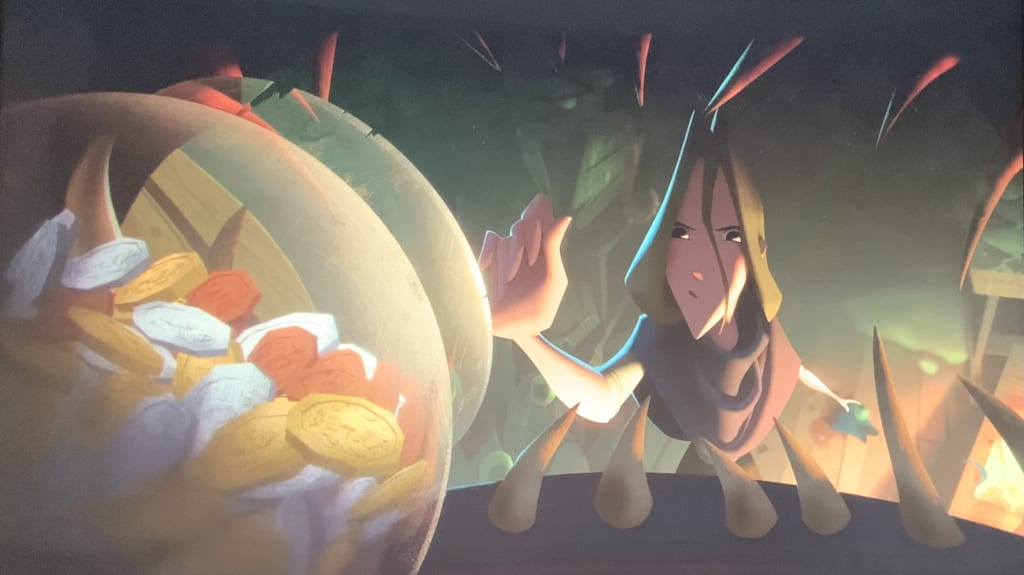
Later, we see the children return to the classroom. Alva chops fish until she makes a deal to teach them something. A small girl marvels at writing her name and all the students explode with excitement. You see Alva taken aback, the smothered embers of desire rekindle. She can teach the children. But they have no supplies! After the education session with the students we see a short scene where Alva opens an angler fish mouth containing her careful savings. She reaches for the jar of money, the camera looks down out of the fish's toothy maw. She hesitates and closes the mouth, then opens the mouth again and takes a few coins out of the jar with pained hesitation. We don’t see Alva and the classroom for another twenty minutes, but during that time she purchases study materials and educates the children. The cynical beaten down woman finds her love to educate, but there’s a problem. The money. Her dipping into her personal funds to pay for classroom supplies. This scene gives one strong example as to why teachers are sick of the system. Teachers are underpaid. Although set in 19th Century Norway, this scene resonates in America if not the rest of the world.
Educators are nurturers. Education requires a balance of teaching and fostering an inclusive, safe classroom. Because of this need to connect with and cherish students the profession, especially among elementary and middle grade education, is predominantly female. As women are historically underpaid, averaging 7% or more, for many teachers, depending on the state and cost of living, that can fall as low as 15% below the national average. Teaching requires hard work and skills honed over many years. Magnifying this calling is costly, both mentally and fiscally. Alva decides to resume teaching. Though indeed honorable, the film praises her for utilizing her personal scavenged funds. This scene exemplifies what many teachers across the nation have to face. She doesn’t go to any boards, grants, or government to ask for classroom assistance, but must pay for the children’s education out of her already meager wages. Although she wouldn’t have received any money even if she tried due to the town’s political strife, in America many states and school districts are so underfunded teachers either need to run fundraisers or pay out of their pockets. One teacher whom I worked with for several years would regularly purchase out of pocket despite working in a wealthy district. She came from a Title One school (fancy lingo for ghetto) in California where she had to dip into her wallet on a regular basis. She had to adjust to working somewhere better funded. It’s a common story among many teachers at inner city schools, distant rural communities, or in districts not supplied by taxes from wealthier socioeconomic classes. So to watch this driven, but exploited educator given a praising light for her sacrifice made these few scenes in an otherwise amazing film difficult to digest.
The problem becomes even more exacerbated towards the end of the second act. Jesper visits Alva to discover the school has transformed from dark-grey, grungy fish-chop-shop to the warm, orange glow of clean, orderly desks and strings zig-zagging across with the students' work on display. The moment challenges Jesper’s core arc. He wants to go back to his posh life, but he needs community, sacrifice, service, and family. Alva, who held the same cynical sentiments has awoken and has become Alva the self-sacrificing teacher. She’s cheerful and radiant as she welcomes him into her improved classroom. Indeed, service and a strong education foundation are essential to a thriving society. Her hard work, and Jesper’s, is paying off, but we’re reminded of the sacrifice she had to make when he asks her about the money she hoarded to get out of town. She says she used some of it then admits she used all of it. In terms of the theme and moral of the story, it’s a gut punch to Jesper to see how selfless she’s become, but of course we have to recognize that this positive light shed upon her veils a societal issue that’s bludgeoning and drowning teachers.
Teachers are underpaid, living frugal lives, and many are still expected to fund their classrooms. Wishing for wages and funding that allows a teacher to live comfortably at a respectable income is talked about but never acted upon. When teachers step up and protest or unions try to barter with state boards of education, teachers are often rewarded with the sentiment, “Teachers are in it for the children not the money.” Which, for many, rings true. They didn’t become teachers for wealth and fame, but they would still like to pay bills and take family on vacations or attend cultural events without weeping over the bank account balance. To teach but still be paid enough to live, is not too much to ask. To see Alva sacrifice all her money for the education of children is touching, but exposes the exploitive expectation society holds over teachers. Children’s education before your own welfare and health.
Teachers leave not because they hate the children, but the stressors, the lack of funds, the emotional and financial burden become too much. With rising costs of living, a trip to the urgent care or hospital ends up canceling vacations and puts bank accounts on such strain teachers face neural fires of mental health implosions. Alva and the angler money jar reveals the ugly truth of teaching. This scene shows how, in order to nurture and build a society, teachers are socially expected to sacrifice their dreams and goals. We can replace the jar in the angler’s mouth to represent not Alva’s escape from Smeerensburg, but many other teacher’s dreams. Buy a house. A car. A trip to forgeign countries. Family vacations to theme parks and resorts. And each time they choose to prioritize their student’s educational welfare over their own mental health and life balances they’re praised by society. This cycle continues until the teacher, burdened, takes their leave. The movie praises a selfless act, and those well intentions only fortifies the festering crisis in America.
These few scenes throughout Klaus take an otherwise phenomenal movie and instill a damper on its overarching theme. Yet, while I could sit here all day and whine about the dismal conditions many teachers work in, we need to talk about solutions. What can we do? What can we do to make Alva’s progression from a dejected escapist to a bright eyed educator an actual gem? We need to improve the conditions for teachers. We need to shift our attention to the importance of education. Many have opinions that schools teach nonsense. I’m a science teacher, and it’s true, once you get past 8th or 9th grade science, it becomes so specific that students stare glassy eyed at you wondering when they’re ever going to use something like the half-life decay rates for radioactive isotopes. But there are Tik Tok videos across the internet of students walking into classrooms void of teachers and the education we took for granted. Government officials and parents call teachers selfish for leaving and abandoning their children, and the students wish they were getting an education.
Like any emergency medical technician learns during training, despite their duty to save lives, self-care comes first. If they can’t provide care to the patient without compromising their safety, they must step back. Nasty car accident and someone lays bleeding out next to a downed telephone pole, live wires jumping across the asphalt? They must stay back. The scene is not safe. For teachers, buckling under the pressures of school shootings, threats, outlandish government responses to safety and an increase of student violent behavior, the scene in schools is no longer safe. Many teachers are caring for themselves until the system resets. Not sure how conditions for teaching are? Check out three social media resources that joke or share the grim reality: Bored Teachers, Devin Siebold (YouTube shorts and a podcast Crying in My Car), and Teacher Misery (most brutally honest) are places where teachers go to laugh, learn, but also vent.
Next, teachers need more pay. Yes. More pay. A teacher with a masters degree and ten years experience teaching makes $20,000 less than many, many other equally educated individuals. Many argue teachers get the whole summer’s off coupled with spring, winter, and fall breaks. Those breaks are essential, as teachers run at 110% during school time and even after hours. Balance is a nightmare. Pay a teacher enough money to live comfortably. Give them, nationwide, a $20,000 raise, and you’ll see many teachers will put up with parents, bureaucrats, and those endless piles of ungraded homework better than they do now. Teachers do have great benefits, true, but sick days and paid time-off are meager. Most teachers don’t want to take time off for two reasons, because they don’t have much and because making sub plans is the worst. Sometimes we go to school sick simply because we can’t trust our classrooms to a half-trained human. Some subs are amazing… others… hurts your soul. It’s possible the use of sick days may not change much simply because of the substitute variable.
Where could we get the money from? Raising taxes is probably the main way, outside of privatizing education. Yet, as we see in modern capitalism such as restaurants, private schools, and the healthcare industry, CEO’s will maintain any exploitation as long as profits are high. On social media, after the school district where I live offered a tax raise for teacher salary, one childless individual complained along the lines of, “Why do my taxes have to support something I don’t use? I don’t have kids?” Yet, when I talk with people and tell them I’m a teacher, so many say, “Oh, teachers should be paid more.” Here’s my response to those who are childless: if there are no educators, and no good schools, those kids have nowhere to go but onto the streets to rifle through your cars, steal your packages, and egg your house. You may not have a kid, but paying your taxes will pay teachers to keep them somewhere and in less trouble. Indeed, it comes down to our focus in society. Are we looking towards progress and exploration or comforts and pleasures? Many complain that football players get paid millions while teachers get pennies. Yet, if we look at our priorities, sports and Hollywood have billions of dollars in revenue and investments. Unless a venture will yield profit, growth, and entertainment; welfare, exploration, and education remain inferior.
The final one, I have to say, is to trust teachers. Teachers need more autonomy in the classroom. Yes, there’s the occasional nut job who goes off the rails, always will be no matter how tight policy stretches the red tape, but teachers who are well-minded and mannered are losing their freedoms law by law, rule by rule, task by task. They want to be there. They want to teach the children, but such ambition gets squashed when their freedom to create gets walled off. They are professionals, and given the space and resources, they’ll explore and develop lessons and activities to engage students in ways that will address multiple facets of learning. Morale would boost, but we can’t put more on the teacher's plate. Give them the resources, the raise, and witness the domino effect.
In the end, teaching and education is a tricky area. Throughout our lives we were made promises by education and teachers are left the most unfulfilled of all those promises. Think back to “College Week,” a time to encourage and teach students about continuing education. We promise them that if they go to college they’ll make enough money to live a comfortable if not wealthy life. Teachers are intended to be the exemplars of that benefit. Yet, each year when I give the presentation, I do so with artificial enthusiasm. When I sit down at home and count my figurative coins-in-the-angler-fish-mouth, I’m left white haired and exhausted. An accountant with the same level of credentials and education as me makes at least $20,000 more than I. How can I tell students to get a college education where I’m the one who received the shortest end of that promise? Our priorities, coupled with political divisions, crumbling societal networks, breeding safety crises, and exploited compensation and expectations, are finally causing America’s education system to collapse. Although I love Klaus and its humor, art, well-designed characters, and storytelling, Alva still stabs a part in my heart. Tasked at repairing and upholding the future generations, she’s glorified as the exploited, underpaid female educator of our modern era.
About the Creator
Christopher Michael
High school chemistry teacher with a passion for science and the outdoors. Living in Utah I'm raising a family while climbing and creating.
My stories range from thoughtful poems to speculative fiction, fantasy, sci-fi, and thriller/horror.
Keep reading
More stories from Christopher Michael and writers in Education and other communities.
What should you do if you accidentally cut off your finger
After a long day helping patients in the emergency room, Priya is calmly preparing dinner when her knife slips and cleanly severs her finger. Fortunately, as an ER doctor, she knows exactly how to respond. First, she carefully cleans the wound with a wet paper towel and bandages her finger— making sure not to wrap it too tightly. To manage the pain, she knows not to take ibuprofen, which could interfere with clotting, and instead chooses acetaminophen. Then she gently rinses the severed finger, wraps it in a clean, slightly moist towel, and places it in a cooler while avoiding any direct contact with ice. Finally, she rushes to the hospital, where, fortunately, a skilled hand surgeon is available. Thanks to the clean cut and Priya's quick reaction, the surgeon can begin immediately. They set the bones and secure them with wires before repairing the tendons, nerves, blood vessels, and finally, the skin. The entire procedure is completed in about eight hours, and after a few months of occupational therapy, Priya's hand is fully functional again. This represents the ideal outcome for reattaching a body part. Unfortunately, it’s also extremely rare— and not only because most people aren’t as prepared as Priya. In reality, many complications arise with most accidental amputations. First, there’s the injury itself. Unlike Priya's clean cut, most traumatic amputations happen in car crashes or industrial accidents that cause severe, uneven tissue damage and contaminate the wound in ways that prevent reattachment. Additionally, more than half of all limb amputations in the United States are caused by disease, and limbs removed for medical reasons clearly aren’t safe to reattach. Then comes preserving the limb. When a body part is severed, its blood circulation stops, cutting off oxygen and essential nutrients. Surprisingly, severed tissues can survive for a limited time without these resources. Keeping them cool further slows tissue death, generally giving surgeons a 6-to-12-hour window for reattachment. But once the tissues die, reconnecting them won’t restore function. This narrow timeline is especially difficult for surgeons. Because of the challenges already mentioned, reattachment surgeries are relatively uncommon. As a result, many hospitals lack the tools and expertise needed to perform these time-sensitive procedures. And even when they can, nerve repair remains extremely complex. With perfectly clean cuts, surgeons may attempt to stitch nerves back together directly. When a cut is jagged, they might use nerve conduits— tunnels between nerve ends that allow nerves to reconnect gradually. However, neither these nor any other surgical methods reliably restore full movement and sensation. These limitations make successful reattachment unlikely. Fortunately, medical technology has developed another reliable solution for amputation: prosthetics. Today, prostheses come in many forms designed to replace different body parts. Prosthetic legs perform well for walking and running. Prosthetic arms have long struggled to replicate fine hand movements. However, modern myoelectric prostheses can detect electrical signals from nearby muscles and translate them into more precise movements. Perhaps the most dramatic advancement in prosthetic technology is transcutaneous osseointegration. First successfully performed in 1990, this procedure surgically anchors a metal implant into the remaining bone. Over time, the bone grows into the metal’s surface, creating a permanent connection. These implants extend through the skin and attach to prosthetic devices, solving several common prosthetic challenges. Where traditional prosthetics can feel heavy, a direct skeletal connection makes their weight feel more natural. Osseointegrated prosthetics are also less likely to irritate the skin and can provide more sensation by transmitting vibrations through the implant to the bone. Even with these advances, not everyone chooses to replace or reattach a lost limb. After an amputation, some people prefer to rely on their remaining limbs, with or without the support of mobility aids and other adaptive equipment.Follow for more stories like this.
By Munesh Yadava day ago in Education
How Social Media Helps Small Businesses Grow Faster
Small businesses need smart ways to grow without large budgets. Social media offers one of the fastest and most affordable paths. When used well, it helps small brands reach new customers, build trust, and drive steady sales. Growth that once took years can now happen in months.
By Michael Kazmaa day ago in Education


Comments
There are no comments for this story
Be the first to respond and start the conversation.