
Keyword Research: Step-By-Step for Absolute Beginners
Taking Your First Step in Keyword Research


If you are reading this article because you want to know how to conduct an effective keyword research as an absolute beginner, I assume that you are either already in the search engine optimization industry and want to learn more or you are curious and inclined to gain more knowledge that you might be missing out on. Either way, you are welcome to this piece. And by the way, I would love to have your feed backs. Please leave a comment and/or share your insights at the end. I would really appreciate that. You know what? Even though I am trying to be a teacher here, I might also learn a thing or two from you. So, the benefits can go both ways. Now, let's get started.
By the way, I was hoping that my articles will be educational in nature; therefore I believe I should have written about keyword research before I wrote "How Beginners Can Master Technical SEO in 7 Steps". I hope you will forgive me for that. Anyway, I hope you will follow my postings on this platform.
While starting my SEO journey back in 2007 and after understanding the most basic principles of search engine optimization (SEO), I realized that the starting point of a successful campaign is keyword research but then, there were no affordable tools, no other resources to begin with. It was practically like tapping in the dark. I am sure you will agree with me that investing in an SEO tool that cost something around $50 back then was an obstacle too high for me to scale over as a beginner. Therefore, I had to do what had to do to make it to the top. It was not an easy road, but, I managed to get through and I am willing to share my experiences with you.
Throughout this article, I will mention mistakes I made, how I corrected them and how I managed to fully understand how to properly conduct an effective keyword research with examples and case studies.
Taking the first step as you embark on your SEO journey can really be frustrating, especially when you are unsure (as I was) where to start with keyword research. This beginner-friendly guide will break down the process into simple steps, focusing on what truly matters — defining your target audience and avoiding typical beginner errors. I hope that I will help you navigate past the first obstacles which I myself encountered without relying on costly tools. The knowledge you acquire here might help you to build a strong foundation for effective SEO practices and beyond.
Most Common Mistakes Beginners Make While Conducting Keyword Research
Before we dive into the real process of keyword research, I feel I must first touch on the most common mistakes beginners make. However, in my many years of practicing search engine optimization and keyword research, I have witnessed that the mistakes are not peculiar to novices but to business owners alike. This assertion stems from my personal experience while working with clients.
1. No Clear Strategy While Doing The Research.
One of the most common pitfalls beginners encounter in keyword research is not having a clear strategy. Just like me back almost seventeen years ago. I dived into the process without a roadmap which often led to scattered efforts and missed opportunities as I later realized and I would add, pure and undiluted frustration. Establishing a defined goal, whether it's increasing traffic, boosting conversions, or building brand awareness, lays the groundwork for effective keyword selection. Without this focus, you as a beginner may find yourself overwhelmed by the sheer volume of potential keywords, leading to ineffective targeting and wasted resources.
2. Keyword Without Reference To Keyword Difficulty.
Another frequent mistake is prioritizing search volumes without considering keyword difficulty. High search volumes can be enticing, (as it did during my start up years) but they often come with fierce competition that can be a great challenge for newcomers. Instead, beginners should balance their approach by targeting long-tail keywords with lower competition, which can provide quicker wins and drive more relevant traffic. Additionally, failing to analyze user intent behind keywords can result in attracting the wrong audience. Understanding whether users are seeking information, making comparisons, or ready to purchase helps in selecting keywords that align with the desired outcomes.
3. Failure to Appropriately Analyze The Target Audience and Their Personas.
Finally, not analyzing the target audience can severely undermine keyword research efforts. Beginners sometimes focus too much on what they want to say rather than what their audience wants to hear. By delving into audience demographics, preferences, and pain points, one can uncover insights that lead to more resonant and effective keyword choices. This audience-centric approach ensures that content speaks directly to the needs and desires of potential customers, enhancing engagement and conversion rates.
The Basics of Keyword Research
Imagine you’ve just opened a little café, and now you need to let the world know about it. The natural step is either to set up a website or you create a Google Business Profile for your café. But, how will your prospective customers find you? This is why you need an exhaustive keyword research. At its core, keyword research is like understanding the language your potential customers use to find your services or products online. It’s about identifying the words and phrases they type into search engines, which means getting inside their heads and knowing what matters to them. When you master this, you can then create your content to meet their needs, ensuring your café, or your website doesn't get lost in the vast internet.
Starting with keyword research might seem intimidating at the beginning, but think of it as embarking on a treasure hunt. You begin by brainstorming a list of potential keywords related to your niche, then dig deeper using tools like Google Keyword Planner or SEMrush to evaluate their popularity and competitiveness. The trick is balancing highly searched terms with less competitive ones, often referred to as long-tail keywords. These are more specific phrases that might not have as high a search volume but can attract more targeted traffic, akin to finding customers who appreciate the unique charm of your café rather than those just passing by.
As you refine your keyword list, consider the intent behind each search. Are users looking for information, hoping to make a purchase, or comparing options? Understanding this search intent helps you craft content that resonates deeply with your audience's needs and desires. Essentially, keyword research isn't just about picking words; it's about crafting a strategic narrative that connects you with your audience. By aligning your content with what your audience genuinely seeks, you create a welcoming digital space that invites them to stay, explore, and eventually become loyal patrons of your virtual café.
Takeaway: Various people use the internet to search for various things with various intentions. Some search for fun, some search for information and some search with the intention to take some kind of action which may be to buy or sign up. Take all these criteria into consideration while analyzing your target audience and their personas.
Why is Keyword Research So Important?
As I have mentioned earlier in this article, the main purpose of keyword research is to identify key phrases that your potential visitors are likely to type in searches on Google for instance. These phrases allow you to connect with your audience by basically "speaking to them in their very own language". Keywords are platforms in bridging the gap between your content and your target audience. These words and phrases are not just tools for visibility; they are the language of connection. When you meticulously choose keywords that align with your audience's searcher intent, you're crafting a pathway that guides potential customers to your virtual doorstep. It’s about understanding what your audience is searching for and providing the most relevant content that meets their needs.
Moreover, keywords help search engines understand the essence of your content, enabling them to present it to users actively seeking what you offer. By aligning your keyword strategy with searcher intent, you enhance the user experience, which in turn can lead to higher engagement and conversion rates. It's no longer about simply driving traffic; it's about attracting visitors who are genuinely interested in what you have to offer. Ultimately, the strategic use of keywords creates a symbiotic relationship between your content and your audience, fostering trust and establishing your authority in the digital space.
Tools for Effective Keyword Research
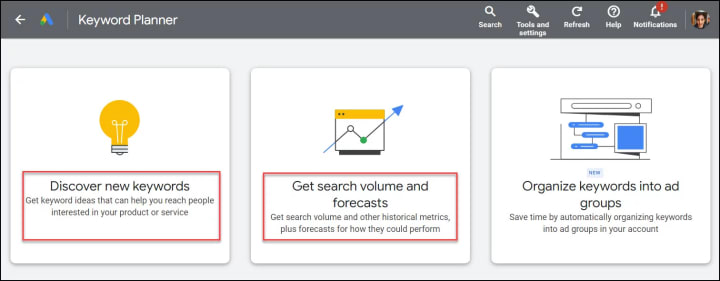
When diving into the world of keyword research, selecting the right tools can significantly impact your SEO strategy's success. Google Keyword Planner remains a fundamental resource, offering invaluable insights into search volume and competition levels for specific keywords. Its integration with Google Ads provides a direct line to data that reflects actual search behavior, making it indispensable for understanding market demands and crafting targeted content.
Beyond the basics, SEMrush elevates keyword research by offering a comprehensive suite of features. Not only does it allow you to explore keyword difficulty and variations, but it also provides a competitive analysis that unveils what your industry rivals are targeting. This depth of insight empowers you to identify gaps in the market and position your content uniquely. Additionally, SEMrush’s ability to track changes in keyword trends over time helps you stay ahead in an ever-evolving digital landscape.
Ahrefs, another powerhouse in the realm of SEO tools, complements these strategies with its robust backlink analysis capabilities. Understanding the backlinks associated with particular keywords can help you assess their value and potential ranking power. Ahrefs' expansive database offers keyword suggestions that might otherwise go unnoticed, giving you a creative edge. By leveraging these tools collectively, you can refine your keyword research process, ensuring your content is not only relevant but also strategically positioned to capture your target audience's attention.
Takeaway: As a beginner, I would advise you to start with Google Keyword Planner because it is a free tool. Also, it is a tool which is associated with Google ads. With a good strategy, you can come up with a valuable list of key phrases you might have never thought about. SEMrush and Ahrefs are expensive (from $99/month) and may not be suitable for absolute beginners. For agencies, yes.
How to Identify Your Target Audience
Understanding your target audience is a crucial step in crafting a successful marketing strategy. One of the most effective ways to pinpoint your audience is by leveraging long-tail keywords, which are specific phrases that potential customers use when they are closer to a point of purchase or are looking for specific information. These keywords not only help in identifying the precise needs and interests of your audience but also enhance your content’s visibility in search engines. For instance, if you own a bakery, instead of targeting the generic keyword "cake," you might focus on "gluten-free birthday cakes in Brooklyn" to attract customers actively searching for this product in your location.
In addition to long-tail keywords, incorporating location-specific keywords for local SEO can significantly refine your audience targeting. This involves understanding their search intent and how it aligns with your offerings. Whether you're a service provider or a retailer, using keywords like “best yoga classes in Austin” can help you connect with local customers who are ready to engage. Furthermore, consider the power of season-related keyword phrases and event-related phrases to capture your audience's attention at specific times. For example, phrases like "summer hiking gear" or "back-to-school sales event" can align your content with seasonal or event-driven searches, ensuring that your message resonates with the right people at the right time.
Takeaway: Going after long-tail keywords is more advantageous for starters. They can rank faster because they usually have low keyword difficulties (KD). KD ranges from 0% - 100%. A difficulty of 0% means very easy to rank for while a KD of 100% means very difficult to rank for. Try to strike a balance here. If you choose the wrong keywords, your strategy will not work. Period!
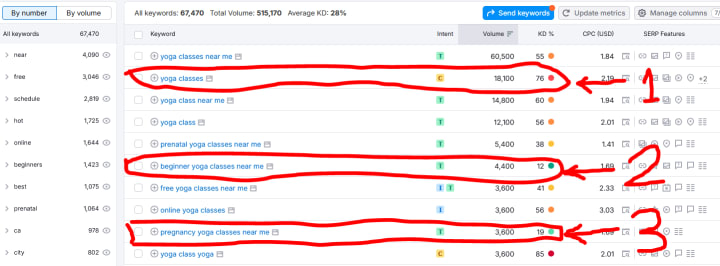
The picture above demonstrates the basic use of keyword research tools. The seed keyword I used is "yoga classes". I will explain each section accordingly.
1. Yoga classes.
- Search Volume: Aproximately 18,100 searches per month.
- Keyword Difficulty: 76%.
- Search Intent: Commercial (C).
Note: The keyword is too broad and the KD of 76% indicates that it will be extremely difficult to rank for. The Cost Per Click (CPC) of $2.19 indicates what it will cost you on average when you use it for paid ads.
2. Beginner Yoga Classes Near Me.
- Search Volume: Aproximately 4,400 searches per month.
- Keyword Difficulty: 12%.
- Search Intent: Transactional (T).
Note: This keyword is more focused. The "near me" clause signifies localized searches. The KD of just 12% indicates easy to rank for, the intent is transactional meaning a high probability of conversion.
3. Pregnancy Yoga Classes Near Me
- Search Volume: Aproximately 3,600 searches per month.
- Keyword Difficulty: 19%.
- Search Intent: Transactional (T).
Note: This key phrase is even more focused than "beginner yoga classes near me" because it targets a specific group of audience - pregnant women who would like to take yoga classes. The intent is also transactional.
Analyzing Competitors' Keyword Strategies
Diving into the realm of competitors' keyword strategies unveils a treasure trove of insights that can significantly enhance your digital marketing efforts. By examining the keywords your competitors prioritize, you gain an understanding of not only what is working for them but also potential gaps in their strategy that you can exploit. This analysis allows you to identify high-performing keywords that drive traffic and conversions, offering a roadmap to refine your own content and advertising campaigns. Furthermore, understanding the intent behind these keywords can provide deeper insights into audience behavior and preferences, enabling you to tailor your content to better meet the needs of your target market.
In addition to identifying opportunities for growth, analyzing competitors' keywords can also help you avoid common pitfalls. Recognizing which keywords do not yield significant results for your competitors can save you time and resources, preventing unnecessary investments in under performing terms. Moreover, this analysis encourages a proactive approach, allowing you to anticipate shifts in market trends and adjust your strategy accordingly. By staying ahead of the curve and continuously refining your keyword strategy based on competitor insights, you position your brand to achieve greater visibility and engagement in an ever-evolving digital landscape.
Organizing and Prioritizing Keywords
My personal strategy which I often use is to focus on long-tail keywords first. These specific, often multi-word phrases are less competitive and can yield higher conversion rates as they cater to niche audiences with clear intent. When you target these long-tail keywords, you not only capture a more engaged audience but also build a strong foundation for expanding into broader terms later especially valuable with topic pillar and content cluster strategy. This approach allows you to gradually increase your site's authority in search engine rankings without facing the fierce competition that comes with short, generic keywords.
Grouping keywords by intent is another effective method to streamline your strategy. Keywords can generally be categorized into informational, navigational, and transactional intents. By organizing your keywords based on what the user aims to achieve—whether it's seeking information, finding a specific website, or making a purchase—you can tailor your content to meet these needs precisely. This alignment enhances user experience and boosts your chances of ranking higher for relevant searches. It's about understanding the user's journey and strategically placing content that answers their questions or solves their problems at each stage.
Moreover, organizing keywords by Keyword Difficulty (KD) is essential to manage your SEO efforts efficiently. KD scores indicate how challenging it is to rank for specific keywords; hence, prioritizing low-to-medium KD keywords can lead to quicker wins and incremental traffic growth. By tackling these achievable targets first, you can steadily improve your site's visibility and authority. As you gain traction, you can gradually incorporate higher KD keywords into your strategy, building on the momentum you've established. This tiered approach ensures a balanced effort between immediate results and long-term goals, making your keyword strategy both sustainable and scalable.
Implementing Keywords in Content Strategy
Start by crafting compelling Meta title tags with strategic keyword inclusion. This can significantly impact click-through rates from search results. A well-optimized Meta title tag should succinctly convey the content's essence while naturally incorporating primary keywords. This approach not only attracts potential readers but also ensures that your content aligns with user intent, ultimately driving more meaningful engagement. By thoughtfully integrating keywords across these various elements, you create a robust content strategy that effectively marries SEO best practices with quality user experience.
Placement and relevance are key. Utilizing headings effectively can significantly enhance your content's SEO performance. Headings not only guide readers through the narrative but also help search engines understand the structure of your content. By incorporating primary keywords into your headings, you signal to search engines the importance of those terms, thereby improving your chances of ranking higher for them.
Maintaining an appropriate keyword density is crucial to avoid the pitfalls of keyword stuffing, which can lead to penalties from search engines (I usually aim for keyword densities between 1% to 2%). A balanced keyword strategy ensures that your content remains natural and engaging for readers while still optimizing for search engines. Additionally, leveraging keywords in image alt tags and Meta descriptions enhances accessibility and provides more context to search engines about the content of your pages. These elements, often overlooked, play a vital role in a comprehensive SEO strategy.
Monitoring and Adjusting Your Keyword Plan
Monitoring and adjusting your keyword plan is a dynamic process that requires constant vigilance and adaptability. In the ever-evolving landscape of search engine algorithms and consumer behavior, keywords that perform well today might become obsolete tomorrow. Regularly reviewing your keyword performance data allows you to identify trends, spot opportunities, and weed out under performing terms. This proactive approach not only helps in maintaining relevance but also in capitalizing on emerging trends before your competitors do.
Incorporating new insights from analytics can lead to strategic adjustments in your keyword plan. For instance, if a particular long-tail keyword is driving unexpected traffic, consider expanding content around it or creating targeted campaigns. Conversely, if certain keywords are under performing despite high search volume, it may indicate a misalignment with user intent, necessitating a shift in strategy. By treating your keyword plan as a living document, rather than a static list, you ensure that your content remains aligned with both user interests and search engine criteria, ultimately enhancing your digital visibility and engagement.
Note: For monitoring and analysis, use Google Search Console and Google Analytics if you are a novice.
Mastering Keyword Research Skills
Lastly but not the least, mastering keyword research skills can significantly elevate your digital marketing efforts by aligning your content with user intent and search engine algorithms. With a well-executed keyword strategy, you can improve your website’s visibility, attract more targeted traffic, and enhance user engagement. It is important to regularly update your keyword list to reflect changes in consumer behavior and market trends. Understanding the balance between long-tail and short-tail keywords can also help in targeting diverse segments of your audience. Embrace the power of data-driven insights to refine your approach and become a leader in the ever-competitive digital space.
About the Creator
Reuben Oyeyele
Reuben Oyeyele is an SEO specialist, a seasoned content writer and blogger with over 17 years of extensive experience in crafting compelling narratives that resonate with diverse audiences.
Keep reading
More stories from Reuben Oyeyele and writers in Education and other communities.
How Beginners Can Master Technical SEO in 7 Steps
I frequently come across people who are just beginning their journey into the world of search engine optimization. The most common question they ask is "What is technical SEO and how do I master it". This is what prompted me to write this article in hope that most people out there may have a glimpse and understanding of the process. Therefore, I would like to share my expertise. Also, some methods I share may not be the "conventional", but I have seen them work.
By Reuben Oyeyeleabout a year ago in Education




Comments
There are no comments for this story
Be the first to respond and start the conversation.