
JWST captures images of the first asteroid belts seen beyond the Solar System
Solar energy

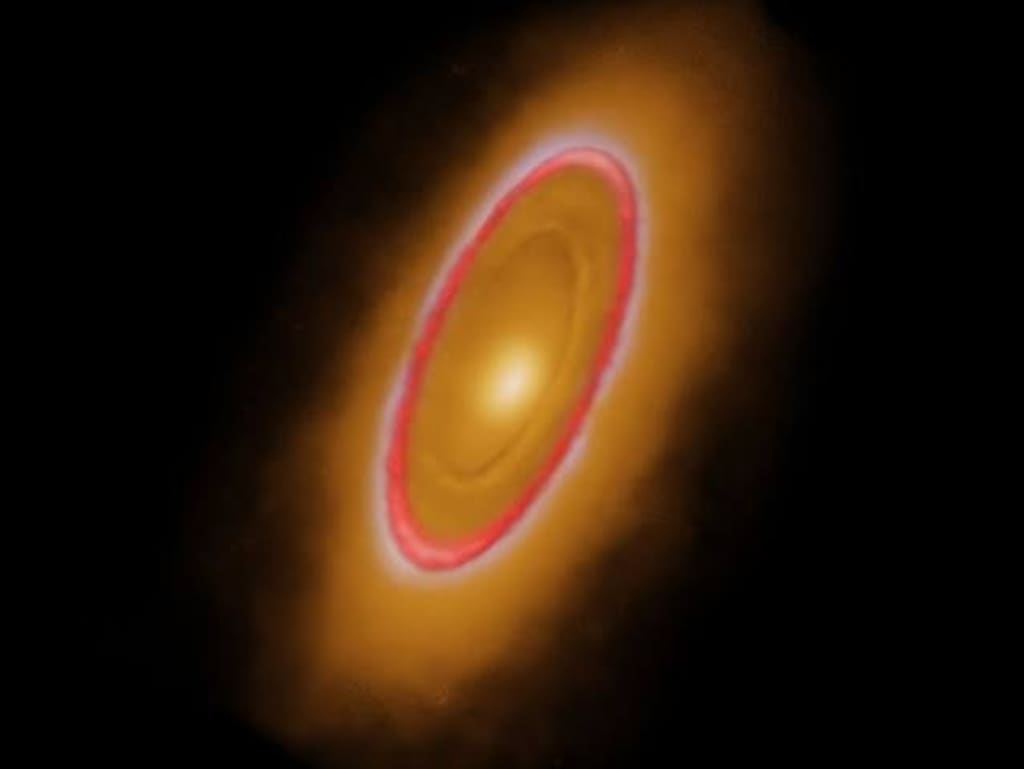
About 25 light years away from Earth lies Fomalhaut, one of the brightest stars in the night sky. The Fomalhaut system has captivated astronomers for decades, but it’s only now that we’re developing a better understanding of it thanks to the James Webb Space Telescope. In a study published in the journal Nature Astronomy on Monday, a group of scientists made up primarily of astronomers from the University of Arizona and NASA’s Jet Propulsion Laboratory say the Fomalhaut system is far more complex than previously thought.
Since 1983, astronomers have known the 440 million-year-old Fomalhaut is surrounded by dust and debris, but what they didn’t expect to find was three different debris fields surrounding the star. One of those, the closest to Fomalhaut, is similar to our solar system’s asteroid belt but far more expansive than expected. As the New Scientist explains, Fomalhaut’s inner asteroid belt stretches from about seven astronomical units from the star to about 80 astronomical units out. To put those numbers in perspective, that’s about 10 times broader of an inner asteroid belt than astronomers expected to find.
This image of the Fomalhaut system, captured by Webb’s Mid-Infrared Instrument (MIRI), shows compass arrows, scale bar, and color key for reference. Labels indicate the various structures. At right, a great dust cloud is highlighted and pullouts show it in two infrared wavelengths: 23 and 25.5 microns.
However, that’s not even the most interesting feature of the Fomalhaut system. Outside of Fomalhaut’s inner asteroid belt, there is a second debris belt that is tilted at 23 degrees from everything else in orbit of the star. “This is a truly unique aspect of the system,” András Gáspár, lead author on the study, told Science News. He added that the tilted belt could be the result of planets in orbit of Fomalhaut astronomers haven’t discovered yet.
“The belts around Fomalhaut are kind of a mystery novel: Where are the planets?” said George Rieke, one of the astronomers involved in the study. "I think it's not a very big leap to say there's probably a really interesting planetary system around the star.”
Yet out further out from Fomalhaut is an outer debris ring similar to our solar system’s Kuiper belt. It includes a feature Gáspár and his colleagues have named the Great Dust Cloud. It’s unclear if this feature is part of the Fomalhaut system or something shining from beyond it, but they suspect it was formed when two space rocks more than 400 miles wide collided with one another. According to Gáspár and company, there may be three or more planets about the size of Uranus and Neptune orbiting Fomalhaut. They’re now analyzing JWST images that may reveal the existence of those planetoids.
The James Webb Space Telescope (JWST), the highly anticipated successor to the Hubble Space Telescope, has made an incredible discovery that is sure to fascinate astronomers and space enthusiasts alike. The JWST has captured images of the first asteroid belts seen beyond our Solar System, providing valuable insights into the formation and evolution of planetary systems throughout the universe.
The discovery was made by a team of scientists led by Dr. Kate Isaak from the European Space Agency (ESA), who used the JWST's powerful Near Infrared Camera (NIRCam) to observe two nearby stars known as HIP 73145 and HIP 73167. These stars are located in a region of the sky known as the Scorpius-Centaurus Association, which is a group of young stars that are thought to be only about 10 to 20 million years old.
The researchers were interested in studying these stars because they have previously been found to have a high level of infrared emission, which is often associated with the presence of dust and debris. By using the JWST's advanced imaging capabilities, the team was able to detect the presence of asteroid belts around both HIP 73145 and HIP 73167, making them the first known asteroid belts outside of our Solar System.
The discovery is significant because it provides valuable insights into the formation and evolution of planetary systems. Asteroid belts are thought to be the remnants of the early stages of planetary formation, and their presence around these young stars suggests that the process of planet formation is ongoing in other parts of the universe. Additionally, the discovery provides clues about the types of objects that may exist in other planetary systems, which could help us to better understand the conditions necessary for the formation of life.
The JWST is uniquely equipped to make these types of observations, thanks to its advanced imaging capabilities and highly sensitive instruments. The telescope's large mirror and sophisticated detectors allow it to capture incredibly detailed images of distant objects, even in the infrared part of the spectrum where many asteroids and other debris emit their most prominent radiation.
Overall, this exciting discovery is just the beginning of what promises to be a wealth of groundbreaking research from the JWST. As the telescope continues to gather data and capture images of the universe beyond our Solar System, it is sure to provide us with even more insights into the mysteries of the cosmos.
About the Creator
Bebe Jimz
Hello, I'm Bebe Jimz, a professional content writer with a passion for crafting engaging and informative content. With several years of experience in the field, I have honed my skills in creating content
E-Invoicing as a Catalyst for Digital Taxation and Business Efficiency in this Digital Era
Introduction In today’s rapidly evolving digital economy, businesses and governments are increasingly turning to technology to improve efficiency, transparency, and compliance. One of the most significant developments in this transformation is electronic invoicing, commonly known as e-invoicing. E-invoicing refers to the generation, exchange, validation, and storage of invoices in an electronic format between suppliers and buyers, often through government-mandated platforms or standardized systems.
By Bobby Yadav4 days ago in Education
Innovation Without Compassion: How the Absence of Empathy Undermines Modern Healthcare
Healthcare innovation promises efficiency, accuracy, and expanded access to care. New technologies, digital platforms, and streamlined systems continue to reshape medicine. However, when innovation moves forward without empathy, it often fails the very people it intends to serve. Patients feel disconnected, clinicians feel overwhelmed, and organizations struggle to achieve meaningful results.
By Mark Bouzyk7 days ago in Education




Comments
There are no comments for this story
Be the first to respond and start the conversation.