
Join our Backend Development with Node.js, Express.js, and MongoDB Online Training-NareshIT
MongoDB Online Training
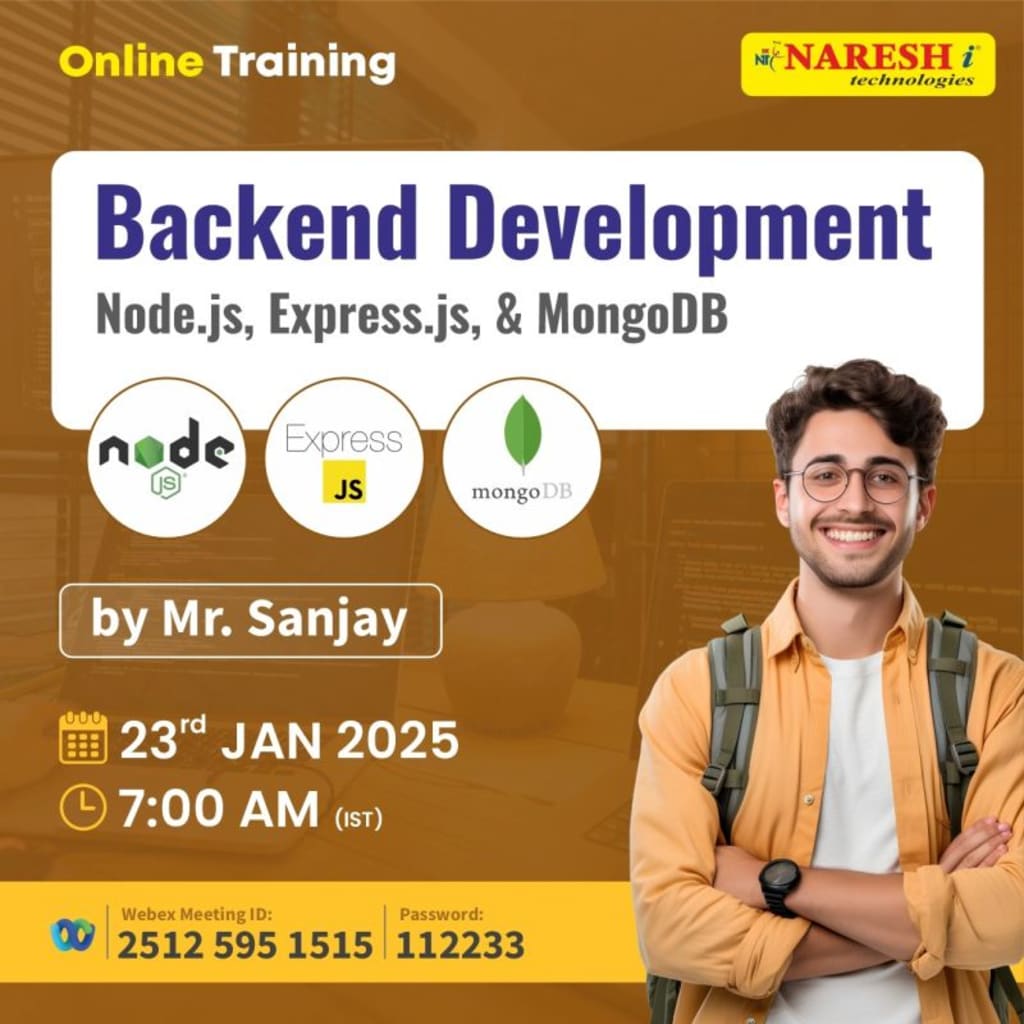
Introduction to Backend Development: Backend development is a critical part of building modern web applications. It involves creating the server-side logic, APIs, databases, and everything that works behind the scenes to make an application functional. In the past few years, the demand for skilled backend developers has increased as more businesses transition to digital platforms. One of the most popular tech stacks for backend development is Node.js, Express.js, and MongoDB (often referred to as the MEAN or MERN stack when combined with Angular or React on the frontend).
If you're looking to learn backend development, particularly using Node.js, Express.js, and MongoDB, online training courses provide an excellent opportunity to build your skills at your own pace.
What is Node.js? Node.js is an open-source, cross-platform runtime environment that allows developers to execute JavaScript code outside the browser. Unlike traditional server-side languages, Node.js uses JavaScript, which makes it popular for full-stack JavaScript development. Node.js is built on Chrome's V8 JavaScript engine and is known for its non-blocking, event-driven architecture, which makes it ideal for building scalable and efficient web applications.
What is Express.js? Express.js is a lightweight framework for Node.js that simplifies the process of building web applications and APIs. It provides a robust set of features, such as routing, middleware support, and template engines, making it an essential tool for backend developers. Express.js allows you to create RESTful APIs quickly and efficiently, which is a common requirement for modern web applications.
What is MongoDB? MongoDB is a NoSQL database that stores data in a flexible, JSON-like format called BSON (Binary JSON). Unlike traditional relational databases (RDBMS), MongoDB does not require predefined schemas, which makes it easier to work with large amounts of unstructured data. It’s highly scalable, providing developers with the ability to handle massive data sets and grow their applications seamlessly. MongoDB is ideal for applications that require flexibility and scalability.
Why Choose Node.js, Express.js, and MongoDB?
1. JavaScript Everywhere: Since Node.js uses JavaScript on the server-side, you can use the same language for both the frontend and backend. This unification of languages makes development faster and reduces context-switching between different languages.
2. Scalability: Node.js is designed to handle asynchronous operations and can scale horizontally, which is perfect for high-traffic applications. MongoDB complements this by offering easy scaling with its document-based data model.
3. Flexibility and Speed: Express.js provides minimal and flexible architecture for building robust APIs with fewer lines of code. MongoDB’s schema-less nature makes it easy to handle changing data structures as your application evolves.
4. Community Support: Node.js, Express.js, and MongoDB have massive communities, with plenty of resources, tutorials, and third-party tools to help you solve problems quickly. This support helps you build applications faster and more efficiently.
Online Training: The rise of online education platforms has made it easy for developers to learn backend development with Node.js, Express.js, and MongoDB. These platforms offer self-paced courses with video tutorials, coding exercises, and projects that help you gain practical experience. Here’s what to look for in a good online training course:
1. Comprehensive Curriculum: Look for a course that covers the basics and advanced topics. A solid course should start with an introduction to Node.js and progress to more complex topics such as creating RESTful APIs, authentication, handling errors, and integrating MongoDB.
2. Hands-on Projects: The best way to learn backend development is by building real-world applications. Ensure that the course includes practical projects like building a blog API, a social media platform, or an e-commerce backend.
3. Support from Instructors and Peers: Choose a course with active community support and instructor availability to answer questions and clarify doubts.
4. Updated Content: Technology evolves quickly, and it's crucial that your training material is up-to-date with the latest features and best practices.
What You’ll Learn in a Backend Development with Node.js, Express.js, and MongoDB Course:
1. Introduction to Node.js:
o Understanding the Node.js runtime environment
o Setting up Node.js on your local machine
o Working with NPM (Node Package Manager)
2. Building APIs with Express.js:
o Introduction to Express.js and middleware
o Creating routes, handling requests, and sending responses
o Implementing RESTful APIs
3. Database Integration with MongoDB:
o Introduction to MongoDB and NoSQL databases
o Setting up MongoDB and using MongoDB Atlas (cloud database)
o Performing CRUD (Create, Read, Update, Delete) operations with MongoDB
4. Authentication and Security:
o User authentication using JWT (JSON Web Tokens) and Passport.js
o Password hashing and storing sensitive data securely
o Protecting your application with best security practices
5. Error Handling and Debugging:
o Handling errors in Node.js and Express.js
o Debugging your application efficiently
6. Deploying the Application:
o Deploying a Node.js app to cloud platforms like Heroku or AWS
o Understanding deployment pipelines and CI/CD (Continuous Integration/Continuous Deployment)
7. Best Practices and Advanced Topics:
o Code organization and modular development
o Asynchronous programming with Promises and async/await
o Building scalable applications with microservices
Popular Online Learning Platforms Offering Backend Development with Node.js, Express.js, and MongoDB:
1. Udemy: Udemy offers various courses on backend development, ranging from beginner to advanced levels. Popular courses often include comprehensive tutorials, quizzes, and downloadable resources.
2. Coursera: Coursera provides professional certificates and degree programs, often in partnership with leading universities and tech companies. Their backend development courses cover both theory and practical projects.
3. Codecademy: Codecademy offers interactive lessons where you can directly write code in the browser. They provide a hands-on learning experience that is excellent for beginners.
4. freeCodeCamp: freeCodeCamp offers free courses on backend development, with projects to build and certifications to earn. Their Node.js and Express.js lessons are especially popular among beginners.
5. Pluralsight: Pluralsight offers high-quality courses with a focus on professional development. Their backend development courses dive deep into Node.js, Express.js, and MongoDB, with industry-recognized instructors.
Conclusion: Backend development with Node.js, Express.js, and MongoDB offers a modern and efficient approach to building scalable and fast web applications. Online training courses provide a convenient and affordable way to master these technologies at your own pace. Whether you're a beginner or an experienced developer looking to expand your skill set, there are plenty of resources to help you succeed. By learning Node.js, Express.js, and MongoDB, you can create powerful applications that handle large volumes of data and traffic, making you a highly valuable asset in the tech industry.
About the Creator
Keep reading
More stories from Jayanthi Nareshit and writers in Education and other communities.
Join our UNIX | LINUX Training-NareshIT
Introduction UNIX and Linux are powerful, versatile operating systems widely used in various sectors, including academia, business, and personal computing. Understanding these systems can open doors to numerous career opportunities in system administration, development, and cybersecurity. This guide aims to provide an overview of UNIX/Linux training, covering essential concepts, skills, and resources.
By Jayanthi Nareshitabout a year ago in Education
Why Laptop Privacy Screens Are Becoming Essential for Remote Workers
Remote work has transformed how and where people get their work done. Cafés, coworking spaces, shared offices, and even home environments are now common workplaces. While this flexibility has many advantages, it also introduces new challenges — especially when it comes to privacy, focus, and long hours in front of a screen.
By Bahati Mulishiabout 18 hours ago in Education
How Poor Healthcare Program Planning Affects Revenue and ROI
Effective program planning is essential for financial stability and long-term success in healthcare organizations. When planning is comprehensive, data-driven, and aligned with organizational goals, it supports efficient service delivery, strong patient outcomes, and healthy financial performance. However, when planning is weak or fragmented, the consequences extend far beyond operational inefficiencies. Poor healthcare program planning directly affects revenue generation, resource utilization, and return on investment, ultimately weakening the organization’s ability to grow and compete. Understanding how these financial impacts occur is crucial for leaders seeking to build programs that deliver measurable value.
By Evyatar Nitzany4 days ago in Education


Comments
There are no comments for this story
Be the first to respond and start the conversation.