
IUL vs. ROTH IRA:
Which Actually Builds More Wealth? (PART TWO)

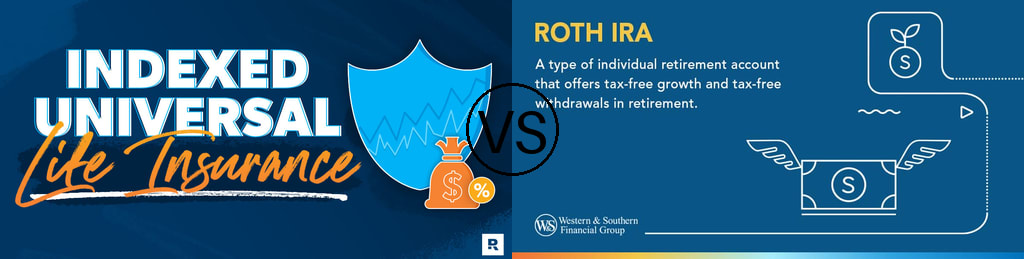
Welcome to part TWO of this THREE part article series where we deep dive into the two most debated topics in the retirement world. IUL or Roth IRA?
Last week we defined an IUL and a ROTH IRA (If you are just tuning in, I recommend you go check out PART ONE of this article for reference), how they work, and some key differences. This article will cover potential, returns/ credits, limits and much more. Lets go!
Comparing Growth Potential
The growth potential between IULs and Roth IRAs stems from their distinct approaches to market participation and investment strategies.
Market Returns vs Index Credits
IULs offer a unique balance of growth opportunity and protection through their index-based crediting system. During market volatility, IULs demonstrated superior performance by preventing losses while capturing market gains. In fact, a comparative analysis showed IULs generated USD 16,327,611 versus the Roth's USD 5,025,422 - resulting in an USD 11,302,189 advantage (4).
The annual point-to-point indexing structure of IULs creates more reliable compound growth over time (4). Specifically, IULs implement a floor rate, typically at 0%, protecting the cash value from market downturns (5). Yet, this protection comes with a trade-off - most IUL policies cap annual returns at approximately 11% (6).
Roth IRAs, alternatively, provide direct market exposure through diverse investment options. Without performance caps, Roth investments can fully participate in market rallies (7). Still, this unrestricted growth potential exposes retirement savings to market volatility, particularly during economic downturns (4).
Still have questions? We'd love to talk to you.
Impact of Contribution Limits
The contribution flexibility between these vehicles creates substantial differences in wealth-building capacity. Roth IRAs face strict annual limits - USD 7,000 for 2024, with an additional USD 1,000 allowed for those over 50 (10). These constraints may restrict aggressive savers from maximizing their tax-advantaged growth potential.
Conversely, IULs operate without predetermined contribution caps (5). The only limitations stem from financial underwriting by insurance providers based on the policyholder's circumstances (1). This flexibility allows high-income earners to potentially accelerate their wealth accumulation through larger premium payments.
The absence of contribution restrictions in IULs provides several advantages:
- Consistent withdrawal rates during retirement
- No forced selling during market downturns
- Protected income base for predictable planning (4)
Premium payment schedules for IULs offer various options - monthly, quarterly, biannual, or annual payments. Annual premium payments might qualify for discounts, therefore reducing overall costs (7). Nevertheless, missing payments could jeopardize policy status depending on specific contract terms.
The growth dynamics extend beyond simple investment comparisons. While Roth IRAs fully expose retirement funds to market fluctuations, IULs' zero-floor protection preserves accumulated gains while maintaining market participation potential (4). This protection mechanism proves particularly valuable during volatile market periods, allowing steady compound growth without the setbacks of significant losses.
Risk Management Features
Risk management stands at the forefront of retirement planning, with IULs and Roth IRAs offering distinct approaches to protecting and preserving wealth.
Downside Protection in IUL
IUL policies incorporate built-in safeguards against market volatility through a zero-floor protection mechanism (8). This guarantee ensures the cash value account maintains stability even amid market downturns, as the interest credited never falls below 0% (9).
Beyond basic protection, IUL policies offer:
- Volatility-controlled indexes that reduce market exposure
- Smoother performance compared to traditional S&P 500 tracking
- Minimum guaranteed interest rates between 0-2% (9)
The zero-floor protection proved especially valuable during the COVID-19 market crash. An account value of USD 1 million remained intact, maintaining consistent 4% withdrawal rates throughout the crisis (4). This protection mechanism enables policyholders to avoid forced selling in down markets and maintain predictable retirement planning (4).
Still have questions? We'd love to talk to you.
Market Exposure in Roth IRA
Roth IRAs present direct market exposure, offering investors complete participation in both market gains and losses (10). Since account values directly correlate with chosen investments' performance, Roth IRAs lack inherent downside protection (11).
Nonetheless, Roth IRAs provide flexibility in risk management through:
- Asset Class Diversification
- Stocks and bonds allocation
- Real estate investments
- Commodity exposure (12)
- Defensive Sector Focus
- Utilities
- Healthcare
- Consumer staples (12)
Investment advisors suggest maintaining some portion in cash equivalents, enabling investors to capitalize on market downturns by purchasing assets at lower prices (12). Moreover, dividend-paying stocks within Roth IRAs offer resilience through steady income generation, regardless of stock price fluctuations (12).
TO BE CONTINUED...
Come back next week to continue with part three of this mini article series. See you then!
Still have questions? We'd love to talk to you.
Laura Munoz, Senior Advisor with Financial Advantage Consultants
References
[1] - https://ogletreefinancial.com/blog/roth-ira-vs-indexed-universal-life-whats-the-best-choice/
[2] - https://investorlosscenter.com/iul-fees-explained/
[3] - https://www.investopedia.com/fees-roth-ira-5220092
[4] - https://www.insurancegeek.com/iul/iul-vs-roth-ira/
[5] - https://www.annuityexpertadvice.com/iul-vs-roth-ira/
[6] - https://www.capitalforlife.com/iul-vs-roth-ira
[7] - https://smartasset.com/retirement/iul-vs-roth-ira
[8] - https://www.nationallife.com/resource-center/indexed-life-insurance-volatility-controlled-indexes
[9] - https://www.modernlife.com/article/indexed-universal-life-insurance-benefits-risks
[10] - https://www.zagconsultgroup.com/blog/iul-vs-roth-ira
[11] - https://www.investopedia.com/articles/personal-finance/103114/roth-iras-investing-and-trading-dos-and-donts.asp
[12] - https://www.nasdaq.com/articles/how-protect-your-roth-ira-stock-market-crash
[13] - https://www.healthcareretirementplanner.com/2023/09/18/indexed-universal-life-vs-roth-ira/
[14] - https://www.aol.com/protect-roth-ira-stock-market-200025458.html
[15] - https://ogletreefinancial.com/blog/tax-treatment-of-iul-cash-value/
[16] - https://thequantum.com/doing-roth-conversions-for-your-clients-consider-an-iul-alternative/
[17] - https://azewebp03sa.blob.core.windows.net/ashbrokerage-web/uploads/40086-Cost-Transparency-How-IUL-Policy-Charges-Work.pdf
[18] - https://bankingtruths.com/indexed-universal-life-insurance-pros-cons/
[19] - https://youstaywealthy.com/podcasts/why-iul-is-a-bad-investment/
About the Creator
Laura E. Munoz
Sr. Advisor at Financial Advantage Consultants, specializing in 403(b)'s, tax advisory, rollovers, IRAs, Roth IRAs, financial planning, Wills, and Trusts. Backed by 50+ years of team expertise, helping clients secure their financial future.
Keep reading
More stories from Laura E. Munoz and writers in Education and other communities.
Retirement Q&A
Retirement Q&A Let's dive in shall we? I asked what people's questions were in retirement and they did not disappoint! In order to keep with the flow of this week's article, I will keep everything strictly Question/ Answer format without any names for confidentiality.
By Laura E. Munoz11 months ago in Education
How Interest Rates Impact Real Estate Investments and Investor Decision Making
Interest rates impact real estate investments at every stage of the buying and owning process. From the first loan application to long term holding strategies, interest rates influence costs, demand, and overall returns. Many investors focus only on property price, but interest rates often play a larger role in success or failure. This article explains how interest rates affect real estate investments in a clear and simple way, using practical examples that are easy to understand.
By Manny Khoshbin2 days ago in Education
Businesses Where AI Does Most of the Work
The idea of a side business used to mean late nights, endless hustle, and doing everything yourself. Today, artificial intelligence has changed the rules. With the right setup, you can start a side business where AI handles most of the heavy lifting—content creation, analysis, customer interaction, and even basic decision-making—while you focus on strategy and growth.
By Anthony Bahamonde3 days ago in Education



Comments
There are no comments for this story
Be the first to respond and start the conversation.