
Is There an Economic System Better Than Capitalism?
Following repeated economic crises in capitalist countries, many thinkers from economics, politics, and philosophy have speculated about capitalism’s future.
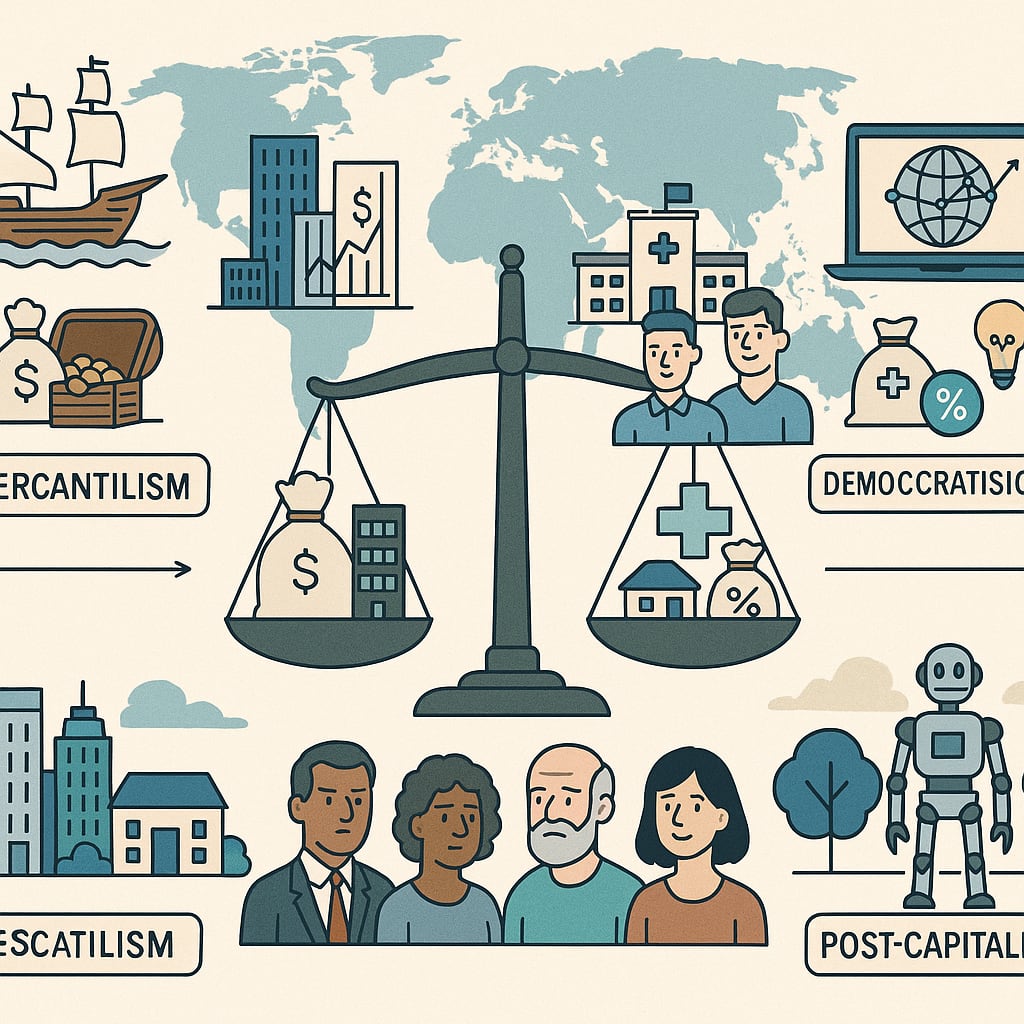
In our daily lives, we often hear the word "capitalism". Especially when talking about the economy, it's not uncommon for you or your conversation partner to link your discussion to the capitalist system. Indeed, we live in a highly capitalist world.
Everything is for sale. Everything we see and touch has become part of a commodity-driven system aimed at capital accumulation. Capitalism has gone through a long historical journey. Since the collapse of communism in most parts of the world by the end of the 21st century, capitalism—rooted in liberal and democratic values—has asserted itself as the reigning economic system.
Today, the majority of countries base their economies on capitalism. Yet, it continues to face criticisms and flaws. Capitalism has been challenged both empirically and rationally, accused of consolidating power among the few, exploiting workers, prioritizing profit over social goods, polluting the environment, and perpetuating inequality and economic instability.
So, is there an economic system better than capitalism? Or are the systems currently adopted in countries like China simply extensions of capitalism?
The End of Mercantilism
For those unfamiliar, mercantilism was the dominant economic theory during the British colonial period in Canada. It proposed that the world's wealth was fixed, and therefore a country could only gain wealth by exporting more than it imported.
Linked closely with imperialism, colonialism, tariffs, and subsidies, this system was used by European powers such as France and Great Britain from the 16th to the mid-19th century. But by the late 18th century, mercantilism was falling out of favor. According to The Canadian Encyclopedia, the repeal of the Corn Laws and Navigation Acts in the mid-19th century marked the definitive end of British mercantilist practices.
The system was famously criticized by Adam Smith in The Wealth of Nations, which laid the foundation for classical economics and modern economic thought.
Capitalism and Adam Smith
Simply put, capitalism is an economic system that grants individuals full freedom to control economic activities for the purpose of making a profit. The idea originates from Adam Smith, a key figure in classical economics and the proponent of free-market theory. His 1776 book, The Wealth of Nations, remains a core reference in modern economics.
Smith, born in Scotland on June 5, 1723, outlined the core tenets of capitalism through concepts such as laissez-faire and the invisible hand—principles that became foundational to capitalist thinking on the value of goods and services.
Today, most countries adopt capitalism as their primary economic system. According to the Heritage Foundation's Index of Economic Freedom, 168 nations rely on capitalist systems. Singapore, Switzerland, and Ireland rank as the top three most capitalist countries. Interestingly, the UK and the US, often associated with capitalism, rank lower at 24th and 25th respectively.
In the US, capitalism is defined as a system in which private individuals or businesses—not the government—own and control production: entrepreneurship, capital goods, natural resources, and labor. Its success depends on a free market economy driven by supply and demand.
Democratic Socialism
One critical issue with industrial capitalism is that it is not designed to meet the needs of those participating in it. It's not the first system ever created, but it is the latest—and most dominant. We live in such a system, often blindly accepting assumptions that may not hold up to scrutiny. Back to the question: is there a better system than capitalism?
Allan G. Johnson offers an interesting proposition. In his essay “If Not Capitalism, So What?” he writes, “We need a system designed first and foremost to meet the needs of people, the planet, and the non-human species that call it home—one that respects the biological and moral realities of life: that we live together.” Norway is one country that reflects this kind of system.
Norway was relatively unaffected by the 2008 global financial crisis, largely because it didn’t allow individual and corporate greed to dominate its economy. Its banks and financial institutions are heavily regulated, and high income taxes ensure that every citizen has access to basic needs, including education and healthcare.
This system is called democratic socialism. We’re often told that socialism means the end of freedom and individualism—examples like the Soviet Union and China come to mind. But Johnson argues that there are more humane and ecological models: Norway, Sweden, Finland, Denmark, Switzerland, and even the Netherlands all practice versions of socialism quite different from Soviet or Chinese models.
Ultimately, if “freedom” under capitalism means doing anything regardless of its consequences, then socialism means a more limited freedom—one that respects the rights of others.
Post-Capitalism
Following repeated economic crises in capitalist countries, many thinkers from economics, politics, and philosophy have speculated about capitalism’s future. Among the most cited is Karl Marx, who argued that material conditions shape social life—"Das Sein bestimmt das Bewusstsein". That is, existence determines consciousness; how we live and work influences what we think and feel.
Marx predicted that capitalism would collapse under the weight of its internal contradictions. The 2007 economic crisis, which saw millions lose their jobs and homes, is one example of its instability.
So, what might define the world after capitalism? Some thinkers propose post-capitalism, a system that emerges naturally once capitalism becomes obsolete.
In 1993, Peter Drucker described this possibility in Post-Capitalist Society. He argued that knowledge—not capital, land, or labor—would become the new basis of wealth. The post-capitalist society would consist of knowledge workers and service workers, replacing the capitalist-proletariat divide.
Drucker predicted this transformation would be complete by 2010–2020. And perhaps, it’s already happening—just unnoticed. For instance, we no longer need to visit cinemas to watch movies. We can subscribe to a platform and access content instantly. As Drucker envisioned, consumers would pay subscriptions, and producers would assume that everything is reproduced and shared through digital networks.
In 2015, Paul Mason noted that rising income inequality, recurring economic crashes, and capitalism’s role in climate change were driving serious discussions about post-capitalist futures. This new system could be enabled by advancements in automation and information technology—developments that drastically reduce the cost of production, potentially to zero.
About the Creator
Wahyu Gandi G.
Researcher, writer, and lecturer | Obtained M.A. in Literature Science Universitas Gadjah Mada.
Keep reading
More stories from Wahyu Gandi G. and writers in Education and other communities.
Comparison of European colonialism in Asia
Several colonial powers, especially different Western Europeans, established colonies in Asia during the 18th and 19th centuries. Although they were on the same land, each imperial power had its style, from administration to colonial officials. As a result, the following countries showed different attitudes towards the people in their colonies. How do these colonial powers compare?
By Wahyu Gandi G.about a year ago in History
A brief history of alcohol
This chimpanzee stumbles across a windfall of overripe plums. Many of them have split open, drawing him to their intoxicating fruity odor. He gorges himself and begins to experience some… strange effects. This unwitting ape has stumbled on a process that humans will eventually harness to create beer, wine, and other alcoholic drinks. The sugars in overripe fruit attract microscopic organisms known as yeasts. As the yeasts feed on the fruit sugars they produce a compound called ethanol— the type of alcohol in alcoholic beverages.
By Munesh Yadava day ago in Education
The Lean Advantage: How Small Improvements Create Massive Business Wins
In today’s fast-moving market, businesses don’t always need massive overhauls to see major growth. The real competitive advantage often comes from Lean process improvement—small, consistent changes that reduce waste, improve speed, and strengthen customer value. With a proactive approach, companies can spot inefficiencies early, prevent recurring problems, and build smarter systems before minor issues become costly setbacks.
By Duke Valentour2 days ago in Education
Smart phones, Humans and Aliens.
WARNING. I will be tapping into one of your favorite creative tensions: The absurdity of humans worshipping their glowing rectangles as if they were tiny oracles. There’s something deliciously poetic about that contradiction, and it lends itself beautifully to an instructive proviso.
By Novel Allen5 days ago in Poets


Comments
There are no comments for this story
Be the first to respond and start the conversation.