
Is there a hidden agenda for your child's poor learning? "Learn about dyslexia
Dyslexia


In every class, there always seem to be two or three children who do not like to read, and they are often evaluated as "smart not on the right path (reading)", and some are even placed directly in the last row of the classroom, and not disrupting the classroom order is the biggest requirement for them.
With bottom grades, parental anxiety, teacher misunderstanding, and peer ridicule, these children's growth paths seem to be forever shrouded in shadow.
In the eyes of everyone, these children are "learning difficulties", "poor students", often labeled as "stupid", "lazy", "lazy", "lazy", "lazy" and "lazy". ""not learning"" label ......
They have been misunderstood, but perhaps, they just suffer from dyslexia.
The knowledge about dyslexia is not popular in our country.
Later, with the broadcast of the famous CCTV documentary "I'm not a stupid kid" in 2021, "dyslexia" was gradually known and accepted by everyone, recording the stories of three children with dyslexia. They have normal intelligence, but they just can't read.
Today, let's learn more about this group - of dyslexic children.
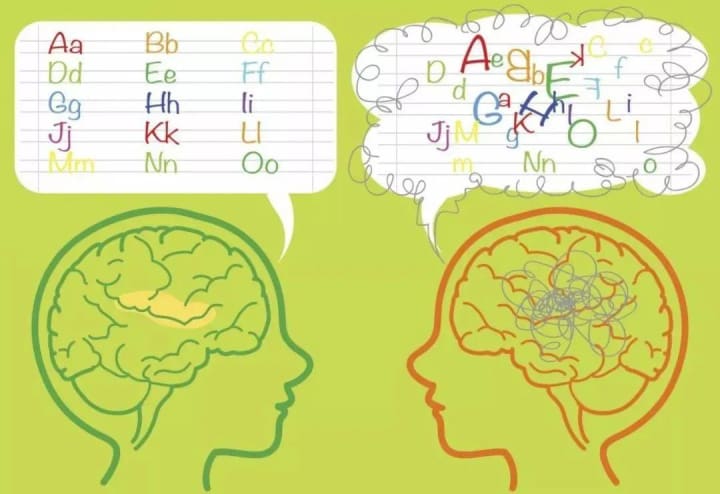
What is dyslexia?
Professionally, developmental dyslexia is mostly characterized by difficulty recognizing and remembering words. They forget what they have just learned immediately, as well as have difficulty understanding the passages they read. It is often accompanied by symptoms such as hyperactivity, lack of concentration, difficulty in identifying directions and distances, and poor memory.
According to Professor Shu Hua of the State Key Laboratory of Cognitive Neuroscience and Learning at Beijing Normal University, "Based on a 10 percent incidence statistic, about 15 million children in China are afflicted with dyslexia."
Children with dyslexia often feel that "the words are dancing, like reading in a bumpy car" when they read.
Dyslexia, simply put, is a child with normal intelligence who is equipped to go to school and is willing to learn, but is unable to keep up with his or her peers in reading and writing, and cannot successfully acquire reading skills at school age.
These children typically exhibit the following typical signs.
Confusion in literacy.
From the beginning of the literacy stage, children with dyslexia will regularly confuse words with similar shapes and sounds, and even some words cannot be copied correctly from a book, and these children will not be able to recognize words if their radicals are disassembled. Some patients see mirrored words and often confuse b and d.
Skipping words while reading.
In children with dyslexia, the words are not written on the page when they read but jump around in flashes. They have difficulty staring at words in rows or columns, often adding words and subtracting words, skipping lines when reading, and having difficulty understanding the meaning of the words even when they are read in their entirety under the supervision of a parent or teacher.
Writing difficulties.
These children are usually not too different from normal children in life, with lively and cheerful personalities, speaking clearly and articulately, but they are often stuck in writing, and some children sit there all morning and end up not even being able to write 20 words.
Poor grades.

These children often do not do as well as they should, and the mothers of the three main characters in the documentary "I'm Not a Dumb Kid" all said.
"There was no one in the class who scored under 90, all of the first graders were double 100, and my son scored 65 ......"
"Just two months into the first semester of first grade, my child is lagging more significantly compared to children of the same age."
"My daughter's best score is to have taken the bottom three once, and usually the bottom one or two at times."
Not being able to read, not being able to learn, and getting poor grades are common characteristics of dyslexic children.
Dyslexic children aren't dumb!
Sally Schwitters, a neuroscientist at Yale University, once wrote in The Educator that about 20 percent of people in the United States have dyslexia problems, and these children are often considered dumb and lazy because of their poor academic performance.
In China, there are not a few parents with such troubles.
Children with dyslexia are not dumb, they are just "sick. Dyslexia is a physiological deficit, a brain disorder, but their intelligence is as good as or better than normal!
Children with dyslexia are unable to translate written words into language through the brain's recognition system, which is caused by a neurophysiological deficit in the brain, a problem with the brain's recognition of written information systems.
Dyslexia is usually detected when a child begins to read and write.
Even with problems in reading, many dyslexics can live normal lives and even have outstanding achievements as adults.
A team of researchers at Harvard University once did a study on college students diagnosed with dyslexia and regular college students, and the results showed that the dyslexic group had a significant visual advantage.
Steve Jobs, and Spielberg, have confessed that they suffered from dyslexia as children. It is well documented that Einstein, Leonardo da Vinci, Thomas Edison, Picasso, Churchill, and others were also highly suspected dyslexics.
Dyslexic children aren't stupid or lazy, they're just not lucky enough.
Love and acceptance are the only antidote
For dyslexic children, the whole atmosphere of society should be concerned and help, not ridicule and give up.
In foreign countries, many doctors are studying the problem of dyslexia, and there are also many speech therapy clinics intervening in it, and children with dyslexia can also receive free assessments and special education.
On the contrary, in China, the knowledge of dyslexia is not enough! Many parents think that their child's poor learning and poor grades mean that the child is stupid or lazy, which is unfair to the child and can cause psychological damage to the child.
As parents, it is more important to face your child's shortcomings head-on and accept each baby in a different situation. Children with dyslexia, need tolerance and understanding.
◆ Communicate more with the teacher after the diagnosis of dyslexia, and face the child's problems squarely.
◆ Lighten the child's reading and writing tasks and lower the academic requirements.
◆ Read with your child often. You can reduce your child's reading pressure by having him/her read along.
◆ Pay attention to your child's interests, perhaps your child has amazing talent in other areas.
For children with dyslexia, the biggest obstacle is not reading, but being misunderstood. Every child is an angel, and parents should learn to appreciate children who are "out of the ordinary".
About the Creator
yunick jovitta
Education is what remains after one has forgotten everything one has learned in school.
Keep reading
More stories from yunick jovitta and writers in Education and other communities.
"Realities to consider when opening a bookstore
Is it still a good business to open a bookstore today? Many book lovers have the dream of opening a bookstore. They choose their favorite books, come to a bookstore in a city they love, at the beginning of the sunrise, in the morning light, read books, sip tea, meet with friends who share the same hobby, and return home at the end of the day in the gentle moonlight, realizing their dream and settling down at the same time.
By yunick jovitta3 years ago in Education
What It Really Takes to Get a Wikipedia Page Approved in 2026
These days, Wikipedia isn't like the one some folks recall. Back then, an okay article often made it through with just small tweaks. Now things feel tighter, more intense. Every day brings thousands of fresh entries. Most vanish fast, blocked before they stick around. Getting turned down used to be rare. Lately, that's just how it goes.
By Hillshire Media4 days ago in Education
Fly Fishing or Spinning: Choosing the Best Fishing Technique for Your Next Adventure
When planning a fishing trip, one of the first questions many anglers face is whether to use fly fishing or spinning. Both methods are effective, enjoyable, and widely used, but they offer very different experiences. The right choice can shape how successful and enjoyable your trip feels. Understanding how each technique works will help you pick the option that fits your goals, location, and comfort level.
By Jett Harris of Arkansas3 days ago in Education


Comments
There are no comments for this story
Be the first to respond and start the conversation.