
Is the Past Still Physically Real? What Physics and Philosophy Reveal
We remember the past, learn from it, and record it in books and data. But a deeper question challenges both science and philosophy: Is the past still physically real, or has it completely vanished? At first glance, the answer seems obvious—the past is gone. Yesterday no longer exists, and tomorrow hasn’t arrived yet. But modern physics paints a far more surprising picture. According to some of our best scientific theories, the past may still exist just as concretely as the present. This question strikes at the heart of reality, time, and existence itself.


The Everyday View: The Past Is Gone
In daily life, time feels like a flowing river.
• The past is behind us
• The present is the “now”
• The future is yet to come
This intuitive view is called presentism—the idea that only the present moment is real.
But intuition does not always align with physics.
________________________________________
Why Physics Challenges Our Intuition
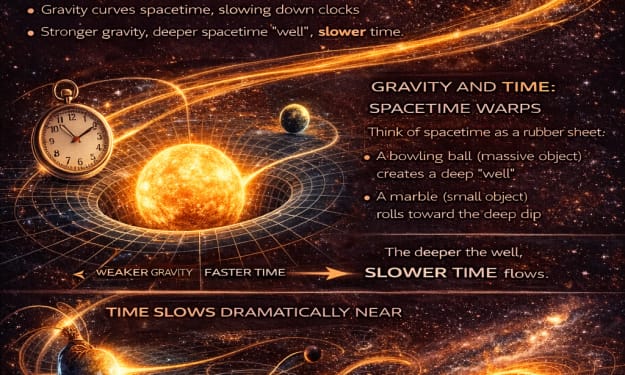
Modern physics, especially Einstein’s theory of relativity, suggests that time is not as simple as we experience it.
Key Discovery
Time is not universal. Different observers experience time differently depending on speed and gravity.
This single fact undermines the idea of a unique, global present.
________________________________________
Relativity and the Death of Absolute “Now”
Einstein showed that:
• There is no universal present moment
• Events that are “now” for one observer may be past or future for another
This means the universe does not share a single moving present.
If the present is not universal, then what defines reality?
________________________________________
The Block Universe Theory
One of the most influential interpretations of modern physics is the block universe model.
What Is the Block Universe?
• Past, present, and future all coexist
• Time is another dimension like space
• The universe is a four-dimensional structure
In this view, the past is just as real as the present.
________________________________________
Space-Time as a Whole
In the block universe:
• You exist as a worldline stretching through time
• Every moment of your life exists permanently
• Change is a feature of perception, not reality
The universe does not “update”—it already exists completely.
________________________________________
Is This Just Philosophy?
No. The block universe arises naturally from relativity.
Einstein himself supported this idea, famously suggesting that:
“The distinction between past, present, and future is only a stubborn illusion.”
This was not poetic—it was scientific.
________________________________________
What About Free Will?
One concern is that if the past and future are real, does that mean everything is predetermined?
Physics does not require strict determinism.
• Quantum mechanics introduces randomness
• Probabilities exist even in a block universe
• Events may still be unpredictable
Reality can be fixed without being predictable.
________________________________________
Quantum Mechanics and the Past
Quantum physics adds another layer of complexity.
Quantum Observations
• Measurements affect outcomes
• Past states seem influenced by future measurements
• Experiments suggest time symmetry at fundamental levels
At the smallest scales, time does not strictly flow forward.
________________________________________
Does the Past Still Exist in Quantum Physics?
Some interpretations suggest:
• Quantum states do not vanish
• Information is conserved
• Past states remain encoded in the universe
Nothing truly disappears—it only transforms.
________________________________________
Entropy and the Arrow of Time
If the past still exists, why do we experience time flowing forward?
The answer lies in entropy.
Entropy Explained
• Entropy measures disorder
• The universe moves toward higher entropy
• This creates the arrow of time
The arrow of time explains experience, not existence.
________________________________________
Memory and Time Direction
We remember the past but not the future because:
• The past has lower entropy
• Records form in one direction only
• Memory depends on irreversible processes
This does not mean the past is unreal—only that it is inaccessible.
________________________________________
Is the Past Stored Somewhere?
The past may not be “stored” in a place, but it may still exist as part of spacetime.
Just as:
• Distant galaxies exist even if we can’t see them
• Past events exist even if we can’t access them
Distance in time is like distance in space.
________________________________________
Light From the Past
When we look at distant stars:
• We see them as they were millions of years ago
• Their past states are still physically observable
This suggests the past is not gone—it’s just far away in time.
________________________________________
Black Holes and Information
Physics strongly suggests:
• Information is never destroyed
• Even black holes preserve information
• The universe keeps a complete record of its history
If information survives, the past must have physical meaning.
________________________________________
Presentism vs Eternalism
There are two major views of time:
Presentism
• Only the present exists
• Past and future are unreal
• Matches human intuition
Eternalism
• Past, present, and future all exist
• Supported by relativity
• Matches modern physics
Physics favors eternalism.
________________________________________
Why We Feel Time Passing
Time feels dynamic because:
• Consciousness processes moments sequentially
• Brains experience change internally
• Awareness moves along a timeline
The feeling of passage may be psychological, not physical.
________________________________________
Is the Past Changeable?
Even if the past exists:
• It cannot be altered
• Causality remains intact
• Time travel paradoxes are forbidden
The past’s existence does not imply malleability.
________________________________________
Does the Past Affect the Present?
Yes—but not by changing.
• The past shapes initial conditions
• Laws of physics propagate forward
• Effects follow causes
The past influences the present without being modified.
________________________________________
What About the Future?
If the past exists, does the future also exist?
According to physics:
• The future may be as real as the past
• But unknown due to probability
• Reality can exist without being knowable
Knowledge and existence are not the same.
________________________________________
Human Perspective vs Cosmic Reality
Humans experience:
• A flowing present
• A remembered past
• An uncertain future
The universe may experience:
• A complete spacetime structure
• No preferred moment
• No flowing time
We live inside the universe—not outside it.
________________________________________
Does Physics Prove the Past Is Real?
Physics strongly suggests:
✔ No universal present
✔ Time is a dimension
✔ Past events remain part of spacetime
While not absolute proof, evidence overwhelmingly supports the past’s physical reality.
________________________________________
Why This Question Matters
Understanding whether the past is real affects:
• Cosmology
• Consciousness studies
• Philosophy of existence
• The nature of reality itself
It reshapes how we understand our place in the universe.
________________________________________
So, Is the Past Still Physically Real?
According to modern physics, yes.
The past is not erased—it is simply not accessible. It exists as part of the spacetime structure, just like distant regions of space exist even when unseen.
Time does not destroy reality—it arranges it.
________________________________________
Conclusion: A Universe That Never Forgets
The universe does not move from moment to moment like flipping pages in a book. Instead, all moments exist together in a vast spacetime structure.
The past is not gone.
The future is not unreal.
The present is not special in physics.
We move through time—but time itself does not move.
And in that timeless universe, every moment that ever happened still exists.
About the Creator
Keep reading
More stories from shahkar jalal and writers in Education and other communities.
7 Online Skills That Can Change Your Financial Future in 2026
7 Online Skills That Can Change Your Financial Future In today’s digital world, one skill can completely transform your life. Just a decade ago, making money online sounded unrealistic to many people. Today, thousands of people are building careers, businesses, and even financial freedom using only their laptops and internet connections. The truth is simple: the internet has created opportunities that never existed before. But the biggest mistake most people make is waiting for the “perfect moment” to start learning. The reality is that learning just one valuable online skill can open doors to income streams you never imagined. Here are seven powerful online skills that can truly change your financial future. 1. Content Writing Content writing is one of the easiest online skills to start with. Every website, blog, and online business needs high-quality content to attract readers and customers. If you can write helpful, interesting, or informative articles, you already have the foundation for this skill. Content writers earn money by writing: Blog posts Website content Product descriptions News articles Platforms like freelance marketplaces, blogging websites, and digital publications are always looking for good writers. With practice, many writers turn this skill into a full-time career. 2. Graphic Design In the online world, visuals matter. Businesses need logos, social media graphics, advertisements, and brand designs to attract attention. Graphic design allows creative people to turn their imagination into income. Even beginners can start by learning simple tools and gradually improving their skills. Graphic designers can work with: Small businesses Online brands Content creators Marketing agencies A single well-designed logo or brand package can sometimes earn more than weeks of traditional work. 3. Video Editing Video is the most powerful form of content on the internet today. From social media platforms to online courses, videos dominate the digital world. But most creators don’t have the time or skill to edit their own videos. This is where video editors come in. If you learn how to cut clips, add music, create smooth transitions, and improve video quality, you can become extremely valuable. Video editors are needed by: YouTubers Businesses Online educators Social media influencers The demand for video editing continues to grow every year. 4. Social Media Management Millions of businesses rely on social media to reach customers. But many business owners don’t know how to grow their pages, create content, or engage with their audience. Social media managers help brands: Plan content Post regularly Respond to followers Grow their audience With the right strategy, social media managers can manage multiple accounts and earn steady monthly income. This skill combines creativity with marketing knowledge, making it highly valuable. 5. Digital Marketing Digital marketing is one of the most powerful online skills you can learn. It involves promoting products, services, or brands through online channels such as search engines, social media, and email. Digital marketers help businesses get: More website visitors More customers More sales Companies are willing to pay well for people who can increase their revenue. Learning digital marketing can open doors to freelance work, remote jobs, or even your own online business. 6. Web Development Every business needs a website. But building a professional website requires technical skills. Web developers create and maintain websites using coding languages and development tools. Although this skill takes more time to learn than others on this list, it is also one of the highest-paying online skills. Many web developers work remotely and build websites for clients all around the world. Once you gain experience, the opportunities become endless. 7. AI Content Creation Artificial intelligence is rapidly changing the online world. Many creators and businesses now use AI tools to produce content faster and more efficiently. AI content creators use technology to generate: Articles Images Videos Marketing content People who understand how to use AI tools effectively have a huge advantage in the modern digital economy. Instead of replacing creativity, AI often amplifies it. Those who learn how to combine creativity with technology will be ahead of the curve. Final Thoughts The internet has made it possible for anyone, anywhere in the world, to build valuable skills and create new income opportunities. But knowledge alone is not enough. The real difference comes from taking action. Pick one skill from this list and start learning today. Practice consistently. Improve a little every day. Over time, that single skill could become the foundation of a completely different financial future. Because sometimes, all it takes is one skill to change everything.
By Baseer Shaheen 6 days ago in Education
I <3 Irasutoya
If you live in Japan, you've seen Irasutoya images everywhere. It's on posters, it's on flyers, it's on internet adverts, it's truly everywhere. You've probably seen it once or twice if you don't live in Japan. It's cute, it's simplistic and it somehow manages to get succinct points across really clearly and concisely.
By Max Brooks7 days ago in Education
📢 Raise Your Voice Thread: 03/05/2026
Our “Raise Your Voice Threads” are hosted most alternating Thursdays at 12PM ET to offer creators more avenues to uncover exceptional stories on Vocal. As we are continuously searching for fresh creators and inspiring stories, this thread provides an opportunity to exchange and discuss the stories that have moved and motivated us on Vocal.
By Raise Your Voice by Vocal7 days ago in Resources


Comments
There are no comments for this story
Be the first to respond and start the conversation.