
Is Spacetime a Fabric or a Field? Understanding the True Nature of Reality
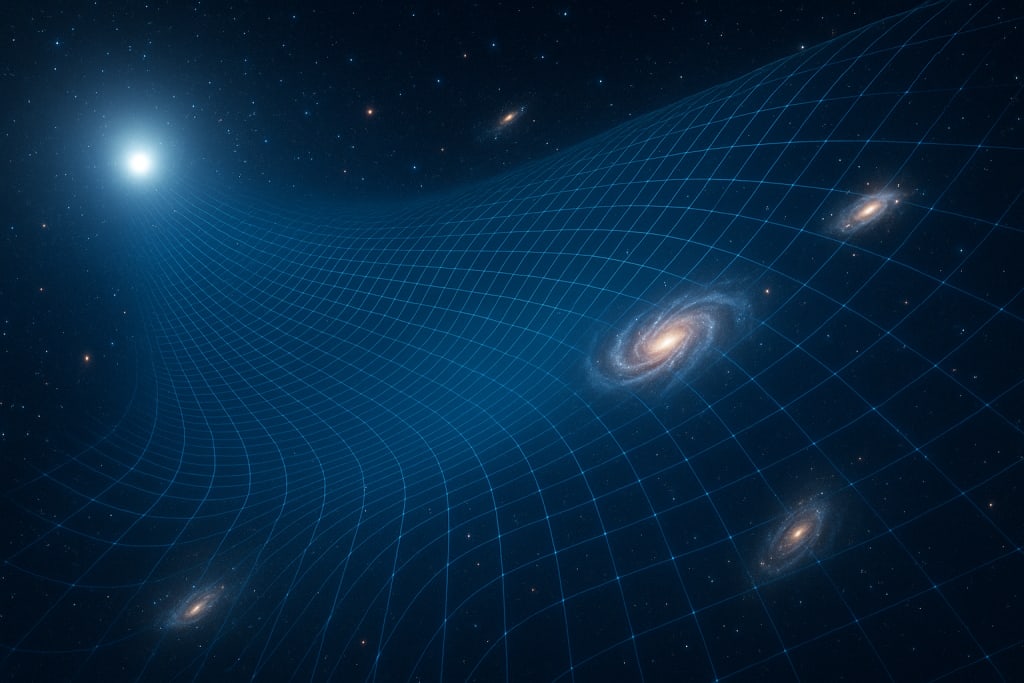
When we picture the universe, we often imagine space as an invisible stage where stars, planets, and galaxies move. Thanks to Einstein, many people now describe spacetime as a "fabric" — something that bends and stretches under the influence of gravity. You may have seen the famous rubber sheet analogy, where a heavy ball placed on a stretched sheet causes it to curve. But is spacetime really a fabric? Or is it something else entirely — perhaps a field, like the electromagnetic field that fills the universe? This question is more than a metaphorical debate. It touches the deepest foundations of physics and our understanding of reality. In this article, we explore what spacetime truly is, how scientists describe it mathematically, and whether it behaves more like a fabric, a field, or something even more fundamental.

What Is Spacetime?
Before deciding whether spacetime is a fabric or a field, we need to understand what spacetime actually means.
In classical physics, space and time were separate. Space was three-dimensional — length, width, and height — and time flowed independently.
In 1905 and 1915, Albert Einstein changed this picture forever.
He showed that space and time are not separate entities but parts of a single four-dimensional structure called spacetime. Events do not simply occur "in space" at "a time." Instead, they occur at coordinates within spacetime.
Most importantly, spacetime is dynamic. It responds to mass and energy.
________________________________________
The Fabric Analogy: Why We Use It
The idea that spacetime is a "fabric" comes from Einstein’s theory of general relativity.
According to general relativity:
• Massive objects like stars and planets curve spacetime.
• Objects moving nearby follow the curved geometry.
• What we perceive as gravity is actually motion along curved spacetime.
To help visualize this, educators use the rubber sheet analogy:
• A stretched sheet represents spacetime.
• A heavy ball placed on it creates a dip.
• Smaller balls roll toward the dip.
This analogy works because it shows curvature influencing motion.
But it has limitations.
A real fabric exists within space. Spacetime does not sit inside something else — it is the structure in which everything exists. The analogy is helpful, but not literal.
________________________________________
What Is a Field in Physics?
To understand the alternative, we need to define a field.
In physics, a field is something that exists at every point in space and time.
Examples include:
• The electromagnetic field
• The Higgs field
• Gravitational fields in classical physics
A field assigns values to every point in space. For example, the electromagnetic field has strength and direction everywhere.
Quantum field theory goes further. It describes particles as excitations in underlying fields.
This raises a natural question:
Is spacetime itself a kind of field?
________________________________________
Spacetime in General Relativity: Geometry, Not Substance
In Einstein’s equations, spacetime is described mathematically by something called the metric tensor.
The metric tells us:
• Distances between points
• How time flows
• How paths curve
Importantly, general relativity does not treat spacetime as a material substance. It treats it as geometry.
Matter tells spacetime how to curve. Spacetime tells matter how to move.
This famous summary captures the relationship.
So in Einstein’s theory, spacetime is neither a fabric in a literal sense nor a field in the same way as electromagnetism. It is the geometry of the universe itself.
________________________________________
Can Spacetime Be Considered a Field?
Despite Einstein’s geometric description, many physicists reformulate gravity as a field theory.
In this view:
• The gravitational interaction is described by a gravitational field.
• This field corresponds to distortions in spacetime geometry.
When physicists attempt to quantize gravity, they treat the metric as a dynamic field — similar to other quantum fields.
In quantum gravity research, spacetime begins to look more like a field than a smooth fabric.
________________________________________
Quantum Field Theory and the Vacuum
Modern physics describes reality in terms of quantum fields.
According to quantum field theory:
• The universe is filled with interacting fields.
• Particles are vibrations in these fields.
• Even empty space contains fluctuating energy.
If everything is fields, then what about spacetime itself?
Some theories suggest spacetime may emerge from more fundamental quantum entities. In this case, spacetime would not be a fabric or a field in the traditional sense — it would be an emergent phenomenon.
________________________________________
Loop Quantum Gravity: Spacetime as Discrete Structure
One approach to quantum gravity, called loop quantum gravity, suggests spacetime is made of discrete units.
In this theory:
• Space is composed of tiny loops.
• These loops form networks called spin networks.
• Areas and volumes are quantized.
This suggests spacetime is neither a continuous fabric nor a classical field, but a granular structure at the smallest scale.
At everyday scales, it appears smooth. At the Planck scale, it may be discrete.
________________________________________
String Theory: Spacetime as Emergent
String theory takes yet another perspective.
It proposes that fundamental particles are tiny vibrating strings existing in higher-dimensional space.
In some formulations of string theory, spacetime geometry emerges from the interactions of these strings.
This means spacetime may not be fundamental at all. It could arise from deeper physical processes — much like temperature emerges from molecular motion.
If true, the fabric analogy becomes even more abstract.
________________________________________
Gravitational Waves: Ripples in What?
The discovery of gravitational waves in 2015 provided dramatic evidence that spacetime is dynamic.
Gravitational waves are ripples in spacetime caused by accelerating massive objects, such as merging black holes.
These ripples travel across the universe at the speed of light.
Does this mean spacetime behaves like a fabric?
In some sense, yes — it stretches and compresses.
But mathematically, these waves are oscillations in the gravitational field — reinforcing the idea that spacetime has field-like properties.
________________________________________
Philosophical Implications
The debate over whether spacetime is a fabric or a field touches philosophical questions about reality.
Is spacetime a substance? Is it relational — defined only by the relationships between objects? Is it emergent from information?
Some modern theories suggest spacetime may arise from quantum entanglement patterns.
If true, spacetime may be more like a network of information than a material fabric.
________________________________________
The Current Scientific View
Today, most physicists would say:
• Spacetime is best described mathematically as geometry.
• In quantum contexts, it behaves like a dynamic field.
• At the deepest level, it may be emergent.
The "fabric" analogy is useful for visualization but should not be taken literally.
Spacetime is not made of threads.
It is a mathematical structure that encodes how distances and times behave — and possibly something even deeper.
________________________________________
So, Is Spacetime a Fabric or a Field?
The most accurate answer is this:
Spacetime is neither a physical fabric nor a traditional field — but it shares properties with both.
It curves like a flexible medium. It propagates waves like a field. It may be quantized at tiny scales. It may even emerge from more fundamental quantum processes.
Our metaphors help us understand it, but they do not define it.
________________________________________
Conclusion: Beyond Metaphors
The idea of spacetime as a fabric has helped generations grasp Einstein’s revolutionary insight. It provides an intuitive picture of gravity as curvature rather than force.
Yet modern physics suggests reality may be far stranger.
Spacetime may behave like a field. It may be quantized. It may emerge from deeper structures we have not yet fully discovered.
Whether fabric, field, or something entirely new, spacetime remains one of the most profound mysteries in science.
As research into quantum gravity continues, future discoveries may reveal whether spacetime is fundamental — or merely the visible surface of a deeper layer of reality.
Until then, the question remains open — and wonderfully intriguing.
About the Creator
Keep reading
More stories from shahkar jalal and writers in Education and other communities.
Sulfonic Acid: Uses, Structure & Synthesis
Sulfonic Acid: Uses, Structure & Synthesis Sulfonic acid is one of the most important classes of organic acids in industrial and applied chemistry. From detergents and dyes to pharmaceuticals and catalysts, sulfonic acid derivatives play a critical role in modern chemical manufacturing. This article explains what sulfonic acid is, its chemical structure, methods of synthesis, and its real-world applications, using only validated and authoritative sources.
By Shraddha Mahajan3 days ago in Education
Unlocking Start up Growth: How to Build a Brand that Leads the Market
Every start up begins with a vision, but turning that vision into a market-leading brand requires strategic planning and focused execution. As start ups grow, their brands must evolve to create a lasting connection with their audience, build trust, and position them as industry leaders. Building a brand that stands out in a crowded market takes more than just offering a great product; it’s about crafting a narrative that resonates with customers and sets the company apart from competitors.
By Nathalie Kyriakoua day ago in Education
Super Bowl LX Recap: A Team Called Hawks
Sixty. The Super Bowl turned 60! Still amazes me that this was the sixtieth Super Bowl played in NFL history. It seems like yesterday that I watched Super Bowl XXVII, the first SB I ever watched. The QB who won Super Bowl XXVII has since called a few SBs, and will call next year's game, but that's another story. Super Bowl LX took place at Levi's Stadium in Santa Clara, California, the home stadium of the San Francisco 49ers. However, it was one of their division foes who represented the NFC, as the Seattle Seahawks faced off against the New England Patriots.
By Clyde E. Dawkinsa day ago in Unbalanced




Comments
There are no comments for this story
Be the first to respond and start the conversation.