
Could Space Itself Be Quantized? Exploring the Possibility of a Discrete Universe
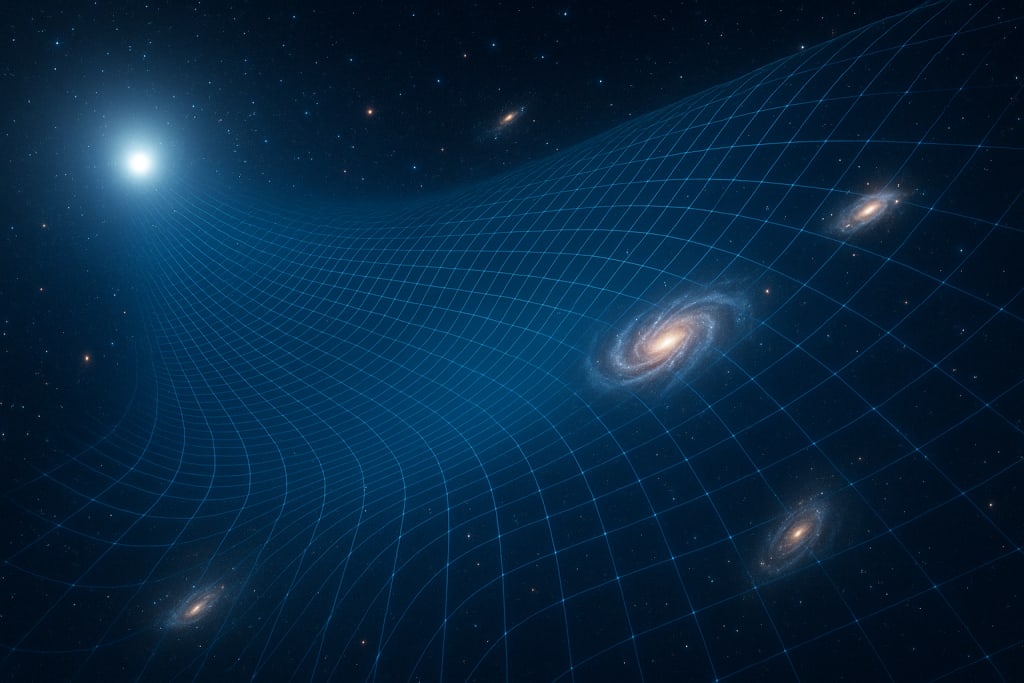
For centuries, scientists believed space was smooth and continuous — an infinite stage upon which matter and energy move. Isaac Newton viewed space as absolute and unchanging. Albert Einstein later revolutionized that idea, describing space and time as a flexible fabric called spacetime, capable of bending and warping under gravity. But modern physics raises an even more radical possibility: What if space itself is not continuous at all? What if it comes in tiny, indivisible units? This concept, known as the quantization of space, suggests that at the smallest scale imaginable, reality may not be smooth — it may be granular. Just as matter is made of atoms and light is made of photons, space itself might be built from fundamental "chunks" far smaller than anything we can directly observe. In this in-depth guide, we explore what it means for space to be quantized, why physicists take the idea seriously, which major theories predict it, and whether science may one day confirm that the universe has a smallest possible scale.

What Does It Mean for Space to Be Quantized?
In physics, quantization means something exists in discrete units rather than as a continuous flow.
For example:
• Energy is quantized into packets called quanta.
• Light is quantized into photons.
• Electric charge exists in fixed units.
• Atomic energy levels come in specific steps.
If space is quantized, it would mean there is a smallest possible unit of length — a fundamental limit beyond which division is impossible.
Instead of being infinitely divisible, space would resemble a digital image made of pixels. From far away, a screen appears smooth. Zoom in closely enough, and you see individual dots.
The question is: does the universe also have a “pixel size”?
________________________________________
The Planck Length: The Smallest Meaningful Distance?
Discussions about quantized space almost always involve the Planck length, approximately:
1.6 × 10⁻³⁵ meters
This number is not random. It emerges from combining three fundamental constants of nature:
• The speed of light (c)
• Planck’s constant (ħ)
• The gravitational constant (G)
When these constants are mathematically combined, they produce natural units of length, time, and mass. At distances near the Planck length, both quantum mechanics and gravity become equally important.
At this scale, our current physical theories break down. General relativity predicts singularities. Quantum field theory produces infinities. This breakdown suggests something fundamental changes at extremely small distances.
Many physicists suspect that the Planck length may represent the smallest meaningful unit of space.
________________________________________
The Conflict Between Quantum Mechanics and General Relativity
The idea that space could be quantized arises from one of the deepest unsolved problems in science: unifying quantum mechanics with general relativity.
Quantum Mechanics
Quantum mechanics governs the microscopic world. It describes particles as probability waves and treats energy as quantized. It has been experimentally confirmed with extraordinary precision.
General Relativity
Einstein’s general relativity describes gravity as the curvature of smooth spacetime caused by mass and energy. It explains black holes, gravitational waves, and the expansion of the universe.
The Problem
When physicists attempt to combine these frameworks — such as inside black holes or at the Big Bang — the mathematics collapses into infinities.
One possible resolution is dramatic: spacetime itself may need to be quantized.
________________________________________
Loop Quantum Gravity: A Granular Spacetime
One major theory proposing quantized space is Loop Quantum Gravity (LQG).
Unlike string theory, which focuses on fundamental strings, loop quantum gravity focuses directly on spacetime.
According to LQG:
• Space is composed of tiny loops.
• These loops form networks called spin networks.
• Areas and volumes exist in discrete units.
In this framework, spacetime is not smooth but woven from fundamental threads.
Imagine a fabric. From a distance, it appears continuous. Under a microscope, it is made of interlocking fibers. Loop quantum gravity suggests spacetime behaves similarly at the Planck scale.
________________________________________
What Would Quantized Space Actually Look Like?
It is important to clarify something: quantized space would not look like tiny cubes floating in emptiness.
There would be no "background" space containing these pieces — the pieces themselves would be space.
At human scales, this discreteness would be completely invisible. The Planck length is so unimaginably small that billions of billions of these units would fit inside a single proton.
Only at extreme energies — near black holes or during the early universe — might this granular structure become noticeable.
________________________________________
Black Holes and the End of Singularities
General relativity predicts that black holes contain singularities — points of infinite density where physics breaks down.
If space is quantized, true singularities may not exist.
Instead of collapsing into an infinitely small point, matter could reach a minimum possible volume defined by quantum spacetime structure.
Some loop quantum gravity models even suggest that black holes may transition into other states, potentially resolving long-standing paradoxes about information loss.
Quantized spacetime could eliminate infinities and restore mathematical consistency.
________________________________________
The Big Bang and Quantum Bounce Theories
The same issue arises when we look at the beginning of the universe.
The classical Big Bang model predicts a singularity — an infinitely dense starting point.
However, if spacetime is discrete, the universe may not have begun from an actual singularity. Instead, some models propose a "quantum bounce" — where a prior collapsing universe reached a minimum size and then expanded again.
While speculative, these models show how quantized space could reshape our understanding of cosmic origins.
________________________________________
String Theory and Minimum Length
String theory approaches the problem differently.
Rather than directly quantizing space, it replaces point particles with vibrating strings. Because strings have finite size, they cannot probe distances smaller than their own length.
This naturally introduces a minimum measurable scale.
In this way, string theory also implies that spacetime may not be infinitely divisible, even if it does not explicitly describe space as granular.
________________________________________
Spacetime Foam: A Turbulent Microstructure
Some physicists propose that at extremely small scales, spacetime resembles a turbulent "foam." This idea, sometimes called quantum foam, suggests that spacetime fluctuates violently at the Planck scale.
Tiny wormholes may briefly appear and disappear. Geometry itself may fluctuate.
This does not necessarily mean space is made of solid blocks — but it suggests that smoothness breaks down at the smallest levels.
________________________________________
Can We Test If Space Is Quantized?
Testing Planck-scale physics is incredibly difficult.
To directly probe such small distances would require energies trillions of times higher than current particle accelerators can achieve.
However, scientists are searching for indirect evidence through:
• High-precision measurements of gamma-ray bursts
• Gravitational wave observations
• Subtle distortions in the cosmic microwave background
• Possible tiny violations of Lorentz symmetry
So far, no definitive evidence has confirmed quantized space.
But the search continues.
________________________________________
Why This Question Matters
Understanding whether space is quantized is not a purely academic exercise.
It could:
• Resolve the incompatibility between quantum mechanics and gravity
• Eliminate singularities in black holes
• Explain the true origin of the universe
• Reveal a deeper structure of reality
• Transform fundamental physics
Few scientific questions are more foundational.
________________________________________
Philosophical Implications: A Digital Universe?
If space is quantized, reality at its deepest level may be digital rather than analog.
This possibility connects physics with information theory. Some researchers even speculate that spacetime could emerge from quantum information.
It raises profound questions:
• Is the universe fundamentally computational?
• Are space and time emergent properties?
• Does reality have a smallest “pixel”?
While such ideas remain speculative, they demonstrate how quantized space reshapes not only physics but philosophy.
________________________________________
Current Scientific Consensus
At present:
• There is no direct experimental proof that space is quantized.
• Several leading theories strongly suggest it may be.
• A complete theory of quantum gravity is still under development.
Most physicists agree that understanding the nature of spacetime at the Planck scale is essential for the future of fundamental science.
________________________________________
Conclusion: Is the Universe Pixelated?
Could space itself be quantized?
Modern theoretical physics suggests the possibility is real and perhaps even likely. Whether through loop quantum gravity, string theory, or a future theory not yet discovered, many researchers believe spacetime may have a smallest scale.
If confirmed, it would mean that the smooth universe we experience is an emergent illusion — arising from unimaginably tiny building blocks woven into the fabric of reality.
Just as atoms revolutionized chemistry and photons revolutionized our understanding of light, quantized space would revolutionize our understanding of existence itself.
For now, the answer remains unknown.
But if space truly has a smallest unit, then the universe is even more astonishing than we ever imagined — a cosmic tapestry stitched together at scales far beyond human perception.
About the Creator
Keep reading
More stories from shahkar jalal and writers in Education and other communities.
Built to Last: How Smart Leaders Design Businesses for Long-Term Sustainability
This understanding also encourages leaders to examine the relationship between profitability, responsibility, and long-term value creation. As they study emerging trends, they identify risks linked to resource depletion, regulatory changes, and shifting societal priorities. This recognition prompts them to act early and make decisions that balance economic performance with sustainable impact. As leaders adapt their vision to reflect these realities, they position their companies for steady growth in an unpredictable world.
By Alexander Schifter7 days ago in Education
Healing Through the Headset: How Virtual Reality Supports Mental Health
Virtual reality and mental health seem like an unusual pairing at first. One brings images of video games and digital adventures, while the other involves deep emotions and healing. But together, they create new ways to feel better and live well. Virtual reality, often called VR, is more than just entertainment. It offers people the chance to step into safe, calm places where healing can begin.
By Alex Kipman6 days ago in Education
When True Love Never Questions Your Soul
“And she’s going to learn that this life will hit you, hard, in the face, wait for you to get back up, just so it can kick you in the stomach but getting the wind knocked out of you is the only way to remind your lungs how much they like the taste of air.” — Sarah Kay’s Poem — If I Should Have a Daughter
By Chantal Christie Weiss2 days ago in Humans


Comments
There are no comments for this story
Be the first to respond and start the conversation.