
Ira vs a Standard Brokerage Account, 2025 Comparison for Stock Investors
Which of the two is better?
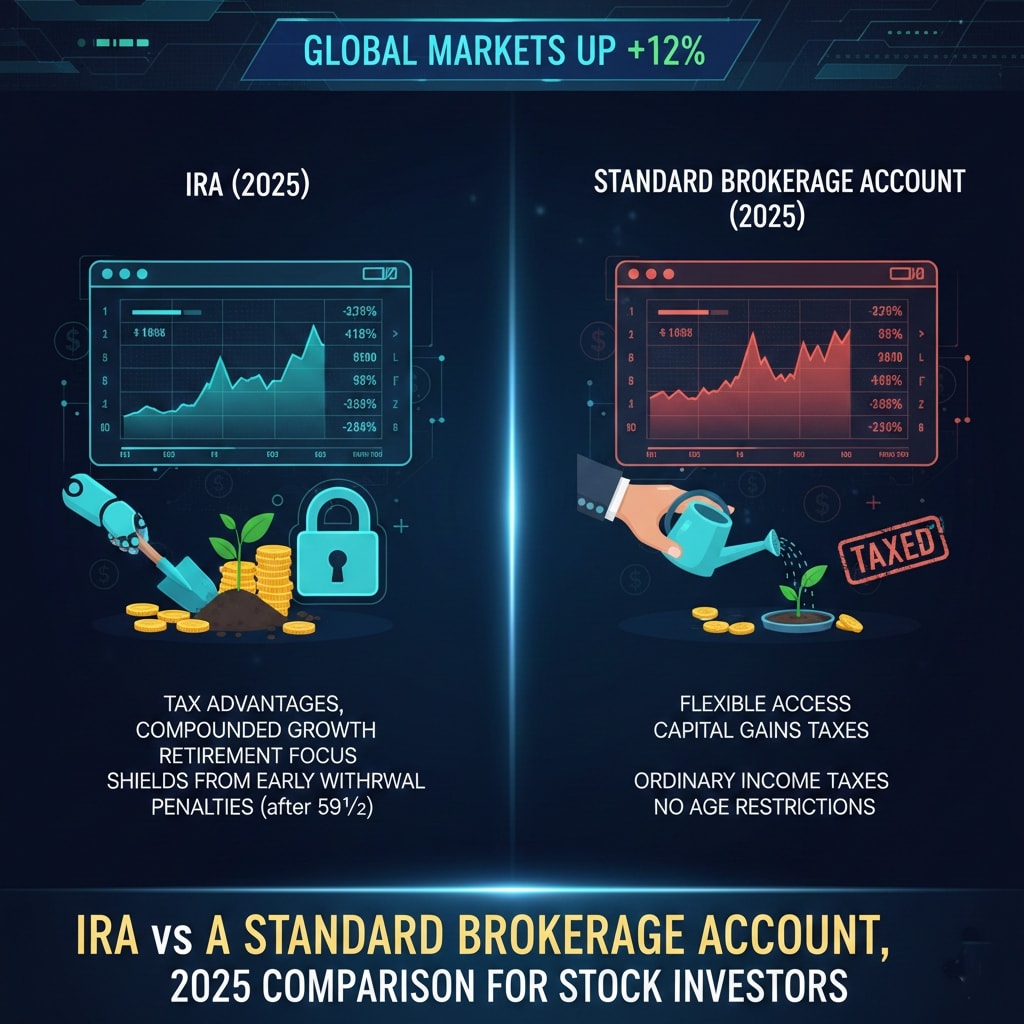
Building long-term wealth starts with more than just picking the right stocks. It begins with choosing the right type of investment account. For most investors, the choice often comes down to two options: an Individual Retirement Account (IRA) or a standard taxable brokerage account. Both let you invest in the same assets like stocks, exchange-traded funds (ETFs), and mutual funds, but the difference lies in how they are taxed, how much you can contribute, and when you can withdraw your money. As we move through to 2026, understanding these differences can help you create a more effective and tax-smart investing strategy.
How Taxes Shape Your Investment Growth
The biggest difference between an IRA and a brokerage account comes down to taxes. Taxes can quietly chip away at your returns over time, so how and when you pay them matters. Think of an IRA as a government-approved shelter for your investments—it allows your money to grow with fewer tax interruptions. A brokerage account, on the other hand, offers complete flexibility but comes with immediate tax consequences each time you earn dividends or sell investments for a profit.
What Exactly Is an Individual Retirement Account (IRA)?
An IRA is designed to help you save for retirement by offering tax benefits that can supercharge your long-term growth. Imagine a protective wrapper around your investments—inside that wrapper, your money grows without the drag of annual taxes. There are two main types of IRAs, each with distinct advantages depending on your income and goals.
Traditional IRA: Save Now, Pay Taxes Later
A Traditional IRA lets you make contributions that may be tax-deductible in the year you invest. That means you can reduce your taxable income today, keeping more of your paycheck in your pocket. For 2025, single filers with a Modified Adjusted Gross Income (MAGI) between $79,000 and $89,000 will see their deduction start to phase out if they also have a workplace retirement plan.
Your investments then grow tax-deferred, meaning you will not owe taxes until you start taking money out in retirement. At that point, withdrawals are taxed as ordinary income. Many investors use this approach when they expect to be in a lower tax bracket after they retire.
Roth IRA: Pay Taxes Now, Reap Tax-Free Growth Later
A Roth IRA flips the equation. You contribute after-tax dollars—money you have already paid taxes on—but the payoff is huge. All your investment growth and withdrawals in retirement are completely tax-free, as long as you meet the requirements. You can withdraw your contributions anytime without penalty, although the earnings portion must stay in the account until age 5921 and at least five years have passed.
The ability to contribute directly to a Roth IRA starts to phase out for single filers earning between $150,000 and $165,000 in 2025. Despite these limits, many investors view Roth IRAs as one of the most powerful tools for long-term, tax-free retirement growth.
What Is a Standard Taxable Brokerage Account?
A brokerage account offers simplicity and total control. You can buy and sell stocks, ETFs, and funds whenever you like, with no limits on how much you invest. The tradeoff is that you pay taxes as you earn profits or dividends, which can reduce your compounding over time—a concept often called “tax drag.”
Here is how it works:
Capital Gains: If you sell a stock for more than you paid, the profit is taxable. Gains on assets held one year or less are taxed at your ordinary income rate—up to 37% in 2025. Assets held longer than a year are taxed at lower long-term capital gains rates of 0%, 15%, or 20%, depending on your income. Most middle-income investors pay 15%.
Dividends: Companies often pay dividends to shareholders, which are taxed in the year you receive them—even if you reinvest them. Qualified dividends benefit from the lower long-term capital gains tax rate.
A brokerage account’s biggest advantage is flexibility. You can access your money whenever you want, making it ideal for both short-term and mid-term goals.
2025 Contribution Limits: IRA vs. Brokerage Account
The IRS sets strict annual contribution limits for IRAs. In 2025, you can contribute up to $7,000, or $8,000 if you are age 50 or older thanks to the $1,000 “catch-up” provision. Contributions can be made until the tax filing deadline—April 15, 2026, for the 2025 tax year.
A brokerage account has no contribution limits. You can invest any amount at any time, making it a practical choice for investors who want to continue building wealth after maximizing their IRA contributions.
Accessing Your Money: Rules and Flexibility
This is where the difference between the two accounts becomes clear. IRAs are built for retirement, so they come with restrictions on early withdrawals. Brokerage accounts are designed for flexibility, allowing you to access your funds whenever you need them.
Traditional IRA: Withdrawals before age 5921 generally trigger a 10% penalty plus income tax. However, there are exceptions for first-time home purchases (up to $10,000), higher education expenses, and certain medical bills.
Roth IRA: You can always withdraw your original contributions tax- and penalty-free. Taxes and penalties only apply to early withdrawals of investment earnings.
Brokerage Account: You can sell your investments anytime and withdraw the proceeds without penalties, though you will owe capital gains taxes on profits.
Required Minimum Distributions (RMDs): What to Know in Retirement
Once you reach a certain age, the government expects you to begin withdrawing from some retirement accounts. This ensures taxes that were deferred over the years are finally collected.
Traditional IRA: Starting at age 73, you must begin taking Required Minimum Distributions. The amount is based on your account balance and life expectancy, and skipping it can result in heavy penalties.
Roth IRA: No RMDs apply during your lifetime, allowing your investments to keep growing tax-free. This makes Roth IRAs particularly valuable for estate planning.
Brokerage Account: No RMDs at all—you can hold or sell assets entirely on your terms.
Comparing Your Investment Choices in 2025
The final choice between an IRA and a standard brokerage account ultimately comes down to a clear understanding of five key features: tax treatment, contribution limits, withdrawal rules, flexibility, and Required Minimum Distributions (RMDs).
First, the most defining feature is Tax Treatment. An IRA (whether Traditional or Roth) is designed to let your investments grow either tax-deferred (Traditional) or completely tax-free (Roth). A brokerage account, however, is fully taxable, meaning profits and dividends are taxed annually as they occur.
Second, the Contribution Limits are rigid for IRAs. In 2025, you are capped at $7,000, or $8,000 if you are age 50 or older. A brokerage account, by contrast, has no contribution limits, allowing you to invest any amount at any time.
Third, Withdrawals have very different rules. An IRA is specifically geared toward long-term retirement savings and applies penalties for early withdrawals before age 5921 (though exceptions exist). A brokerage account offers complete freedom; you can withdraw your funds anytime without penalty, though you will still owe capital gains taxes on any profits. This leads to the fourth point, Flexibility—IRAs are suited only for long-term retirement goals, while brokerage accounts are suitable for any goal, short or long term.
Finally, the rule for Required Minimum Distributions (RMDs) also splits the accounts. A Traditional IRA mandates RMDs starting at age 73, forcing you to begin withdrawing money. A Roth IRA, and the standard Brokerage Account, have no RMDs during the original owner's lifetime.
The differences highlight why the smartest strategy for 2025 is often not choosing one over the other—it is combining both.
Disclaimer: This article is for informational purposes only and is not intended as financial or tax advice. The contribution limits and income thresholds are for tax year 2025 and are subject to change. Please consult with a qualified financial professional or tax advisor before making any investment decisions.
About the Creator
Michael Joseph
Michael Joseph is an entertainment, political, financial news reporter. He holds a Bachelor of Economics degree from the London School of Economics and Political Science.
Keep reading
More stories from Michael Joseph and writers in Education and other communities.
Choosing the Best Ira, A Guide to Traditional vs Roth Ira (December 2025)
Planning for retirement is not just about saving money, it is about making strategic choices that shape your financial future. At the center of this decision lies one of the most influential tools for American investors: the Individual Retirement Arrangement, or IRA. Created in 1974 through the Employee Retirement Income Security Act (ERISA), the IRA gave people a way to save for retirement independently of traditional pension plans while enjoying tax advantages. Over the years, the concept has evolved into a range of account types, each offering unique benefits and strategies. The question is not which IRA is universally best, but rather which one best fits your personal financial goals, income, and outlook.
By Michael Josephabout a month ago in Education
Was Alexander the great really that great?
Order, order! Who do we have on the stand today? Alexander... the Great, eh? Well, what’s so great about him? Your honor, the better question is, what's not great about him? He was the King of Macedon and considered a living demigod by Egyptians and Greeks alike. He conquered Persia when it was one of Earth's largest empires. And he was a thoughtful student of Aristotle, creative enough to untie the impossibly tight Gordian knot by cutting it in half. The Gordian knot is a myth— just like the countless other stories invented to enhance Alexander’s legend!
By Munesh Yadavabout 2 hours ago in Education
The 1793 Chain Cent: America's First Large-Scale Copper Coin
Holding a 1793 Chain Cent is like holding the first argument of a new nation. More than just America’s first mass-produced penny, this coin is a piece of history that sparked public debate, fueled by a design many found utterly wrong. Its story—from a chaotic mint to a collector's dream—explains why it remains one of the most coveted pieces in all of American numismatics. This guide will walk you through its turbulent birth, teach you to spot the tiny detail that can mean a fortune, and explain what truly makes it valuable.
By Laura Bennett7 days ago in Education


Comments
There are no comments for this story
Be the first to respond and start the conversation.