
Intel Arc: A New Era in Graphics Processing
Will Intel make it into the GPU Industry?
In 2022, Intel entered the discrete graphics card market with the launch of its Arc series GPUs, marking a significant entry into the dedicated graphics hardware sector. Intel’s strategic intent is to disrupt the duopoly held by Nvidia and AMD, offering consumers and gamers a compelling alternative.This article will explore Intel’s Arc graphics cards, their features, and their potential impact on the GPU landscape.
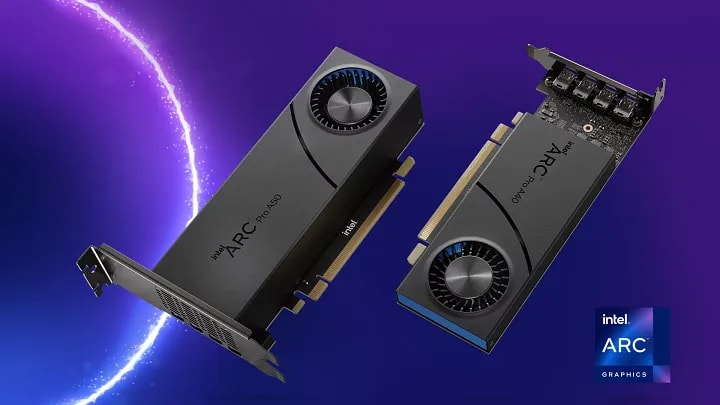
At the core of Intel Arc GPUs is the Xe HPG (High Performance Gaming) architecture. Xe HPG is a scalable graphics architecture designed to deliver strong performance across a range of gaming and content creation workloads. Key features of Xe HPG include:
High-performance vector engines for efficient graphics and computation- Advanced media encoders and decoders for accelerated video processing- Hardware-based ray tracing for realistic lighting and shadows- AI-accelerated super sampling for enhanced performance and image quality.
The Arc Lineup
Initially, Intel has launched three tiers of Arc graphics cards catering to different market segments:
Arc 3 Series: Entry-level GPUs aimed at mainstream gamers and content creators, competing with Nvidia’s GeForce GTX 16-series and AMD’s Radeon RX 6400.
Arc 5 Series: These are mid-range offerings designed for 1080p and 1440p gaming, and are comparable to Nvidia’s GeForce RTX 3060 and AMD’s Radeon RX 6600 XT.
Arc 7 Series: These high-end cards are designed with enthusiast gamers and professionals in mind, competing with Nvidia’s GeForce RTX 3070 and AMD’s Radeon RX 6700 XT.
Intel has committed to a consistent release schedule for Arc GPUs, with plans to expand the product line and target additional market segments in the future.
Software and Ecosystem
In conjunction with the Arc hardware, Intel has developed a comprehensive software stack to support its GPUs. The Intel Graphics Command Center functions as a centralised hub for driver updates, game optimisations, and control over GPU settings.
Furthermore, Intel has collaborated closely with game developers to ensure optimal performance and compatibility across a broad spectrum of titles at the time of launch.
To further strengthen the Arc ecosystem, Intel has introduced several software technologies, including:
Deep Link: Facilitates optimised cooperation between Arc GPUs and Intel CPUs for enhanced performance in gaming and content creation.
XeSS (XeSS: Intel’s AI-powered super sampling technology, similar to Nvidia’s DLSS, that uses machine learning to upscale games from lower resolutions for increased performance).
Arc Control (Arc Control: a comprehensive overclocking and monitoring utility that allows users to push their Arc GPUs to the limit).
The substantial investments made by Intel in software and developer relations demonstrate the company’s long-term commitment to becoming a major player in the graphics industry.
The introduction of Intel Arc GPUs signifies an exciting new chapter in the realm of discrete graphics, with Intel positioned to compete with established rivals Nvidia and AMD due to its scalable architecture, extensive product stack, and broad software support. As Intel continues to innovate and expand its presence in the GPU market, consumers stand to benefit from increased choice, competition, and performance. The future outlook for Intel Arc appears to be promising, and its influence on the graphics landscape will be closely monitored in the forthcoming years.
Intel's entry into the discrete GPU market with Arc represents more than just a new product line – it marks a significant shift in the competitive landscape of computer graphics. By leveraging its extensive semiconductor expertise and combining it with innovative features like XeSS and Deep Link, Intel has demonstrated its capability to challenge the established duopoly. While early drivers and compatibility issues presented initial hurdles, Intel's consistent software updates and growing developer partnerships show a clear commitment to long-term success in this space. As the company continues to refine its offerings and expand its presence across different market segments, the increased competition is likely to accelerate innovation and potentially lead to more competitive pricing in the GPU market. This benefits not only gamers and content creators but the entire computing industry as it moves toward an increasingly graphics-intensive future.
About the Creator
Ega Mahendra Hafid
A Freelance writer that want to share about Games , Automotives and Technology
Keep reading
More stories from Ega Mahendra Hafid and writers in Education and other communities.
Reasons Why Warhammer 40,000 should be considered a great work of science fiction
The original Warhammer, called Warhammer Fantasy Battle, came out in 1983 and was all about fantasy miniatures featuring classic characters like orcs, goblins, dwarves, and elves — think J.R.R. Tolkien vibes. A few years later, they introduced Warhammer 40k, which took a lot of those fantasy races and gave them a futuristic twist.
By Ega Mahendra Hafidabout a year ago in Gamers
Understanding PMP Certification in Pakistan: A Guide for Project Professionals
As industries in Pakistan continue to expand and modernize, the need for skilled project managers is becoming increasingly clear. From IT and telecom to construction, healthcare, and finance, organizations rely on structured project leadership to deliver results on time and within budget. One credential that frequently enters this conversation is the PMP certification in Pakistan, a globally recognized qualification for experienced project managers.
By James Mburu3 days ago in Education
Off the Book
It ended like every other stupid idea: badly, and by himself. He stated, “I’m researching digital confession ethics.” A tech ethics expert. He pointed at floating data I couldn’t see, then pulled out a physical notebook. Real paper. A fountain pen. He held it up like scripture.
By Silent Truth 2 days ago in Education


Comments
There are no comments for this story
Be the first to respond and start the conversation.