
Inside The Black Hole
What is the truth behind the Black Hole?

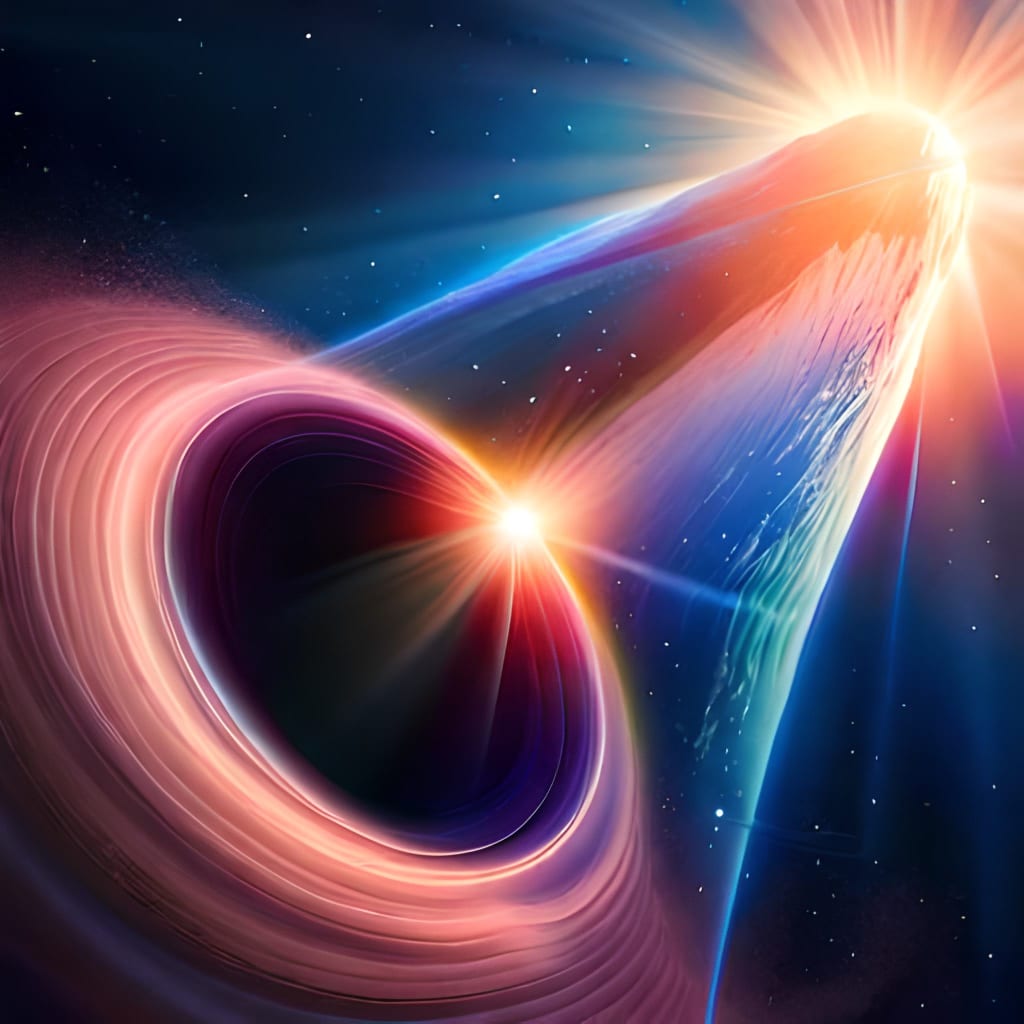
The black hole is one of the most intriguing and mysterious phenomena in the universe. It is a region of space where the gravitational pull is so strong that not even light can escape. This makes it impossible for us to see inside a black hole, leaving us with many questions about what happens inside.
For centuries, scientists and astronomers have been studying black holes and trying to understand their nature. They have come up with several theories about what happens inside a black hole, but it wasn't until the discovery of the Event Horizon Telescope that we were able to get a glimpse of what happens inside.
The Event Horizon Telescope (EHT) is a network of telescopes around the world that work together to capture images of black holes. In 2019, the EHT captured an image of the black hole at the center of the Messier 87 galaxy, which is located 55 million light-years from Earth. The image showed a bright ring of light surrounding a dark center, which is believed to be the event horizon, the point of no return beyond which nothing can escape the black hole's gravitational pull.
But what happens inside the event horizon? According to current theories, matter falling into a black hole is compressed and heated to extreme temperatures, creating a hot and dense region called the accretion disk. The gravitational pull of the black hole causes the accretion disk to spiral inward, eventually merging with the black hole's singularity, a point of infinite density at the center of the black hole.
The singularity is where the laws of physics break down, and our current understanding of the universe becomes irrelevant. At the singularity, the matter is compressed to a point of infinite density, and the laws of space and time no longer apply. This makes it impossible for us to understand what happens inside a black hole, and it remains one of the greatest mysteries in astrophysics.
However, the discovery of the black hole image has provided us with new insights into the nature of black holes and their effects on surrounding matter. As matter falls into the black hole, it releases a tremendous amount of energy in the form of radiation, including X-rays and gamma rays. This radiation can be detected by telescopes, allowing scientists to study the properties of black holes and their effects on the surrounding environment.
The study of black holes has also led to new discoveries in the field of astronomy. Black holes have been found to play a crucial role in the formation and evolution of galaxies, and they may hold the key to understanding the fundamental nature of the universe itself. Some theories suggest that black holes may even lead to the formation of new universes, creating a multiverse of parallel universes.
Despite the new discoveries and insights into the nature of black holes, there is still much we do not know about these mysterious phenomena. Some theories suggest that black holes may be linked to the phenomenon of dark matter, which is thought to make up 85% of the matter in the universe. If this is true, then the study of black holes may hold the key to unlocking the secrets of the universe and understanding the nature of dark matter.
In conclusion, the discovery of the black hole image has opened up new avenues of research and provided us with new insights into the nature of black holes and their effects on the universe. The study of black holes remains one of the greatest mysteries in astrophysics, and scientists continue to search for answers to the many questions they raise. Who knows what other secrets and discoveries the universe may hold for us to uncover in the future?
About the Creator
Ahmad Raza
I am a professional content writer with a passion for creating engaging and informative content. With three years of experience in the field, I have honed my skills and knowledge to deliver high-quality content that exceeds expectations
Keep reading
More stories from writers in Education and other communities.
Punjab Orders Action Against Private Schools Pressurizing Parents to Buy From Selected Shops
In a bold move to protect parents and uphold fair practices in education, the Punjab government has ordered strict action against private schools that allegedly pressure parents to purchase supplies, uniforms, or books from selected vendors. The directive comes after multiple complaints surfaced regarding unfair practices that forced families to spend extra money or adhere to specific buying instructions, often leaving them with little choice.
By Muhammad Hassan7 days ago in Education
Is There a Fifth Fundamental Force?
The Four Known Fundamental Forces Modern physics describes nature using four fundamental forces: 1. Gravity Gravity is the weakest but most familiar force. It governs the motion of planets, stars, and galaxies, shaping the large-scale structure of the universe. Despite its importance, gravity remains the least understood at the quantum level.
By shahkar jalalabout 5 hours ago in Education



Comments
There are no comments for this story
Be the first to respond and start the conversation.