
Infrared mode of Absorption and its Stretching Vibrations
"High Molecular vibrations that are Quantized"


1.1-The infrared mode of absorption
When molecules absorb radiations with specific energy they get excited and move from lower to higher energy state. Similarly, molecules absorb infrared radiations that are quantized. Radiations of selected frequencies of infrared radiations are absorbed by the molecules. This absorption leads to energy change on the order of 9 to 40KJ/mole. Electromagnetic radiations of that energy range correspond to the stretching and bending vibrational frequencies of different organic and inorganic molecules. In the infrared mode of absorption, frequencies of infrared radiations that are correctly matched with the natural vibrational frequencies of the covalent compounds are simply absorbed. This absorbed frequency lead to increase the vibrational amplitude of the moving bonds in the organic molecule. Only those compounds have a dipole moment that may change as a function of time has the ability to absorb infrared radiations.
Compounds like H2, Cl2 contains symmetric bonds are not capable of absorbing infrared radiations. So, it is necessary for the bond to show a changing electrical dipole that is may be same at the same frequency range like the incoming radiations for the molecular energy that is to be transmitted. This electrical dipole that changes with time of the molecular covalent bonded compound can then couple with the observing electromagnetic field of the radiations. Thus, compounds having symmetrical bond contain almost same groups attached on both end have not absorbs IR radiations.
2-Modes of stretching and bending of vibrations
Stretching and bending are the most common modes of vibrations for a molecule that are more IR active. Other complex types of molecular vibrations are also active.
2.1-Vibrational frequencies and their modes: All molecules vibrate at specific wavelength. It was observed that when a radiations of certain wavelength fall on a molecule, the molecule start vibrating. Some vibrations are associated with specific bonds or a specific functional group in a molecule. These types of vibrations are called fundamental vibrations. Other types of vibrations associated with the whole molecule. Fundamental vibrations show two types of vibrational mode. These are;
• Stretching Vibrations
• Bending Vibrations
2.2-Stretching Vibrations: In stretching vibrations the two bonded atom along a bond horizontal shows a periodic movement in which the distance between both the atoms may increase or decrease. Stretching vibrations can be sectioned into;
• One is Symmetric
• Other is Asymmetric.
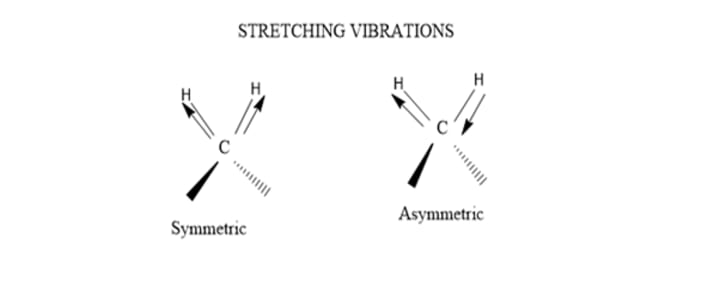
2.3-Bending Vibrations: Bending vibrations is the periodic movement of the groups of atoms in which the angle of two common bonded atoms usually change. However, the bond length remains the same. In bending vibrations more than three atoms must be present in a molecule. Bending vibrations consist of four different types;
• Rocking
• Scissoring
• Twisting
• Wagging

2.4-Others types of Molecular vibrations:
These types of vibrations arise due to excitations of molecules from the lower orbital state to the highest energy orbital exited state. Complicated peaks observe in the spectrum due to the presence of vibrations like,
• Overtones
• Difference bands
• Combinations bands.
1.2-Applications of the IR spectrum:
We observe that each kind of molecular bond shows totally different ranges for natural frequency of vibrations. Similarly, two same identical covalent bonds present in two totally different molecules may show almost different environment. So, no two compounds having different structural formula show exact infrared spectrum. However, rarely in two cases some of the vibrational frequencies might be same, but no two different compounds shows their infrared absorption pattern be identical. Therefore, we use the infrared spectrum for the identification of compounds much like the fingerprint that we use for human identification. We simply compare the infrared spectra of two compounds to confirm whether they are identical or not. If their spectra match peak for peak, they must be identical compounds.
About the Creator
Fatima Jamil
In a world where you can be anyone, be yourself.
Keep reading
More stories from Fatima Jamil and writers in Education and other communities.
Infrared Region
Interaction of electromagnetic radiations with the matter is termed as spectroscopy. All types of compounds organic and inorganic, containing covalent bonds must absorb frequencies in the range of Infrared of the electromagnetic radiations. This region has wavelength higher than the ultraviolet region and has shorter wavelength than the microwaves region. It ranges from 400cm-1 to 4000cm-1. We use the infrared spectrum for the identification of compounds much like the fingerprint that we use for human identification. We simply compare the infrared spectra of two compounds to confirm whether they are identical or not. If their spectra match peak for peak, they must be identical compounds. Infrared spectroscopy did not provide complete information about compound spectra. The information obtained from it, nevertheless often correct, is always indefinite and is used together with confirmations by chemical, physical and other means of spectroscopy. Amines can be derived from ammonia. In amines one of the hydrogen atoms of ammonia compound can be displace by hydrocarbon group like alkyls. These amines can be distinguished on the basis of their spectra in dilute solutions in infrared region. Primary amines depict two bands in the region of 3300 to 3000cm-1 due to their fundamental N-H stretching vibrations. Secondary amines show only single band in this region of 3300 to 3000cm-1 while, tertiary amines do not show any band at all. Stretching vibrations of N-H region shows absorption bands near the range of 3550 to 3300cm-1. In clear solution samples the N-H shows feeble and acute peaks than O-H band which mostly appears in same region. For primary amines spectra shows in plane strong N-H scissoring absorptions at the range of 1550 to 1650cm-1 along with out of plane wagging vibrations at the range of 650 to 900cm-1. These peaks are usually broad and are the characteristics of amines. Infrared spectra of secondary amines showed weak N-H bending absorptions that are visible in the infrared region of 1500 to 1600cm-1. An intense broad wagging absorption bands may appear in the range of 650 to 900cm-1. Tertiary amines showed broad bands in the infrared spectra aside from the N-H stretch and these compounds shown specific characteristics for their alkyl and aryl substituents.
By Fatima Jamil3 years ago in Education
The Emotional and Human Impact Behind Major Medical Breakthroughs
Major medical breakthroughs often capture attention for their scientific achievement, yet their most profound significance lies in the emotional and human stories they shape. Although clinical data, research milestones, and technological advancements illustrate progress, the accurate measure of success lies in the lives transformed by these discoveries.
By Mark Bouzyk7 days ago in Education
The Duelist
The rays of a dying red sun flashed against the onrushing blade. The grey beards say the key to dueling lies in size, speed, reach, righteous fury, whatever the person in front of them pays them to say. Matteo knew better than any it was none of these and had an undefeated record on these sands to prove it.
By Matthew J. Fromm3 days ago in Fiction



Comments
There are no comments for this story
Be the first to respond and start the conversation.