
Incorporating AI into Decision Making: A Comprehensive Guide to Tools and Software"
A Comprehensive Guide to Incorporating Artificial Intelligence into Decision-Making Systems


Introduction:
Artificial intelligence (AI) has the potential to revolutionize the way decisions are made in various industries. From healthcare to finance to retail, AI-powered decision-making systems can help organizations make better and more informed decisions, leading to increased efficiency and productivity. However, with so many tools and software available for decision-making, it can be difficult to know which one to choose.
In this blog post, we'll take a closer look at some of the most popular tools and software that can be used to incorporate AI into decision-making systems, and discuss when and how to use them.
Machine Learning Platforms:
One of the most popular ways to incorporate AI into decision making systems is through the use of machine learning algorithms. TensorFlow, PyTorch, and scikit-learn are all popular open-source libraries that can be used to build, train, and deploy machine learning models for decision-making.
TensorFlow is a powerful machine learning platform that can be used to build and train deep learning models, while PyTorch is a more flexible library that can be used for both deep learning and traditional machine learning. Scikit-learn is a simpler library that is specifically designed for traditional machine learning tasks.
Business Intelligence (BI) Tools:
Another popular way to incorporate AI into decision making systems is through the use of business intelligence (BI) tools. Tableau, Power BI, and QlikView are all popular tools that can be used to analyze and visualize data, and make data-driven decisions.
Tableau is a data visualization tool that can be used to create interactive dashboards and reports, while Power BI is a more comprehensive tool that can be used for data visualization, data modeling, and data analysis. QlikView is a self-service BI tool that can be used to create interactive data visualizations and dashboards.
Decision Tree Software:
Decision tree software is another popular way to incorporate AI into decision making systems. Orange, RapidMiner, and KNIME are all popular open-source tools that can be used to build and analyze decision trees.
Orange is a data mining and machine learning tool that can be used to build decision trees and other models, while RapidMiner is a more comprehensive tool that can be used for data visualization, data modeling, and data analysis. KNIME is a data integration and analytics platform that can be used to build decision trees and other models.
Expert Systems:
Expert systems are another popular way to incorporate AI into decision making systems. CLIPS, JESS, and Prolog are all popular programming languages that can be used to build expert systems for decision making.
CLIPS is a rule-based programming language that can be used to build expert systems, while JESS is an extension of CLIPS that is specifically designed for building expert systems. Prolog is a logic-based programming language that can also be used to build expert systems.
Optimization Software:
The optimization software is another popular way to incorporate AI into decision making systems. Gurobi, CPLEX, and Mosek are all popular optimization software that can be used to find the best solution to a problem, and make decisions based on that solution.
Gurobi is a powerful optimization software that can be used to solve linear, quadratic, and nonlinear programming problems, while CPLEX is another popular optimization software that can be used to solve linear and mixed-integer programming problems. Mosek is a more comprehensive optimization software that can be used to solve a wide range of optimization problems, including linear, quadratic, and nonlinear programming, as well as conic and semidefinite programming.
Artificial Intelligence Platforms:
Finally, Artificial Intelligence Platforms like IBM Watson, Microsoft Azure, and Google Cloud AI are another popular way to incorporate AI into decision making systems. These platforms provide pre-built models, APIs, and a wide range of services for decision making.
IBM Watson is a powerful AI platform that can be used for a wide range of tasks, including natural language processing, computer vision, and machine learning. Microsoft Azure is another popular AI platform that can be used for tasks such as computer vision, natural language processing, and predictive analytics. Google Cloud AI is another comprehensive platform that provides a wide range of services including machine learning, natural language processing, and computer vision.
Conclusion:
Incorporating AI into decision making systems can help organizations make better and more informed decisions, leading to increased efficiency and productivity. However, with so many tools and software available for decision-making, it can be difficult to know which one to choose. This guide provides an overview of some of the most popular tools and software that can be used to incorporate AI into decision making systems, and discuss when and how to use them. It's important to evaluate your specific use case and requirements when choosing a tool or software for decision-making, as well as considering the cost and resources required for implementation.
About the Creator
Dineshkumar M
"As a passionate writer, I have always been fascinated by the power of the written word. I have been drawn to the magic of words to transport readers to new worlds and perspectives.
Keep reading
More stories from Dineshkumar M and writers in Education and other communities.
Scientific Introduction to Freezing Point Depression
Freezing point depression is a phenomenon that occurs when a solute is added to a solvent. The solute particles are dissolved in the solvent, and the solvent's ability to form a solid (freezing point) is diminished. This results in a decrease in the freezing point of the solvent, which is why this phenomenon is referred to as "freezing point depression."
By Dineshkumar M3 years ago in Education
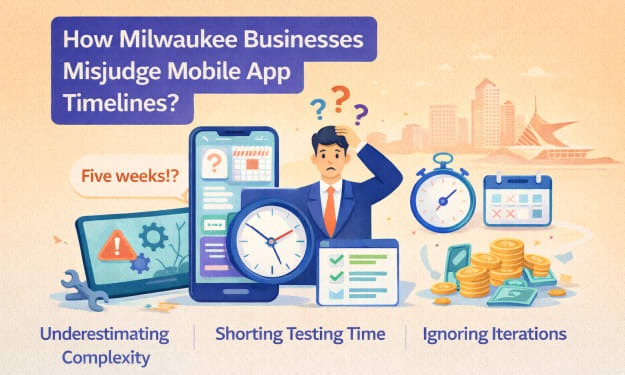
How Milwaukee Businesses Misjudge Mobile App Timelines?
Timeline optimism is one of the most expensive habits in software. In Milwaukee, it shows up quietly. A launch date is set to align with a trade show. A quarter-end deadline is chosen to please leadership. A six-month roadmap is approved because “the features aren’t that complex.” On paper, everything looks reasonable.
By Mary L. Rodriquez7 days ago in Education
The Lean Advantage: How Small Improvements Create Massive Business Wins
In today’s fast-moving market, businesses don’t always need massive overhauls to see major growth. The real competitive advantage often comes from Lean process improvement—small, consistent changes that reduce waste, improve speed, and strengthen customer value. With a proactive approach, companies can spot inefficiencies early, prevent recurring problems, and build smarter systems before minor issues become costly setbacks.
By Duke Valentourabout 9 hours ago in Education



Comments
There are no comments for this story
Be the first to respond and start the conversation.