
Imran Khan is not just a man — he is a movement
From Cricket Legend to Political Warrior — A Journey of Conviction, Sacrifice, and Unbreakable Will

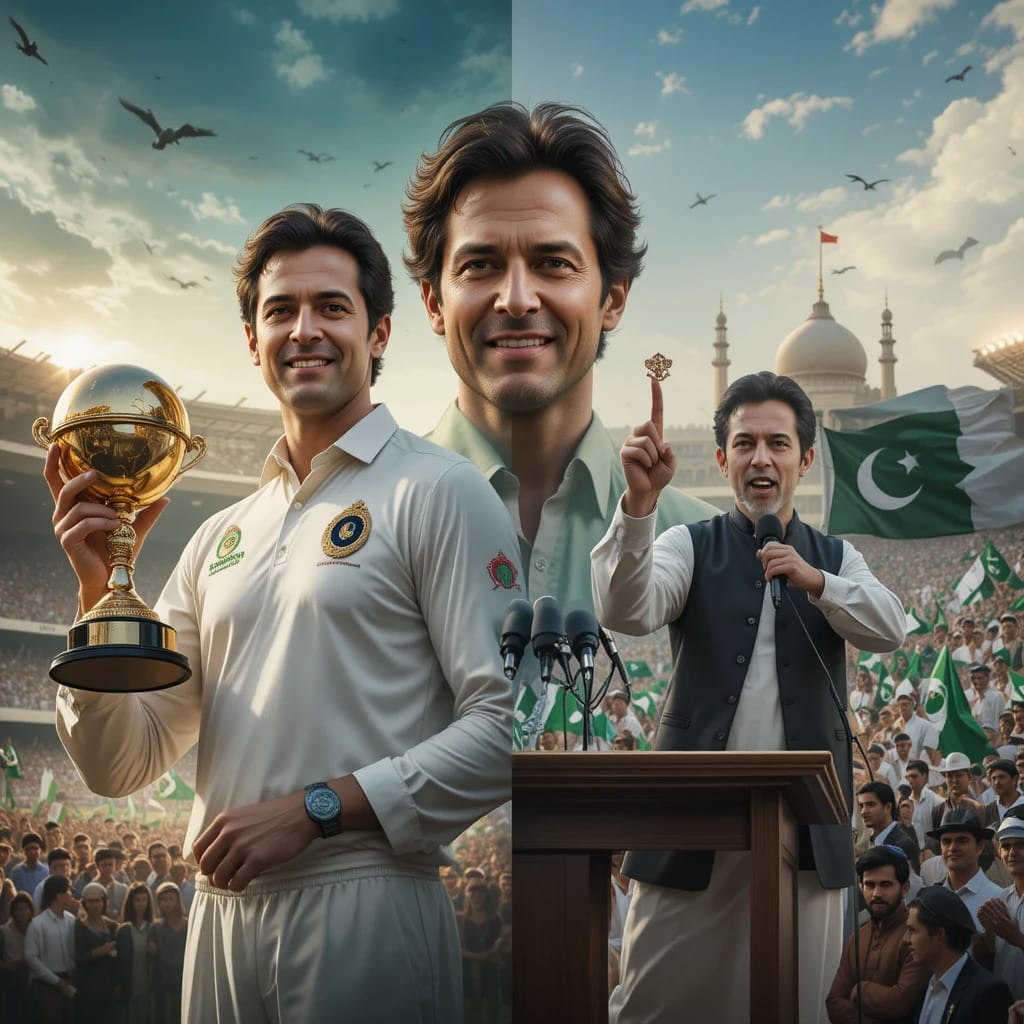
Imran Khan is not just a man — he is a movement. A towering figure in both sports and politics, Khan’s journey from cricket stadiums to the chaotic corridors of power in Pakistan is one of unwavering determination and passionate patriotism. He is a name that evokes admiration, controversy, loyalty, and opposition in equal measure — but one thing no one can deny is that Imran Khan has always stood for something far greater than himself: the future of Pakistan.
Born into a well-educated Pashtun family in 1952, Imran Khan was raised in an environment that valued discipline, learning, and tradition. He attended prestigious institutions such as Aitchison College and later Oxford University, where he not only honed his academic skills but also laid the foundation of his legendary cricket career. It was on the cricket field that Imran first captured the hearts of Pakistanis. His fiery leadership, charisma, and unmatched skill helped Pakistan win its first and only Cricket World Cup in 1992 — a moment etched into the national memory forever.
But Imran Khan’s ambition did not end with glory on the field. While others would have retired into comfort and fame, Khan turned his gaze toward the suffering and injustices he saw in his country. The Pakistan he returned to after cricket was riddled with corruption, inequality, and political decay. It stirred something deep within him — and he began his second innings, this time in the high-stakes arena of politics.
In 1996, he founded the Pakistan Tehreek-e-Insaf (PTI), a party born not of dynastic power or elite influence, but from a deep yearning for change. The early years were brutal. Khan was mocked by political veterans, ignored by the media, and dismissed as a celebrity playing at politics. But he did not flinch. Like the fast bowler he once was, he kept coming back, again and again, learning from every defeat, and sharpening his vision with every failure.
His message was clear and consistent: Justice, humanity, and self-reliance. He campaigned against corruption, against the foreign dependency that plagued Pakistan’s policies, and for the empowerment of ordinary citizens. Slowly, his voice grew louder, and his following swelled. He didn’t rely on feudal networks or money — he relied on the hearts of the youth, the dreams of the poor, and the hopes of the forgotten.
In 2018, the impossible happened. Imran Khan, the political outsider for over two decades, was elected Prime Minister of Pakistan. It was a seismic shift in the nation’s politics. For the first time, someone outside the traditional ruling families had been chosen to lead. His government inherited a mountain of problems — a failing economy, diplomatic tensions, and a deeply polarized society. But he tackled these with the same grit he once showed on the pitch.
Khan launched initiatives focused on human development — Ehsaas for poverty alleviation, Sehat Card for healthcare access, and massive afforestation projects under his climate vision. He raised his voice on global platforms, especially at the United Nations, where he forcefully spoke about Islamophobia, Kashmir, and the hypocrisy in global power politics.
But leadership is not a path paved in roses. His term was marred by relentless opposition, internal sabotage, and growing pressures. In 2022, he was ousted through a no-confidence vote — a moment many believed would mark the end of his political journey.
They were wrong.
What followed was perhaps the most dramatic and defining phase of Imran Khan’s life. Far from backing down, Khan emerged from his political dismissal stronger, louder, and more popular than ever. He took to the streets, reigniting his connection with the people. Rallies drew millions. His social media presence broke records. He became not just a politician but a phenomenon. For many, he came to symbolize resistance — a man who would not bow, would not sell out, and would not be silenced.
Even when faced with arrest, court cases, censorship, and violent crackdowns, Imran Khan stood firm. His message was simple: “I will never compromise on the sovereignty and dignity of my country.” His supporters, particularly the youth and overseas Pakistanis, rallied to his side, transforming political frustration into a powerful wave of national consciousness.
What makes Imran Khan so unique is not perfection — he has made mistakes, misjudged alliances, and faced administrative challenges. But his enduring power lies in authenticity. He does not pretend to be what he is not. He speaks plainly, often emotionally, always passionately. And people feel that he believes in what he says. That is his greatest political weapon.
In a region dominated by dynasties and strongmen, Khan remains an anomaly: a leader whose authority comes not from legacy but from struggle. Whether he returns to office or not, Imran Khan has already carved his name into the soul of Pakistan. His impact is irreversible. He has redefined what it means to stand up for one's country — not with cynicism, but with courage.
In Imran Khan, Pakistan sees its reflection — imperfect, wounded, but still hopeful. He may have started as a cricket champion, but he will be remembered as a relentless fighter for justice. His legacy, like his journey, is not yet complete. But one thing is clear: as long as people believe in change, they will look to Imran Khan — not just as a man, but as a movement.
About the Creator
GoldenTone
GoldenTone is a creative vocal media platform where storytelling and vocal education come together. We explore the power of the human voice — from singing and speaking to expression and technique.
Keep reading
More stories from GoldenTone and writers in Education and other communities.
My Mother Is My Law
There are people who guide you, people who nurture you, and people who discipline you. But rarely do you find all these roles encapsulated in one person — unless you are talking about a mother. For me, my mother is more than just a caregiver or a role model. She is the very law of my life — not a dictator, but a living embodiment of principle, justice, and unconditional love. When I say “my mother is my law,” I mean she is the moral compass by which I steer, the judge in my courtroom of decisions, and the eternal guardian of what’s right.
By GoldenTone7 months ago in Education
The Energy Pivot The State of Russia’s Oil and Gas in 2026
For decades, this was the "world's gas station": Russia's pipeline network to Europe was the veins of the world economy. By 2026, that aura is dull and those veins are rerouted out of Europe. Since the collapse of the Soviet Union, the Russian oil and gas sector is facing the largest structural change.
By Neeraj kumar3 days ago in Education
What’s the best position to sleep in?
In the 1970s, psychoanalyst Samuel Dunkell proposed a curious, albeit almost completely unsubstantiated, theory that the position you sleep in reflects your personality. For example, preferring to snooze in the so-called royal position indicated self-confidence, while sleeping semi-fetal meant you’re sensible and well adjusted. While Dunkell’s ideas lack any definitive proof, how we sleep can impact our health. So, what’s the best position to sleep in? Sleep positions go by countless creative names—
By Munesh Yadava day ago in Education


Comments
There are no comments for this story
Be the first to respond and start the conversation.