
Identity politics are now in the ranks of the Indian Military
The spectrum of identity politics is vast and very complex to comprehend. We can take India as an example. India was once a proponent of secularism in South Asia, but now, many things are happening that may threaten India's secular foundation

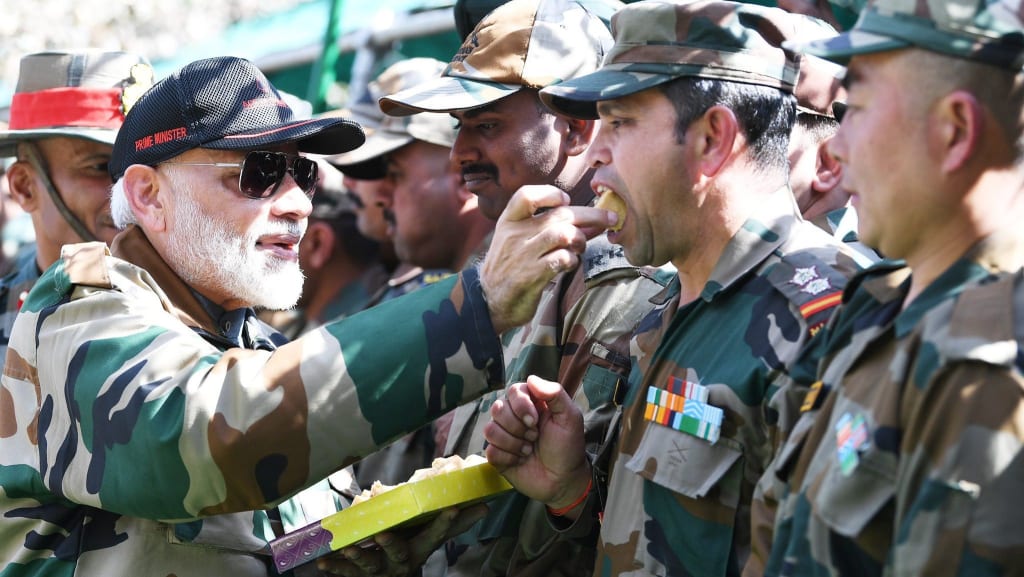
Identity politics has been a prominent aspect of the 21st century; it is easier for a politician to use it to gain political leverage in this post-truth era. In an era where emotions and sentiments can be easily manipulated through religion and nationalism to deceive the people through false rhetoric. This can be done for many purposes, such as creating a like-hood mentality and a mount voice for political support.
The spectrum of identity politics is vast and very complex to comprehend. We can take India as an example. India was once a proponent of secularism in South Asia, but now, many things are happening that may threaten India's secular foundation. The history of the Hindu ideology and Akhand Bharat in the subcontinent is ancient; we get its first traces from the War of Independence of 1857, but later, Savarkar gave it a formal shape in 1925.
There are stories about racial differences and discrimination in India, including how low castes like Dalits and Shudars, as well as minorities like Sikhs and Muslims, are treated. However, it is very odd to know that this selective racial approach is also in the Indian Army. The promotions in the Indian Army are now beyond the merits; the Hindutva ideology has now penetrated "Modi's Sena," where promotion is now based on loyalty and geography.
Indian military leaders are allegedly opening doors for Hindutva ideology within the ranks, seeking to align with the BJP's political influence, signaling a shift away from secular values. Reports indicate military officers are fostering personal bonds with political leaders, gifting lavish items on birthdays and anniversaries to curry favor, which raises concerns about impartiality within the armed forces. The Indian Army is seeing the emergence of two power blocs based on regional ties to Uttarakhand and Nagpur. Even top commanders who support these blocs differ, notably the CDS and COAS.
Northerners, who are the Hindu majority, are purportedly advocating an ethnic superiority narrative against Southerners, and a divide is forming among the Indian Army. Allegations have emerged that confident military commanders utilized their relationships with influential regional politicians to gain preferential assignments, bonuses, and promotions.
Preference for graduates of specialized military institutions promotes intolerance and cliques; when ideology, rather than professional talent and merit, increasingly determines career development, internal unhappiness rises. The existing structure of CDS and COAS appointments suggests a divide among senior commanders. Counterterrorism (CT) professionals, commonly called "CT Generals," are given precedence in promotions to high-level postings.
New theater commanders are apparently finding it more difficult to coordinate and maintain operational unity because of Prime Minister Modi's influence over the Indian armed services.
Veteran Lt. Gen. Prakash Menon has publicly cautioned against Hindutva radicalism entering the military, saying the Army cannot afford to become "Modi ki Sena," which puts political interests over national unity.
According to sources, there is debate around General Manoj Pande's appointment, as COAS Nepotism and devotion to the ideals of the Rashtriya Swayamsevak Sangh (RSS) and the Bharatiya Janata Party (BJP) are claimed to have been the fundamental causes of his elevation.
The results of David Smith's book "The Wellington Experience" demonstrate institutional discrimination, stating that Muslim officers are virtually relegated to lesser ranks. Conversely, there is a long-established religious hierarchy in the military since Hindu officers hold most senior positions.
Among the most visible formations in the Army, the President's Bodyguard, which recruits only from the Rajput, Hindu, and Sikh Jatt castes, exemplifies caste-based discrimination in hiring and the maintenance of preferential treatment at the cost of increased involvement. Opposition parties and civil society organizations should speak out against the social bias and politicization of the Indian Armed Forces, advocate equitable representation, and reject the BJP's supposed involvement.
One of the worst outcomes of politicizing the military is weakening democratic governance and civilian authority. This is precisely what the Modi government is doing with identity politics. Governments must utilize the military to unite the country rather than build a divide across society. Conflicts, human rights abuses, and tensions occur from the overuse of the military for supremacy. Intercommon violence in India intensified as a result of the Modi government's militarism and Hindu nationalistic views.
In a post-truth culture, emotions and subjective experiences are prized more highly than facts and rational reasoning. Identity politics easily converts people—including soldiers—into its victims. Social networks facilitate this process by propagating misinformation and participating in media black PR that erodes audience faith.
It is characterized by promoting group identity above common values, inhibiting communication, and evaluating the potential reciprocal impacts of cultural appropriation. Additionally, warriors may be skilled at reducing these identities to the level of collective agency by weighing them with ideology. People who are narrow-minded and tenacious in pursuing their interests also disturb the equilibrium of the social order.
About the Creator
Abdul Mussawer Safi
Abdul Mussawer Safi is pursuing his bachelor's in international relations at the National Defense University (NDU), Islamabad. He has a profound interest in the regional dynamics of South Asia. He tweet at @MussawerSafi.
Keep reading
More stories from Abdul Mussawer Safi and writers in Education and other communities.
Understanding Chronic Kidney Disease (CKD) and Strategies to Delay Progression
Introduction Chronic Kidney Disease (CKD) is a long-term condition where kidney function gradually declines, impairing the body's ability to filter waste and excess fluids. Affecting 9-13% of adults globally, CKD often progresses silently, with symptoms emerging only in advanced stages. The disease is commonly linked to diabetes, hypertension, and genetic predisposition, making early detection crucial. CKD is classified into five stages, ranging from mild impairment to complete kidney failure, requiring dialysis or transplantation. While irreversible, proactive management—including dietary adjustments, blood pressure control, and nephrology consultations—can significantly slow progression. Addressing risk factors and adopting a kidney-friendly lifestyle can improve patient outcomes, reducing complications such as cardiovascular disease, anemia, and metabolic imbalances.
By Abdul Mussawer Safi7 months ago in Writers
Traphall Romance
Traphall Romance: How a Global Love Sound Was Born, Who’s Leading It, and Where It’s Headed Genres don’t usually start in boardrooms. They start in bedrooms, cars, late-night studio sessions, and cities where cultures overlap. Traphall Romance is no exception. It’s not a sound that was formally announced — it’s one that quietly emerged from emotion, from artists who wanted their music to hit hard and feel deep.
By K.y.e Dynasty Records3 days ago in Education
Gemini, ChatGPT, and the Future of Artificial Intelligence: 5 Trends Changing Everything in 2026
Introduction Artificial Intelligence (AI) has moved far beyond simple chatbots and automated replies. In 2026, AI is shaping the way people work, shop, study, and even make life decisions. Tools like Google Gemini and OpenAI’s ChatGPT are at the center of this transformation, offering advanced generative capabilities that allow users to create content, automate tasks, and solve complex problems in seconds.
By anilca jazmin pichardo clase2 days ago in Education
🅼🅸🅳🅽🅸🅶🅷🆃 🆂🅽🅰🅲🅺🆂
"It's 10 in Tuscon! We all know what that means... It's Time for Midnight Snacks with your man, Gerald Gee! Ready to spend the night together? Me too! I'm full of snacks and can't wait to regurgitate them all back into your hungry ears. Crack a brew! Pop some corn! Anything to get ready for one hell of a show where the talk maybe cheap but the words cut deep...
By Lamar Wigginsabout 24 hours ago in Fiction



Comments
There are no comments for this story
Be the first to respond and start the conversation.