
HRMS System: Transforming Human Resources for the Digital Workforce
HRMS System

In today's competitive and tech-driven business environment, how you manage people is as important as what you sell or produce. Employees expect seamless experiences, fast responses, and opportunities to grow—all of which depend on a modern approach to human resources.
Enter the HRMS system—a digital solution that automates and unifies HR tasks under one centralized system. With a Human Resource Management System, companies can optimize everything from recruitment and payroll to employee development and performance evaluation.
Let’s take a closer look at how an HRMS system reshapes the workplace and delivers measurable value across industries.
1. What Is an HRMS System and What Does It Include?
A Human Resource Management System (HRMS) is software designed to manage every part of the employee lifecycle. It simplifies complex HR processes, making them more efficient, reliable, and data-informed. Unlike traditional systems or manual processes, an HRMS centralizes employee data and creates consistency across the organization.
Essential Components of an HRMS System:
Recruitment & Onboarding
Streamlines the hiring pipeline—from publishing job ads to tracking applicants and welcoming new hires.
Employee Records
Maintains digital files containing employment history, contact details, job titles, appraisals, and documents.
Attendance and Time Tracking
Captures in/out timing, remote work logs, shift planning, and vacation records.
Payroll Integration
Automates salary calculations, tax deductions, bonuses, and generates monthly payslips.
Performance Management
Supports goal setting, performance reviews, 360-degree feedback, and promotion tracking.
Learning & Development
Provides access to training modules, tracks certifications, and manages upskilling programs.
Compliance Tools
Ensures company-wide adherence to labor laws, tax codes, and regulatory requirements.
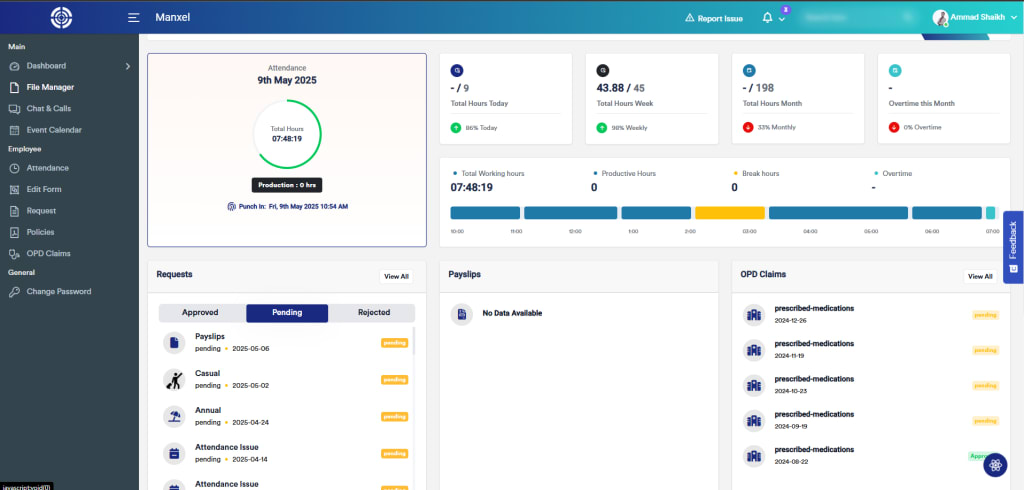
An effective HRMS system brings these features together on one easy-to-use dashboard, accessible to both HR teams and employees.
2. Benefits of Using an HRMS System in Modern Workplaces
Implementing an HRMS system isn't just about automation—it's about changing how HR contributes to overall business success.
A. Smarter Decision-Making
With real-time analytics and detailed reports, HR leaders gain visibility into workforce trends such as attrition, attendance, training gaps, and engagement. These insights support strategic planning and predictive analysis.
B. Better Employee Experience
Self-service access means employees no longer have to wait for HR to respond to simple requests. They can check leave balances, download payslips, submit expense reports, and request time off with ease.
C. Time and Cost Efficiency
Automated tasks like payroll processing or interview scheduling free up HR teams to focus on higher-value work. This results in lower operational costs and faster service delivery.
D. Improved Compliance and Reduced Risk
Whether it's filing taxes, managing labor records, or preparing for audits, HRMS systems help you stay legally compliant and reduce the risk of penalties or lawsuits.
E. Enhanced Collaboration and Transparency
When everyone—HR, managers, and employees—has access to real-time information, accountability improves. Team collaboration becomes seamless, and employees feel more connected and engaged.
3. Best Practices for Choosing and Implementing an HRMS System
Choosing the right HRMS system is critical. A poorly chosen system can result in underuse, frustration, and wasted money. Here's how to get it right:
A. Identify Your Goals
Start with a list of your HR challenges. Is your team wasting time on manual payroll? Are your onboarding processes disorganized? Your goals will guide your choice of features.
B. Focus on User Experience
Select a platform that offers a clean, mobile-friendly interface. If the system is too complex or unattractive, adoption will be a struggle.
C. Prioritize Integration
Make sure your HRMS system integrates with your existing accounting, ERP, or communication tools. This ensures a smoother data flow and reduces the need for duplicate entry.
D. Ensure Data Security
Since HRMS systems contain sensitive employee data, look for platforms with strong encryption, multi-factor authentication, and compliance certifications (e.g., GDPR, ISO).
E. Provide Ongoing Training
After deployment, offer periodic training and refreshers. Keep employees updated on new features or upgrades to ensure long-term engagement and productivity.
Conclusion: The HRMS System is a Strategic Necessity, Not a Luxury
The nature of work has changed—and so have the demands on HR. To build a resilient, people-first organization, businesses must move beyond manual methods and outdated spreadsheets. They need tools that support agility, scale, and insight
About the Creator
Ejaz Hussain
Email marketing | SEO |Blog
Keep reading
More stories from Ejaz Hussain and writers in Education and other communities.
HRMS System: The Backbone of Smart Workforce Management
In an age where businesses must adapt quickly to change, effective people management is key to staying competitive. But manual HR processes can no longer meet the demands of a fast-paced, data-driven world. This is where a Human Resource Management System (HRMS system) becomes a strategic asset—not just a tool.
By Ejaz Hussain9 months ago in Education
Wuthering Heights uni module given content warning for students"
The 1847 novel Wuthering Heights has long been considered one of the most intense works in English literature. Written by Emily Brontë, the book explores obsession, revenge, cruelty and emotional torment on the Yorkshire moors. Now, nearly two centuries after its publication, the novel has become the center of a modern academic debate after a university module introduced a content warning for students studying the text.
By Fiaz Ahmed 4 days ago in Education
EdTech for Early Childhood Market to hit USD 55.6 Bn By 2034
EdTech for Early Childhood Market Overview The EdTech for Early Childhood Market was valued at USD 13.4 billion in 2024 and is projected to reach approximately USD 55.6 billion by 2034, expanding at a CAGR of 15.30% from 2025 to 2034. The increasing integration of digital learning tools into early childhood education is supporting this expansion. Educational technology platforms designed for young learners are helping educators deliver interactive learning experiences through digital content, educational games, and adaptive learning applications that support cognitive and language development.
By Roberto Crumabout 2 hours ago in Education
A Transparent Look at Vocal Challenges and Top Stories
Almost three years ago, we shared a resource article that served as a place for people to suggest new challenge prompts. We thought it would be a good idea to refresh that thread, and take the opportunity to answer a few common questions about top stories, how challenges are judged and how submissions are reviewed.
By Vocal Curation Team4 days ago in Resources




Comments
There are no comments for this story
Be the first to respond and start the conversation.