

INTRODUCTION OF SPAWN
Seed or planting material of mushroom i.e. spawn, consists of mycelia of the fungus multiplied on suitable substrates like cereal grains. The mycelia of mushroom fungus cannot be propagated as such; hence the mycelia are multiplied on a carrier like cereal grains.
Like in all other crop production systems, seed or spawn is the key input in mushroom cultivation. Non-availability of quality spawn is the major constraint in mushroom production. Good quality spawn conform to –
i) high yield potential,
ii) absence of contaminants,
iii) better economic benefit.
Spawn production primarily depend on the easy availability of spawn substrates. A good source of fruit body supplies and laboratory conditions for a sterile environment are needed.
The process requires special technical skill and a laboratory for quality and economic spawn production.
The basic steps involved in spawn production are:
1. Pure culture preparation
2. Mother spawn preparation
3. Spawn multiplication/commercial spawn preparation.
* Pure culture preparation
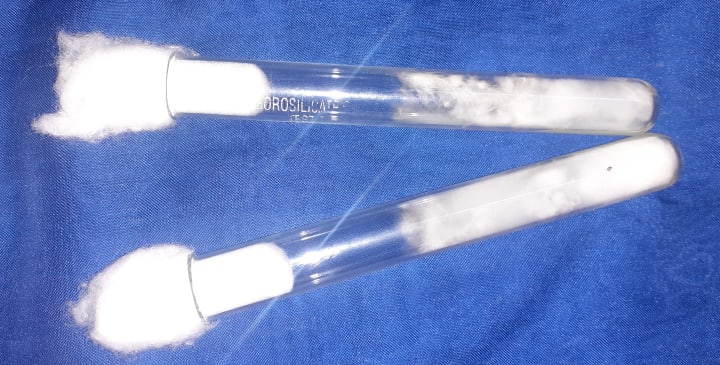
Pure culture of mushroom species can be obtained either by spore culture or tissue culture. Although mushrooms are spore bearing fruit bodies of macro fungi, all spores are seldom vigorous and the pure cultures obtained show variations because of genetical reasons.
In tissue culture, a well grown mushroom fruit body is collected (usually from the first flush harvest). The fruit body is longitudinally split open into two halves. A small bit of tissue from the inside of the junction area of the pileus/cap and stalk is taken aseptically with forceps and placed over potato dextrose agar(PDA) or malt extract agar (MEA) media in slants or petri plates.
These are incubated at 25±2°C and after a week’s time the tissue generates mycelium which cover up the entire media surface and the cultures become ready. The first generation (T1 ) pure culture prepared from mushroom fruit body tissue is called mother culture.
* Spawn preparation
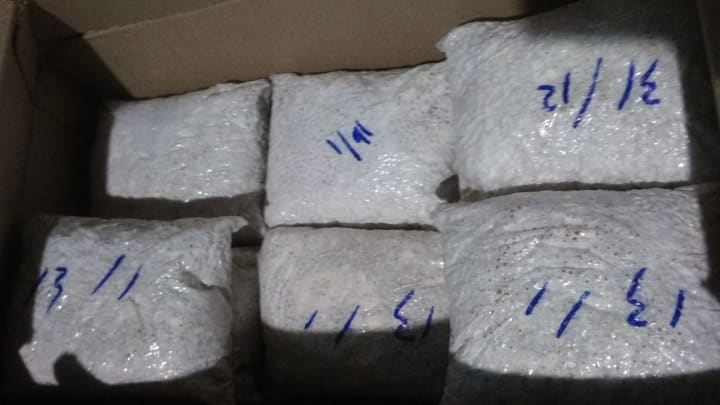
Criteria for base material selection along with the steps involved in spawn preparation are:
1. Jowar (sorghum) and bajra (pearl millet) are considered best as spawn substrate,
2. while wheat is the next best cereal. In the region, wheat is not readily available and
3. costlier than paddy grains. Moreover, bacterial contamination of spawn is less in paddy grains as compared to wheat.
This is due to presence of a harder husk in paddy. Maize grains are also abundantly available in the hilly areas and serve as very good base material.
Maize grain is one of the best substrate to be used for mother spawn production. However, maize grains are not preferred for planting spawn due to bigger size and less surface area.
There is a negative correlation between the protein content of grain used for spawn and the yield of mushroom. The protein content of paddy is 7% and that of wheat is 12%. However, wheat is the best substrate for button mushroom spawn
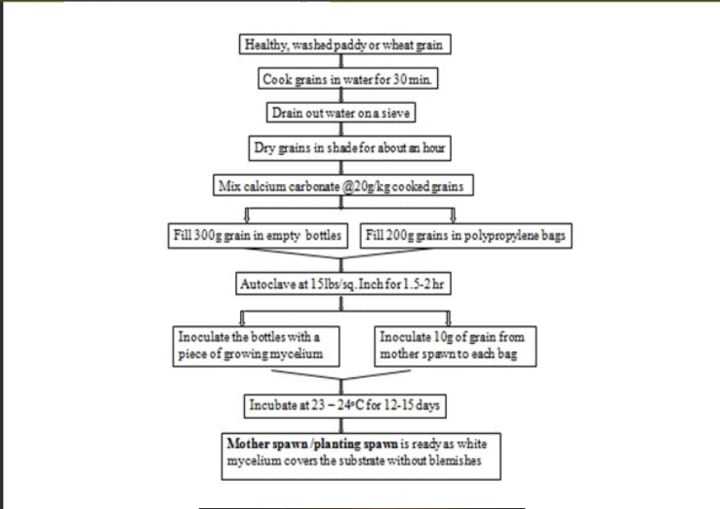
I. The suitable substrate is prepared by cleaning, washing and cooking for about thirty minutes. After draining off the excess water, 20g pharmaceutical grade calcium carbonate (CaCO3 ) is mixed with per kg of the cooked cereal grain.
The grains are coated with CaCO3 to raise the pH above 7; to accelerate the growth of the spawn. Sometimes the reason for slow growth of spawn is due to use of cheaper grade of CaCO3 or French chalk.
II. The processed substrate is either filled polypropylene bags (15x21cm size) to hold 200g/bag for mother spawn and planting or commercial spawn. The open end of the bags are plugged with cotton plugs and covered with butter paper.
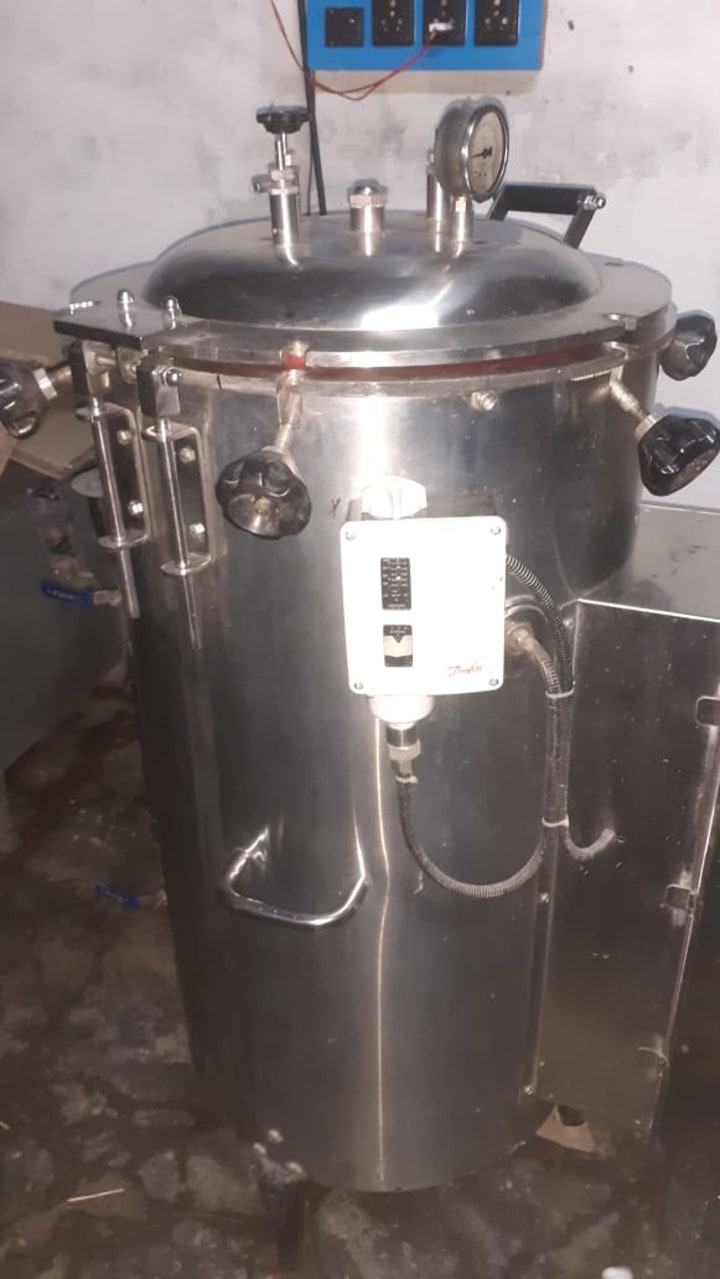
III. The filled bags are then sterilized in an autoclave at 121oC (15 lb pressure/sq. inches) for about 1-1½ h.
IV Mother spawn is the T2 generation prepared by aseptically inoculating the substrate in saline bottles with the T1 mother culture.
V. Spawn is used by the mushroom growers for planting the mushroom beds. This planting spawn is prepared aseptically by multiplying from the mother spawn up to the third (T3 ) or fourth (T4 ) generation on substrate prepared as mentioned earlier.
Sub culturing of the spawn from T4 generation usually reduces the efficiency and vigour of the spawn which leads to reduction in mushroom production.
VI. The mother and planting spawn should be properly labelled with the species name, generation and date. Spawn of fifteen to twenty days old is the best for planting.
* Storage process
Temperature of 25±2ºC or at room temperature spawn can be stored up to 30 days, from the date of inoculation.
Under refrigerator conditions, spawn can be stored for another 3 months. However, there will be some decrease in yield of mushroom with increased storage time above 2 months.
* Contamination
Growth of the mycelia gets restricted in the substrate when bacteria or moulds over grow the mycelia and the spawn is gets contaminated or get spoilt.
Bacterial contamination in spawn packets is generally found as patches of slimy fluid on the substrate where the mycelium growth ceases. Spoilage caused by the moulds Aspergillus sp., Pencilliun sp., Rhizopus stolonifer and Trichoderma sp., can be seen when the substrate has patches and at times much of it colonized with different coloured mycelia or spores other than white.
The factors like excess moisture in the grains, bad quality grains, improper sterilization and high temperature during storage contribute to spoilage of spawn.
END
About the Creator
AM1 MUSHROOM
Hi this is Mohamed Alishath from India and am doing mushroom cultivation and spawn production since 2012 then i have above 10 years experience in mushroom cultivation so i would like to share about mushroom and some other topics like story.
Reader insights
Good effort
You have potential. Keep practicing and don’t give up!
Top insight
Excellent storytelling
Original narrative & well developed characters
Keep reading
More stories from AM1 MUSHROOM and writers in Education and other communities.
HOW TO CULTIVATE MILKY MUSHROOM?
INTRODUCTION OF MILKY MUSHROOM Milky mushrooms, also known as Calocybe Indica or Agaricus lanipes, are a type of edible mushroom that is native to India and Indonesia. They are a white or pale yellow color, and have a dense, meaty texture when cooked. Milky mushrooms are a good source of protein, fiber, and several essential vitamins and minerals.
By AM1 MUSHROOM3 years ago in Education


Comments
There are no comments for this story
Be the first to respond and start the conversation.