
How to Prepare for the Torts Exam
Learning Tips for Law Students

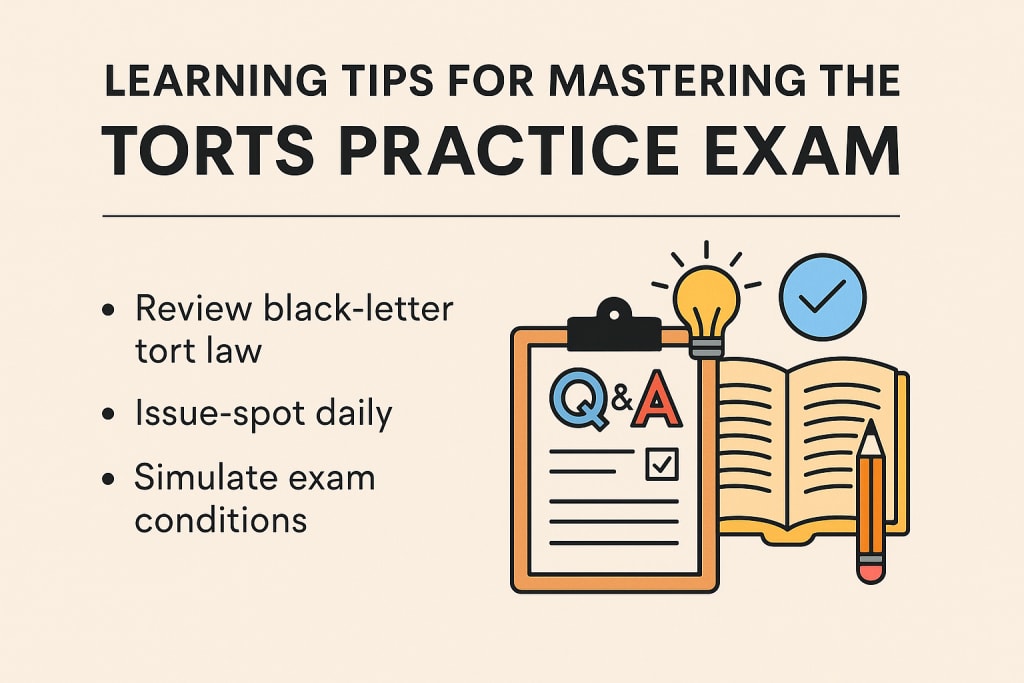
Preparing for a torts exam can feel overwhelming. Between memorizing doctrines, keeping track of defenses, and analyzing fact patterns, law students often find themselves wondering how to manage the volume of material effectively. While textbooks and lectures provide the foundation, success on exam day depends on practice, strategy, and disciplined study habits. This article explores practical learning tips for approaching a torts exam with confidence, along with examples of the types of questions you’re likely to face.
What Makes Torts Exam Preparation Challenging?
Unlike exams that rely primarily on rote memorization, torts assessments require the ability to:
• Identify multiple issues in a single fact pattern.
• Apply black-letter law while balancing policy arguments.
• Consider both plaintiff and defendant perspectives.
• Organize analysis clearly under strict time constraints.
A single hypothetical might involve negligence, product liability, and a defense like assumption of risk—all within a few paragraphs. Without practice, students risk overlooking key issues or mismanaging their time.
Step 1: Start With the Doctrinal Foundations
Every strong study plan begins with the basics. Torts law revolves around a handful of core categories:
• Intentional Torts: Battery, assault, false imprisonment, trespass.
• Negligence: Duty, breach, causation, damages.
• Strict Liability: Abnormally dangerous activities, product liability.
• Defamation & Privacy Torts: Libel, slander, intrusion, false light.
• Nuisance & Economic Torts.
Before diving into complex hypotheticals, students should ensure they can recite elements of each tort and corresponding defenses. Flashcards, flowcharts, and concise outlines are useful at this stage.
Step 2: Practice Issue Spotting Every Day
Torts exams reward students who can identify all potential claims. Consider this fact pattern:
During a crowded sports event, Alex pushes through the aisle to reach his seat. He accidentally bumps into Jordan, causing Jordan to fall down the steps and break an arm. The venue provided no handrails along the steps.
From this short scenario, a well-prepared student might identify:
• Battery (unlikely, unless intent to harm is shown).
• Negligence by Alex (duty, breach, causation, damages).
• Possible negligence by the venue (unsafe premises).
• Defenses such as lack of intent or comparative negligence.
The more you practice spotting these layers, the more automatic the process becomes under exam pressure.
Step 3: Write Out Hypotheticals Under Timed Conditions
Outlining rules is one thing; applying them in writing is another. Under exam conditions, students must craft coherent essays in limited time. A good habit is to:
1. Spend 5 minutes outlining issues before writing.
2. Use IRAC (Issue, Rule, Application, Conclusion) for clarity.
3. Balance both sides—plaintiff arguments and defendant defenses.
4. Avoid spending too long on one issue; give proportional attention.
Timed practice builds endurance and prevents last-minute panic.
Step 4: Learn From Model Answers
After attempting a hypothetical, compare your work against a sample or model answer. Note:
• Did you spot the same number of issues?
• Was your rule statement accurate and complete?
• Did you analyze causation clearly (actual vs proximate)?
• Was your conclusion well supported?
Treat model answers as guides for structure and depth—not as scripts to memorize.
Step 5: Don’t Neglect Defenses and Damages
One of the most common mistakes students make is focusing only on the plaintiff’s claims. On exam day, points are often awarded for addressing defenses such as:
• Consent
• Assumption of risk
• Contributory or comparative negligence
• Privileges (e.g., defense of property, self-defense)
Additionally, remedies and damages should not be skipped. Calculating compensatory vs punitive damages, or explaining mitigation, can earn extra points.
Step 6: Build a Six-Week Study Schedule
For students with a few weeks before the exam, a structured plan helps. Here’s a sample schedule:
• Week 1: Review intentional torts; complete MCQs on basics.
• Week 2: Focus on negligence, especially duty and causation.
• Week 3: Study strict liability and product liability cases.
• Week 4: Cover defamation, privacy, nuisance, and damages.
• Week 5: Complete two full practice exams under timed conditions.
• Week 6: Review weak areas, refine outlines, and practice essays.
This steady rhythm avoids cramming and allows material to sink in gradually.
Common Pitfalls to Avoid
• Memorizing without application. Knowing the elements is not enough—apply them to facts daily.
• Ignoring defenses. Always ask: “What could the defendant argue back?”
• Poor time management. Allocate time proportional to issue weight.
• Unorganized writing. Clear headings and IRAC structure help graders award points easily.
Sample Additional Questions
Here are two more practice-style questions you might encounter:
Question 1:
Maria posts on social media accusing a bakery of using expired ingredients, though she has no direct evidence. The bakery sues for defamation. What must the bakery prove, and what defenses might Maria raise?
Question 2:
A manufacturer fails to warn that its paint is flammable. During use, a small spark causes an explosion, injuring several workers. Under which tort theories might liability arise?
Practicing these scenarios sharpens both doctrinal recall and analytical skills.
Sources & Further Learning
Studying tort law is not just about memorizing elements—it’s about applying legal principles to fact patterns, analyzing possible defenses, and developing a structured method of reasoning. Law students and bar candidates benefit most when they combine doctrinal outlines with consistent practice. Practice exams serve as an essential bridge between theory and performance, allowing learners to sharpen their exam preparation skills while building confidence under timed conditions.
For those looking to expand beyond classroom notes or casebooks, a comprehensive practice tool can make a significant difference. It’s one thing to understand negligence or strict liability in theory, but another to apply those doctrines quickly in response to complex scenarios. That’s where structured resources become invaluable: they present a wide range of hypotheticals, detailed model answers, and a mix of multiple-choice and essay-style questions.
If you’re seeking a complete set of updated practice materials, you may find the practice torts exam particularly useful. It offers realistic scenarios and explanations that reflect what you’re likely to encounter in law school or bar assessments, helping you refine your approach and strengthen your overall performance.
Final Thoughts
Preparing for a torts exam is a marathon, not a sprint. Students who combine doctrinal review with consistent practice—especially under exam-like conditions—are more likely to succeed. Focus on issue spotting, structured writing, and balanced analysis. Pay attention to defenses and damages, and avoid common pitfalls such as cramming or neglecting weaker areas.
With a solid plan and disciplined approach, any law student can walk into the torts exam with confidence, ready to analyze fact patterns thoroughly and present clear, well-reasoned answers.
About the Creator
PrepPool
PrepPool helps students prepare smarter for exams through realistic practice questions, exam-aligned study resources, and practical strategies for AP, nursing, healthcare, and professional certification exams.
How a Brush Cutter Engine Works: A Simple Explanation
Understanding How a Brush Cutter Engine Works: A Simple Explanation is very important for farmers, gardeners, and landscaping workers in Pakistan. Brush cutters are widely used across villages, farms, roadsides, and housing societies to cut grass, weeds, bushes, and small plants efficiently.
By Abdul Alim6 days ago in Education
Before the Bell: Daily Pre-Market Steps That Drive Consistent Trading Wins
In daily trading, the difference between consistency and chaos often comes down to what happens before the session starts. The most reliable traders don’t wait for the bell to decide what to do—they use the early hours to map out a plan, filter distractions, and establish a tactical approach to the day.
By Agast Mishra3 days ago in Education




Comments
There are no comments for this story
Be the first to respond and start the conversation.