
How to Make Your Website HIPAA Compliant?
Summary of the HIPAA guidelines & HIPAA Security Rule

The best approach to keep your patient's information and your business secure at all times is to follow HIPAA guidelines and conduct periodic audits.
Sensitive data, such as patient information and medical records, is vital to the healthcare sector. Both patients and healthcare professionals care about the privacy and security of health and medical information. However, how you handle these standards has a direct bearing on your company's reputation.
To maintain their privileged position as providers of health care, doctors, clinics, hospitals, nursing homes, pharmacies, and other medical facilities need to make sure that their websites are HIPAA compliant.
What Are the Key Aspects to Consider?
You are responsible for making sure that data is:
- Consult your web host about their HIPAA-compliant procedures.
- To improve security and protect customer information, buy an SSL certificate for your entire website.
- Verify that web forms (e.g., contact forms, chatbots, and email) are properly encrypted
- All third-party service providers should be carefully vetted.
- Evaluate who has access to the PHI and make any necessary changes.
- Teach employees how to handle personal information responsibly.
Is your website capable of providing all of this and more?
If your website was built using off-the-shelf software and does not follow best security practices, you should read on.
As a healthcare business owner, your topmost priority should be to ensure that patient-protected health information (PHI) is safe and secure at all times, whether during collection, storage, or transmission. Using a website that is HIPAA (Health Insurance Portability and Accountability Act) compliant and confirming that the most up-to-date security measures are constantly in use is the greatest answer.
It's also a good idea to have security measures in place. This not only prevents hackers from obtaining sensitive information but also boosts your credibility and trustworthiness. If your website is identified as HIPAA-noncompliant, you run the risk of violating the HIPAA Security Rules and incurring penalties for failing to follow these standards.
Easy Steps to Make Your Website HIPAA Compliant
The HIPAA security rules constrain healthcare data handling. To meet the requirements of HIPAA, you'll need to implement several measures. The following are some suggestions for protecting your website against HIPAA-related breaches:
1. Use SSL protection
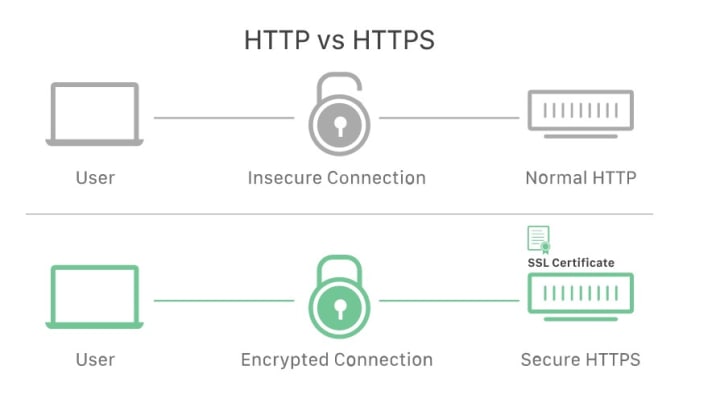
Obtaining an SSL certificate for your website is one of the first steps toward HIPAA compliance. This is evident in the URL before your site's name, which contains https://.
The acronym HTTPS stands for Secure Sockets Layer. It refers to the method by which you can keep an internet connection secure and protect data transmitted between your website and the server.
SSL encrypts data to keep it from being read. As a result, if someone were to try and access your website, it would be meaningless.
Although SSL meets HIPAA's data transmission security requirement, the most important thing to remember is that your web host should have a sufficiently robust SSL configuration.
2. All data should be encrypted.
Your website's data must be kept secure. Whether the information you have is gathered through emails or online web forms on your site, it must always be encrypted. This ensures that all traffic between your website and the end-user is secure. The only person who should have access to the information is the end-user.
However, this implies that data that is stored locally or in the cloud must be encrypted. It's especially essential if you've backed up data to locations outside of your control or if you share a web server with other customers.
3. Make a complete backup of everything
Backing up customer information is critical since it must be restored in the event of an emergency. You must make sure that your backup is HIPAA compliant, whether you use a local copy or a secure cloud service.
It is critical to have a data backup strategy and recovery processes in place in case PHIs are destroyed due to fire, natural calamities, accidental deletion, or system failures.
4. Maintain data integrity
Data integrity means that the data hasn't been tampered with or modified in any way. There are a variety of encryption techniques that provide tamper-proof integrity, including AES, PGP, and SSL.
You'll need to establish integrity policies and put in place the appropriate processes to meet these standards. To identify and validate all of the users with authorization to access PHI, do comprehensive regular integrity checks.
5. Encrypt data when it is transmitted.
While it is critical to keep data on a server that is HIPPA compliant, you must also provide transmission security.
It is critical that any data exchanged between users and websites be encrypted. Data is frequently scrambled during transit, requiring encryption tools to unscramble it. Even if a hacker tries to intercept the information while it is being transmitted, they will not be able to comprehend or modify any data.
6. Data permanently deleted
You must permanently delete data if a client asks you to remove their information from your database or decides to stop using your service. All data that is not relevant to a business must be deleted under HIPAA rules.
However, finding this information may be difficult. Locating all of the places where the data is stored and archived takes time. This covers data that has been backed up to storage or servers as well.
7. Only authorized personnel will have access to your personal information.
You've made the effort and invested the time to ensure that data is encrypted and kept in a safe environment. Anyone with access to the right keys, however, can gain access to the information as well.
You should use such regulations as:
- Unique and secure logins
- Only authorized individuals are permitted to modify controls.
- Limiting the number of people who may access your email and messaging systems
- Only administrators should be able to access administrative features, such as updating a website.
- Assigning varying levels of clearance and access to systems to personnel based on their job descriptions
Employees must be made aware that only authorized persons have access to HIPAA-protected health records and information. This may jeopardize HIPAA rules.
8. Approved security management and data breach procedures
The second layer of protection, administrative safeguard number four, is awareness and training. As part of your overall HIPAA compliance program, you should consider the following security best practices:
- Make it a point to keep your systems up to date and notify you when critical updates are available.
- To keep employees safe, make certain that they are following all safety precautions.
- Check whether anyone is logging in to the account.
- To minimize their influence, devise responses to suspicious activities and neutralize them.
- Examine whether your policies and procedures are doing their job in keeping client data secure.
- Develop a backup plan to assist minimize the damage from a breach and manage compromised data in the event of one.
9. Change your passwords regularly
You should establish and enforce stringent password creation, modification, and protection regulations. All passwords, however, must be changed regularly according to HIPAA.
10. Third-party service providers that adhere to HIPAA requirements may be included in client contracts.
Third-party vendors and service providers who have access to your website must also sign a HIPAA Business Associate Privacy Agreement. This ensures that they will adhere to HIPAA security standards as well.
Both the web development company and web host provider will have to make sure that the infrastructure they offer is HIPAA-compliant.
Final thoughts

There are numerous methods to assure HIPAA compliance. But the bottom line is that you must now put in place the appropriate HIPAA compliance procedures and ensure your company's success isn't harmed. If you are discovered to be non-compliant, severe fines can be levied, with criminal penalties potentially reaching $1.5 million and civil liability for each violation.
The easiest method to safeguard your patients' information and your business at all times is to follow HIPAA standards and conduct routine checks regularly.
About the Creator
Keep reading
More stories from Amlan Maiti and writers in Education and other communities.
How to Rank #1 on Google
When it comes to online marketing, SEO is one of the most important strategies you can implement. If you want your website to rank #1 on Google, you need to make sure your SEO is on point! In this blog post, we will discuss the ultimate guide to ranking #1 on Google. We will cover everything from keyword research to link building. Before we start this blog we recommend you hire an SEO Company. So whether you are just starting with SEO or you are looking for ways to improve your current strategy, this blog post is for you!
By Amlan Maiti4 years ago in Education
Striking the Right Balance: Modern Tech and the Human Touch in Harmony
As technology continues to reshape every corner of business and daily life, the balance between innovation and personal interaction becomes increasingly important. Automation, artificial intelligence, and digital communication have allowed companies to operate faster, smarter, and more efficiently. These tools improve productivity and offer consumers greater convenience, transforming how services are delivered and experiences are shaped.
By Ian Schenkel Haliburtonabout 4 hours ago in Education



Comments
There are no comments for this story
Be the first to respond and start the conversation.