
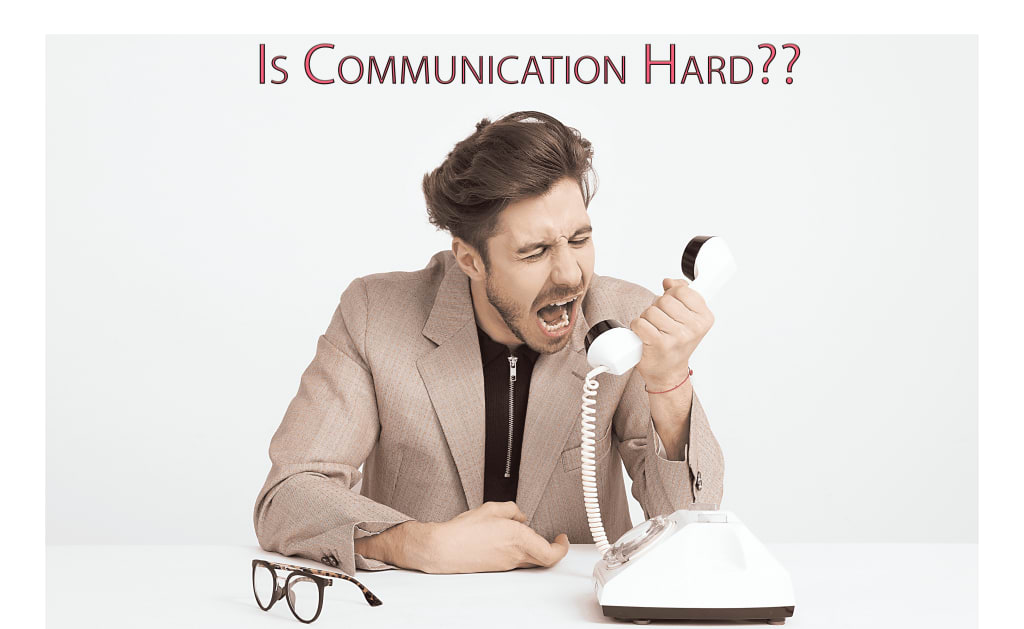
Communication
Communication is the process of exchanging information, ideas, and thoughts between individuals or groups. It can be done through various means, including verbal, nonverbal, and written forms. Communication plays a critical role in personal and professional relationships, as it enables individuals to convey their needs, wants, and ideas, and to understand the perspectives of others.
Types
Verbal communication
This involves the use of spoken words, such as in face-to-face conversations, phone calls, and presentations.
Nonverbal communication
This involves the use of body language, such as facial expressions, gestures, and posture, to supplement verbal communication.
Written communication
This involves the use of written words, such as in emails, letters, and text messages.
Interpersonal communication
This involves communication between two or more individuals in a personal or professional setting.
Group communication
This involves communication among a group of individuals, such as in meetings, team projects, and presentations.
Mass communication
This involves the use of media, such as television, radio, and newspapers, to disseminate information to a large audience.
Effective Communication
Effective communication is vital for success in any field. It involves the ability to convey information clearly and effectively, as well as the ability to listen actively and respond appropriately.
There are several key elements of effective communication:
Active listening: This involves paying full attention to the speaker and providing feedback, such as nodding or repeating key points.
Clarity and concision: Speak clearly and at a moderate pace, and use simple and direct language. Avoid jargon or overly complex words or phrases.
Adapting to your audience: Be aware of your audience and tailor your message to their level of understanding.
Nonverbal communication: Use appropriate body language, such as maintaining eye contact and using gestures, to supplement your verbal message.
Confidence: Speak with confidence and remain calm under pressure.
Empathy: try to understand the point of view of the other person and respond accordingly.
Feedback: Seek feedback on your communication skills and work on areas that need improvement.
Practice: The more you communicate, the more comfortable and skilled you will become.
Seek out opportunities to communicate in a variety of settings and with different people.
Continuous learning: read books, articles, and blogs about communication, and watch videos of effective communicators. Take a course on effective communication or public speaking.
By developing these skills, you can improve your communication and build stronger, more productive relationships with the people around you.
There are several ways to improve communication skills, including:
Practice active listening: This means truly focusing on the person speaking and trying to understand their perspective.
Speak clearly and at a good pace: This will help others understand you better.
Be aware of nonverbal communication: This includes things like facial expressions and body language, which can convey a lot of information.
Use simple, straightforward language: Avoid using jargon or overly complex words and phrases.
Be open to feedback: Ask for feedback on your communication skills and take it constructively.
Read and write frequently: This will help you improve your vocabulary and grammar, which are important for effective communication.
Take a class or workshop: There are many resources available to help you improve your communication skills, such as classes, workshops, or online tutorials.
Practice, practice, practice: The more you practice communicating, the better you will become.
Thank You for reading and learning from this stories,
Comments and likes are welcomed!!
About the Creator
Keep reading
More stories from Sivasankaran and writers in Education and other communities.
Moral Story
Once upon a time, there was a wealthy merchant named Rohan who lived in a small village. Rohan had always been known for his wealth and had always been very proud of it. He never missed an opportunity to flaunt his wealth and always looked down upon the poor people of the village.
By Sivasankaran3 years ago in Education
LLMs in Education Market Forecast to Hit USD 127.9 Bn by 2034: Transforming Digital Learning Worldwide
Introduction The LLMs in Education market refers to the use of large language models within digital learning platforms, academic institutions, and corporate training systems. Large language models such as OpenAI’s GPT systems and Google’s Gemini are designed to process and generate human-like text, enabling tutoring, content creation, assessment support, and personalized feedback. These models are integrated into learning management systems, virtual classrooms, and mobile applications. The market is projected to reach USD 127.9 billion by 2034, reflecting rapid digital transformation across global education systems.
By Roberto Crum6 days ago in Education
The BAFTA Awards
By now, in a stunning departure from recent years, most of the world is aware of what happened at the BAFTA film awards. Social Media Headlines will tell you the bare bones: that John Davidson, a Tourette's Syndrome advocate, shouted a racial slur at two Actors of Colour, Michael B Jordan and Delroy Lindo.
By Natasja Rose4 days ago in Psyche



Comments
There are no comments for this story
Be the first to respond and start the conversation.