
How to Get Your Driver's License in Ontario
Driver's license
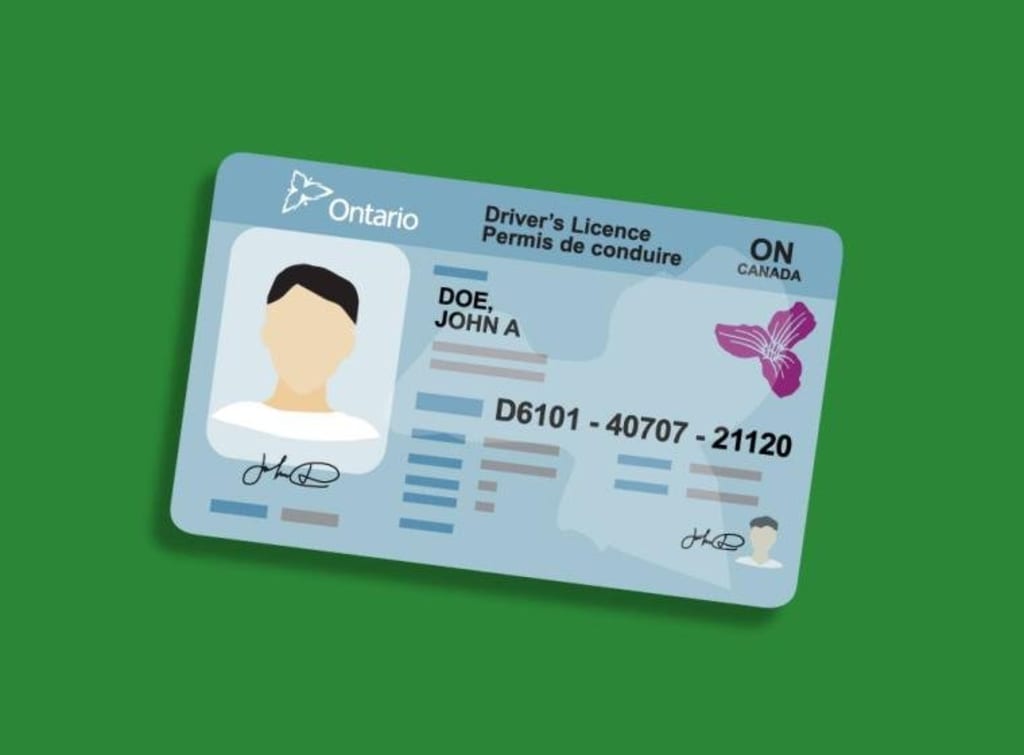
Getting a driver's license in Ontario is a process that involves passing various tests, completing required training, and meeting certain eligibility criteria. Whether you're a new driver or someone looking to upgrade to a different class of license, the steps you'll need to follow are generally the same.
Step 1: Get a Learner's Permit
The first step in obtaining a driver's license in Ontario is to get a learner's permit, which allows you to practice driving under certain conditions. To be eligible for a learner's permit, you must be at least 16 years old and pass a vision test. You'll also need to complete a written test that covers the rules of the road and safe driving practices.
Step 2: Complete a Beginner Driver Education (BDE) Course
Before you can move on to the next stage of licensing, you must complete a Beginner Driver Education (BDE) course. This course is designed to teach new drivers the basics of safe driving and is mandatory for all new drivers in Ontario. The course consists of in-class and in-car instruction and is usually completed over a period of several weeks.
Step 3: Pass a Road Test
Once you've completed the BDE course and held your learner's permit for at least six months, you're eligible to take the road test. This test assesses your driving skills and knowledge of the rules of the road. You'll be evaluated on a variety of skills, including accelerating, turning, changing lanes, and parallel parking.
Step 4: Get a G1 License
tep 4 in obtaining a driver's license in Ontario is to take the G1 knowledge test. The G1 knowledge test is a multiple-choice test that assesses your understanding of the rules of the road, traffic signs, and safe driving practices. You must pass this test to receive a G1 license, which allows you to practice driving on Ontario roads with a fully licensed driver in the car.
It's important to study the Official Driver's Handbook, available from the Ministry of Transportation, to prepare for the G1 knowledge test. You can also take practice tests online to get a sense of the types of questions you'll be asked.
After passing the G1 knowledge test, you'll receive a G1 license, which is valid for 5 years. With a G1 license, you can start practicing your driving skills and preparing for the next step in the licensing process, the G1 road test.
Remember, while holding a G1 license, you're subject to certain restrictions, such as not being able to drive on 400-series highways, not being able to drive between midnight and 5:00 a.m., and not being able to drive with more than one passenger under the age of 19 unless accompanied by a fully licensed driver. These restrictions are in place to help ensure that new drivers have enough time and experience to develop their skills before taking on the responsibilities of a full license.
Step 5: Obtain a G2 License
After holding your G1 license for at least 8 months, you're eligible to take the G2 road test. This test is similar to the G1 test, but it's designed to assess your driving skills in more complex situations. If you pass the G2 road test, you'll receive a G2 license, which allows you to drive on your own with fewer restrictions than a G1 license. With a G2 license, you can drive without a fully licensed driver in the car and at any time of day, although you're still subject to some restrictions, such as not being able to drive with more than one passenger under the age of 19 after midnight.
Step 6: Get a Full G License
After holding your G2 license for at least 12 months, you're eligible to take the final road test for a full G license. This test is designed to assess your driving skills and knowledge of the rules of the road in real-life situations. If you pass the final road test, you'll receive a full G license, which allows you to drive without any restrictions.
With a full G license, you have the freedom to drive anywhere, anytime, and with any number of passengers. It's important to remember, however, that a driver's license is a privilege, not a right, and it's your responsibility to always drive safely and responsibly. To maintain your license, you must follow all traffic laws, keep your vehicle in good working condition, and avoid convictions for driving-related offenses.
Conclusion
In conclusion, getting a driver's license in Ontario is an important and exciting step toward achieving independence and freedom on the road. The process of obtaining a license involves obtaining a learner's permit, completing a beginner driver education course, passing various road tests, and meeting eligibility criteria. It's important to take the time to learn the rules of the road, practice safe driving habits, and always prioritize safety while behind the wheel.
A driver's license is a privilege and a responsibility, and it's important to remember that you must always follow traffic laws, maintain your vehicle in good working condition, and avoid convictions for driving-related offenses to keep your license in good standing.
By following the steps outlined above, you'll be well on your way to obtaining your driver's license in Ontario and enjoying the freedom and independence that comes with it.
About the Creator
Keep reading
More stories from Inirah Nahomi and writers in Education and other communities.
Higher studies process in Canada
Higher studies process in Canada There are many individuals who choose to prefer higher studies. For example, an astute student who passed out of his/her undergraduate studies could be an employee who is bored with his/her career and willing to possess himself into a new career or an aspirant who loves to expand his/her border of knowledge. If you are one of the abovementioned and need to know the whole process before their desired actual learning. the steps involved in this process are as follows,
By Inirah Nahomi3 years ago in Education
How Japan Saved Its Biggest City from Collapse
400 years ago, modern-day Tokyo was known as Edo, and it was already one of the biggest cities in the world, with a population approaching 1 million. However, it was on the verge of ecological collapse. Years of intense logging had led to massive deforestation. The city now faced timber shortages and the impacts of severe erosion and frequent flooding that threatened food supplies. But over just a few decades, Edo will transform and become one of the most sustainable and efficient cities in history.
By Munesh Yadavabout 12 hours ago in Education
Understanding Laravel Helper Functions and Their Use Cases
Laravel is widely appreciated for its clean syntax, expressive structure, and developer-friendly ecosystem. One of the most underrated yet powerful features of the framework is its built-in helper functions. These helpers simplify common tasks, reduce boilerplate code, and improve overall development speed. If you’re working with Laravel regularly, understanding helpers in Laravel can significantly improve how efficiently you write and maintain code, especially when building modern applications such as dashboards, SaaS platforms, or integrations with tools like the Best AI Video Ads Tools for marketing automation.
By Lennox Grayabout 15 hours ago in Education



Comments
There are no comments for this story
Be the first to respond and start the conversation.