
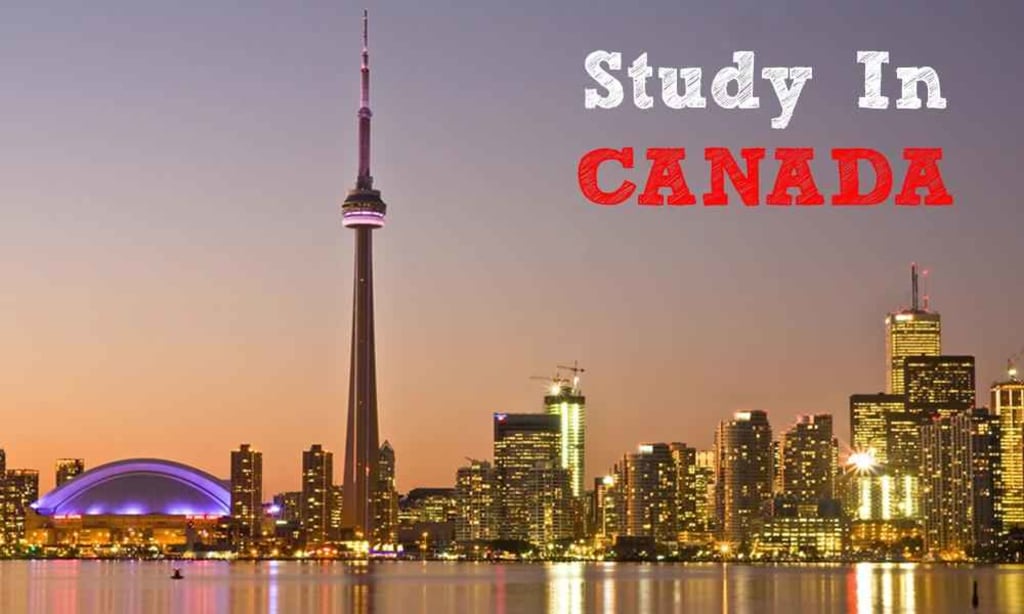
Higher studies process in Canada
There are many individuals who choose to prefer higher studies. For example, an astute student who passed out of his/her undergraduate studies could be an employee who is bored with his/her career and willing to possess himself into a new career or an aspirant who loves to expand his/her border of knowledge. If you are one of the abovementioned and need to know the whole process before their desired actual learning. the steps involved in this process are as follows,
1. Choose your area of interest
when it comes to higher studies it is always imperative to choose your area of interest. One might have come across many fields throughout their undergraduate studies or their professional life. However, it is essential to understand our favorite subject and narrow down our interest areas.
2. Choose your study destination
Once choosing our desired areas to study, the next and most important step is to choose the education destination – which college/ university and which country to study. This requires a lot of research. One needs to consider many factors such as course curriculum, college fees, living expenses, and the locality. The course curriculum should exactly or at least should match about 80% of your interest. College fees and living expenses should be under our budget and most importantly the locality you choose should provide job opportunities once you finish your higher studies. Also, it should be amenable, multi-diverse, and foster multiculturalism.
3. Write SOP to get into the college
SOP is a Statement Of Purpose- an essay required by your college and immigration high commission. It is an essential document with which you will decide whether to provide a student visa.
In this essay, a student must describe the following
- Academic background
- Professional background
- Why this course?
- How this course will improve you?
- Justification for choosing this college
- Justification for choosing this country
- What is your plan after your studies?
- Financial background?
All the above-mentioned should be well described maintaining coherence and cohesion with high standards of vocabulary.
4. prepare your past academic certificates ready
Convert all your past academic transcripts into a single PDF not exceeding 5MB which includes all your semester-wise mark sheets, provisional certificates, overall mark sheets, and degree certificates. If you have a diploma, provide all the above-mentioned in a separate single PDF. Include 10th mark sheets and 12th mark sheets with any of the files.
5. Prepare other documents (LOR, Experience certificate, last 3 months’ paystubs
There are certain other documents that are also required such as LOR (Letter of recommendation), the experience letter from your last employer, and the last 3 months’ salary slips. All these documents should be merged into a single PDF, not exceeding 5MB. One of the easiest ways to do this is by using the ilovepdf.com website.
6. Applying for the college
Let’s apply for the college with all said documents. Each college/university will be having its own timeline to announce its results whether you are given a chance to study in that institution or not considering your academic background, professional background, and other attached documents.
Once they decided, if you are selected into their program, you will receive a document name LOA (Letter Of Acceptance) or will be informed as not selected. This LOA consists of a set of essential information, instructions, and payment schedules.
Later, this LOA can be used to apply for an educational loan.
7. Apply for a student visa
Now we have obtained admission and our next step is to apply for a student visa to enter the foreign country and pursue higher studies. Student visa for Canada has 2 types 1. SDS -category and another one is Non-SDS category.
To apply for an SDS category, the following documents are required,
- E medical receipt,
- Academic and professional documents,
- Proof of acceptance to a DLI institution
- IELTS TRF (No band less than 6.5 in each module) report
- 1-year tuition fees
- 10000$ of CAD into a GIC account as proof of living expenses
- Student visa application
8. A valid passport
To apply for the Non-SDS category, the following documents are required,
- A valid passport
- Proof of acceptance to a designated learning institution in Canada
- Proof of financial support, such as bank statements or a letter of financial support
- Results of a language proficiency test (if applicable)
- A police clearance certificate or certificate of good conduct
- Medical examination results (if required)
- Any other supporting documents that may be requested, such as a CV, personal essay, or reference letters.
It is important to note that the exact documents required may vary depending on the country of origin and the specific circumstances of the applicant. It is recommended to check the immigration website of the Government of Canada for up-to-date information and specific requirements. All the best for your future endeavors.
About the Creator
Keep reading
More stories from Inirah Nahomi and writers in Education and other communities.
How to get a Study permit in Canada an Indian student
To obtain a student permit in Canada as an Indian student, you need to follow the below steps: 1. Choose a Designated Learning Institution (DLI): You need to first choose an educational institution in Canada that is designated to host international students. Make sure to check that the institution is on the Government of Canada's DLI list.
By Inirah Nahomi3 years ago in Education
UMPCO Inc: My Insider View on an Unsung Aerospace Fastener Maker
When I first learned about UMPCO Inc, I had no idea how deep its influence ran through aviation and aerospace hardware. Today, I want to take you behind the scenes of this fastener and hardware solutions manufacturer — a company that quietly supports every aircraft clip, clamp, and bracket that helps keep our skies safe.
By Beckett Dowhan6 days ago in Education
Getting Started with Still Fishing: A Beginner’s Guide
A Beginner’s Guide to Still Fishing So, you’ve decided to take up fishing, and after a quick search online, still fishing catches your eye. The name alone probably makes it sound easy, right? Just sit back, relax, and wait for the fish to bite.
By Irimia Rares5 days ago in Education


Comments
There are no comments for this story
Be the first to respond and start the conversation.