
How to Choose the Right Industrial Architectural Modeling Partner in the U.S.
Key Factors to Consider Before Partnering With an Industrial Modeling Firm

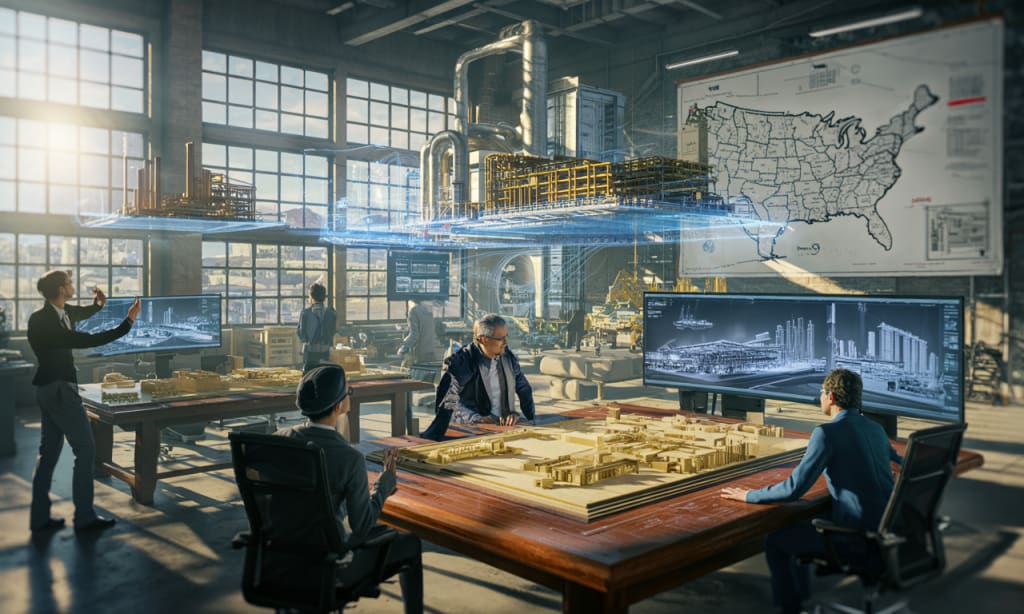
The Architecture, Engineering, and Construction (AEC) industry is experiencing unprecedented transformation in 2025. With 74% of industry professionals planning to implement new technologies to overcome key challenges, selecting the right industrial architectural modeling partner has never been more critical for project success.
Whether you're planning a manufacturing facility, warehouse complex, or industrial infrastructure project, your modeling partner will significantly impact project efficiency, cost management, and long-term operational success. This comprehensive guide will help you navigate the selection process with confidence.
Understanding the Current AEC Landscape in 2025
Digital Transformation and Technology Integration
Building Information Modeling (BIM) has been rated as the most prevalent digital technology in the industry today, fundamentally changing how industrial facilities are designed, constructed, and managed. The modern AEC environment demands partners who can leverage cutting-edge technologies while maintaining practical, cost-effective solutions.
The construction industry is undergoing a once-in-a-generation transformation, with AI-driven automation, digital twins, modular construction, and cloud-based workflows completely reshaping the DNA of AEC. Your modeling partner must be equipped to handle these evolving demands.
Industry Standards and Compliance
The U.S. market operates under specific standards that your modeling partner must understand and implement:
ISO 19650 – The international standard for BIM information management throughout a building's lifecycle
National BIM Standard-United States (NBIMS-US) – Provides consensus-based standards for the entire built environment
IFC (Industry Foundation Classes) – Open standard format enabling seamless data exchange between different BIM software applications
COBie (Construction Operations Building Information Exchange) – Standard for facility management information exchange
Adhering to established industry standards such as ISO 19650 ensures BIM practices align with regulatory requirements, leading to improved industry credibility and project outcomes.
Key Criteria for Selecting Your Industrial Architectural Modeling Partner

1. Technical Expertise and BIM Proficiency
Your ideal partner should demonstrate mastery across multiple dimensions of BIM technology:
Essential BIM Capabilities:
- 3D Modeling – Accurate spatial representation and visualization
- 4D Integration – Time-based scheduling and construction sequencing
- 5D Capabilities – Cost estimation and resource management integration
- 6D Implementation – Sustainability analysis and lifecycle assessment
Look for partners who can provide case studies demonstrating successful implementation of these multi-dimensional BIM approaches on industrial projects similar to yours.
Software Proficiency:
Your partner should be proficient in industry-standard software platforms including Autodesk Revit, AutoCAD Civil 3D, Navisworks, and demonstrate the ability to work with IFC formats for cross-platform collaboration.
2. Industry-Specific Experience
Industrial architectural projects have unique requirements that differ significantly from commercial or residential developments.
Evaluate potential partners based on their experience with:
- Manufacturing facilities and production plants
- Warehouse and distribution centers
- Industrial infrastructure and utilities
- Heavy industrial and process facilities
- Prefabricated and modular industrial construction
Request detailed portfolios showcasing completed industrial projects, including project scale, complexity, and specific challenges overcome.
3. Collaboration and Communication Systems
As projects grow in scale, so does stakeholder involvement. Your modeling partner must facilitate seamless collaboration across all project participants.
Essential Collaboration Features:
- Cloud-based BIM platforms for real-time access and updates
- Common Data Environment (CDE) implementation
- Structured information exchange protocols
- Multi-stakeholder coordination capabilities
- Clash detection and resolution processes
4. Understanding of Sustainability and Energy Standards
Carbon disclosure requirements for public projects took effect in early 2025 in several U.S. states, accelerating the adoption of low-carbon materials, lifecycle carbon accounting, and energy-efficient design practices.
Your partner should demonstrate capabilities in:
- LEED certification support
- Energy modeling and analysis
- Lifecycle carbon accounting
- Sustainable material selection
- Green building compliance documentation
5. Digital Twin and Lifecycle Support

Digital twins are shifting from futuristic concepts to must-have tools, offering a continuous data loop throughout a building's lifecycle.
Industrial facilities particularly benefit from digital twin technology for:
- Real-time operational monitoring
- Predictive maintenance planning
- Performance optimization
- Facility management integration
- Future renovation planning
Ensure your partner can deliver models that transition smoothly from design through construction to facility management.
6. Scalability and Resource Management
The average employee in an architectural or engineering firm has been there for 4.9 years, down from 7 years a decade ago. This industry-wide talent challenge makes partner scalability crucial.
Evaluate potential partners on:
- Team depth and redundancy
- Ability to scale resources for project demands
- Backup plans for key personnel transitions
- Training programs and knowledge transfer systems
- Workforce stability and retention rates
7. Quality Control and Accuracy Standards
Industrial projects demand exceptional precision. Your modeling partner should have:
- Documented quality assurance processes
- Multi-level review procedures
- Clash detection protocols
- Accuracy verification methodologies
- Clear error correction procedures
- Version control systems
8. AI and Automation Capabilities
74% of AEC companies globally are utilizing AI in one or more phases of their projects, with significant applications in design (48%) and planning (42%).
Progressive modeling partners should offer:
- AI-powered design optimization
- Automated clash detection and resolution
- Predictive risk assessment
- Generative design capabilities
- Automated documentation generation
9. Cost Transparency and Value Delivery
Beyond competitive pricing, evaluate partners on:
- Clear, detailed pricing structures
- Transparent change order processes
- Value engineering capabilities
- ROI demonstration on similar projects
- Cost-saving innovation track record
10. Security and Data Management
Industrial projects often involve proprietary processes and sensitive information. Ensure your partner provides:
- Robust cybersecurity measures
- Secure file transfer protocols
- Non-disclosure agreement compliance
- Data backup and recovery systems
- Long-term data archiving solutions
Future-Proofing Your Selection
62.5% of AEC professionals plan to adopt at least one emerging technology trend in the next five years.
Choose a partner committed to:
- Continuous technology adoption and training
- Industry trend monitoring and adaptation
- Innovation investment
- Long-term relationship development
- Flexibility to evolve with changing project needs
Conclusion
Selecting the right industrial architectural modeling partner is a strategic decision that will impact every phase of your project and beyond. By thoroughly evaluating potential partners against the criteria outlined in this guide, you'll position your project for success in an increasingly digital and collaborative AEC environment.
The ideal partner brings not just technical expertise, but also industry knowledge, collaborative spirit, and commitment to your project's long-term success. Take the time to conduct a thorough evaluation process, and you'll establish a partnership that delivers value well beyond the initial project deliverables.
Remember that the AEC industry is rapidly evolving, and your modeling partner should be a forward-thinking collaborator who helps you navigate emerging technologies and industry trends while maintaining focus on practical, cost-effective solutions that meet your specific industrial project needs.
About the Creator
Matt Sharon
A professional content writer. Having years of experience in Technology, health, finance, and construction and real estate field. Writing is my passion and I love to play with words Confidently.
Keep reading
More stories from Matt Sharon and writers in Education and other communities.
Why Scan-to-BIM Is Transforming Historic Building Restoration?
Restoring historic buildings is one of the most delicate responsibilities in the architecture, engineering, and construction (AEC) industry. Every stone, column, arch, and decorative detail carries cultural, architectural, and ancestral value. Traditional surveying methods often fall short when dealing with aging structures, inaccessible areas, or intricate ornamentation.
By Matt Sharon4 months ago in Education
Reel Cap Components in Aerospace Electronics: History, Function, and Aviation Applications
Introduction: My Experience Exploring Reel Cap Components When I started researching aerospace electronic components, I discovered that even the smallest hardware pieces play a crucial role in aircraft systems. One such component that caught my attention was the Reel Cap, an often overlooked but essential element in electronic component packaging, aviation circuitry, and aerospace manufacturing systems.
By Beckett Dowhan7 days ago in Education
How Magnetic Fields Shape Solar Activity: The Hidden Power Behind Solar Flares and Sunspots
At first glance, the Sun appears calm and steady—a glowing sphere lighting our skies every day. Yet beneath this peaceful appearance lies a star constantly shaped by powerful and invisible forces. These forces twist, stretch, and reshape the Sun’s surface, producing dramatic events such as sunspots, solar flares, and massive eruptions of energy.
By shahkar jalal2 days ago in Education




Comments
There are no comments for this story
Be the first to respond and start the conversation.