

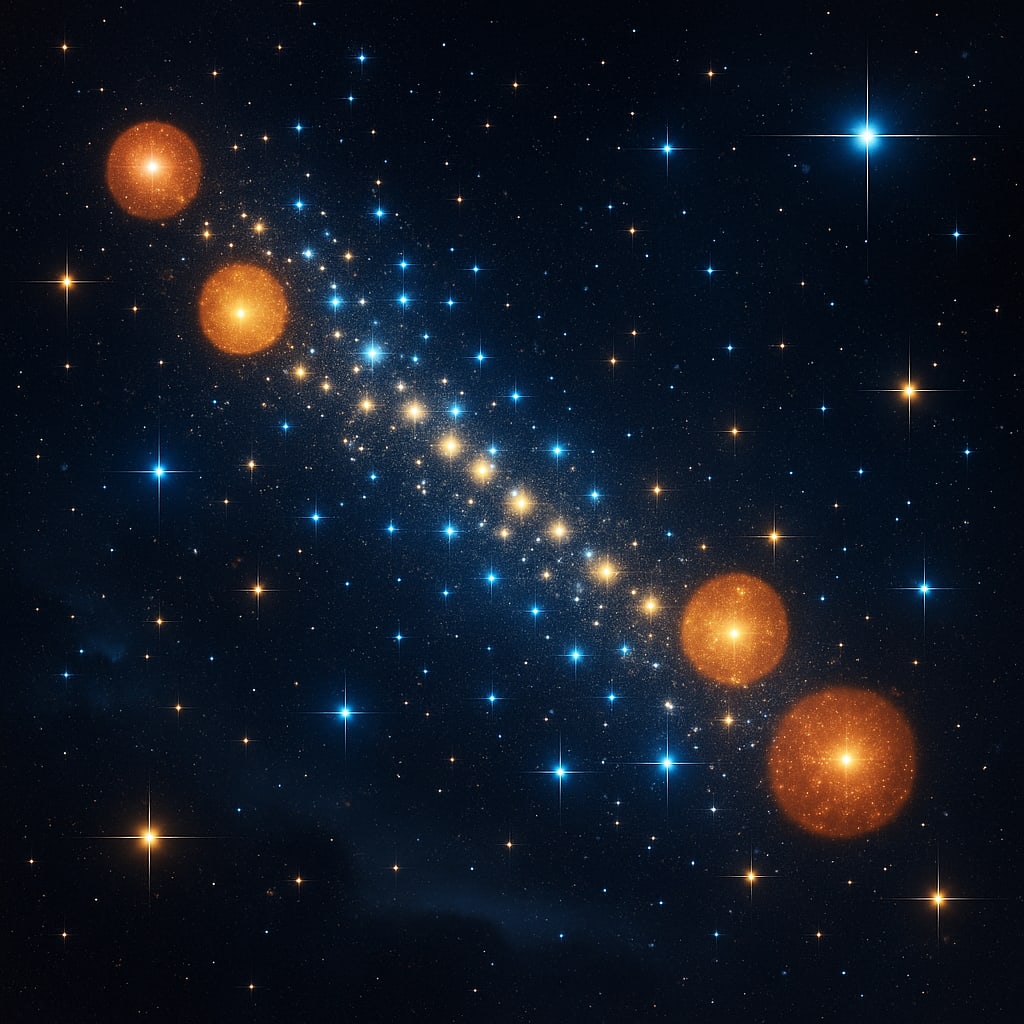
The stars shine so steadily and so far away that it feels impossible to imagine them having a beginning or an end. Yet every star has a “date of birth” and a life cycle that eventually comes to an end. Astronomers have developed several clever methods to estimate how old stars are—even though nobody was around to watch them form.
Why Measuring the Age of Stars Is So Tricky
On Earth, geologists can use radioactive isotopes in rocks as natural clocks. The decay of uranium or potassium, for example, tells us exactly how long a rock has existed. But stars don’t conveniently contain such isotopes that we can measure from afar. Instead, scientists rely on indirect methods, looking at the way stars shine, evolve, and change over time.
The challenge is that two stars can look nearly identical on the outside yet be at very different stages of their lives. Figuring out the difference requires combining physics, observation, and models of stellar evolution.
Stellar Evolution: The Cosmic Clock
A star’s lifetime is written into its mass. Massive stars burn their fuel furiously and live only a few million years, while smaller stars like our Sun can shine steadily for billions of years. Each star passes through predictable phases:
- Birth: Collapsing from a cloud of gas and dust.
- Main sequence: Burning hydrogen in its core, where it spends most of its life.
- Old age: Swelling into a red giant or supergiant, then shedding its outer layers or exploding as a supernova.
By comparing a star’s current state to these evolutionary tracks, astronomers can estimate its age.
The H-R Diagram: Plotting the Life of a Star
One of the most powerful tools is the Hertzsprung–Russell diagram (or H-R diagram), which plots stars according to their brightness and surface temperature (which we see as color). A star’s position on this chart reveals how much fuel it has already burned.
The technique is especially useful for star clusters, where thousands of stars form at the same time. In a young cluster, all the stars still sit on the main sequence. In older clusters, the more massive stars have already “peeled off” and evolved into giants. By finding this “turn-off point” in the diagram, scientists can calculate the cluster’s age with surprising precision.
For example, globular clusters orbiting our Milky Way have turn-off points that reveal ages of around 12–13 billion years, making them nearly as old as the universe itself.
Listening to Stellar Heartbeats: Asteroseismology
A more modern approach comes from space telescopes like Kepler and TESS. They detect tiny fluctuations in a star’s brightness caused by vibrations running through its interior—like starquakes. This field, known as asteroseismology, works a bit like seismology on Earth, where scientists study earthquakes to probe the planet’s interior.
By analyzing the frequencies of these oscillations, astronomers can measure a star’s density and internal structure. From there, they can estimate its age to within about 10%, which is an incredible level of accuracy for objects light-years away.
Chemical Clues Written in Starlight
Stars also carry a chemical “fingerprint” that reflects when they were born. The earliest stars in the universe contained almost nothing but hydrogen and helium. Each new generation of stars formed out of material enriched by previous stellar explosions, adding heavier elements like carbon, oxygen, and iron.
Astronomers call this property metallicity. Generally, a star with very low metallicity is ancient, while stars rich in heavy elements are younger. By studying the absorption lines in a star’s spectrum, scientists can read this chemical code and place the star within the broader timeline of cosmic history.
Dating the Sun: Our Local Example
So how old is our own star, the Sun? Using meteorites—tiny fragments left over from the birth of the solar system—as well as stellar models, scientists have determined that the Sun is about 4.57 billion years old. It is roughly halfway through its life on the main sequence, meaning it still has another 4–5 billion years before transforming into a red giant.
This estimate not only tells us about the Sun’s age but also provides a benchmark for studying other stars.
Why Knowing Stellar Ages Matters
Measuring the ages of stars is not just an academic exercise. It helps scientists:
- Trace galactic history: By mapping the ages of stars across the Milky Way, astronomers can reconstruct how our galaxy formed and evolved.
- Understand the universe’s timeline: The oldest stars serve as cosmic fossils, giving us minimum ages for the universe itself.
- Study exoplanets and life: The age of a star is crucial when studying its planets. A very young system may still be too chaotic for life, while an older, stable system could be more promising for habitability.
Reading the Biography of the Stars
Every star you see at night is not just a distant point of light—it is a cosmic biography written across billions of years. Scientists have learned to read these biographies using brightness, vibrations, chemistry, and detailed models of stellar evolution.
The next time you gaze up at the stars, remember: each one has a story. Some are just beginning their journey, while others are ancient survivors from the dawn of the universe. Thanks to the work of astronomers, we can finally place these distant suns on the timeline of cosmic history.
About the Creator
Keep reading
More stories from Holianyk Ihor and writers in Education and other communities.
What Are Cosmic Jets and Why Are They So Powerful?
If you ever found yourself near a young star, a neutron star, or a black hole, you might witness one of the most awe-inspiring spectacles in the universe — a cosmic jet. These are enormous streams of matter and energy blasting into space at nearly the speed of light. They appear as brilliant beams shooting from the poles of celestial objects, sometimes stretching for thousands or even millions of light-years. But what exactly are these cosmic “fire hoses,” and why are they so incredibly powerful?
By Holianyk Ihor5 months ago in Education
The Day Learning Spoke Back
The classroom had learned to be silent long before the students did. Its walls were pale, almost apologetic, as if they knew they were holding more than chalk dust and old posters. They held unfinished thoughts. Forgotten questions. The kind of curiosity that once burned brightly and then learned, slowly, to dim itself.
By Jhon smitha day ago in Education


Comments
There are no comments for this story
Be the first to respond and start the conversation.