
How Does the Renal System Regulate Fluid and Electrolyte Balance?
Various Ways How Renal System Controls Fluid and Electrolyte Balance

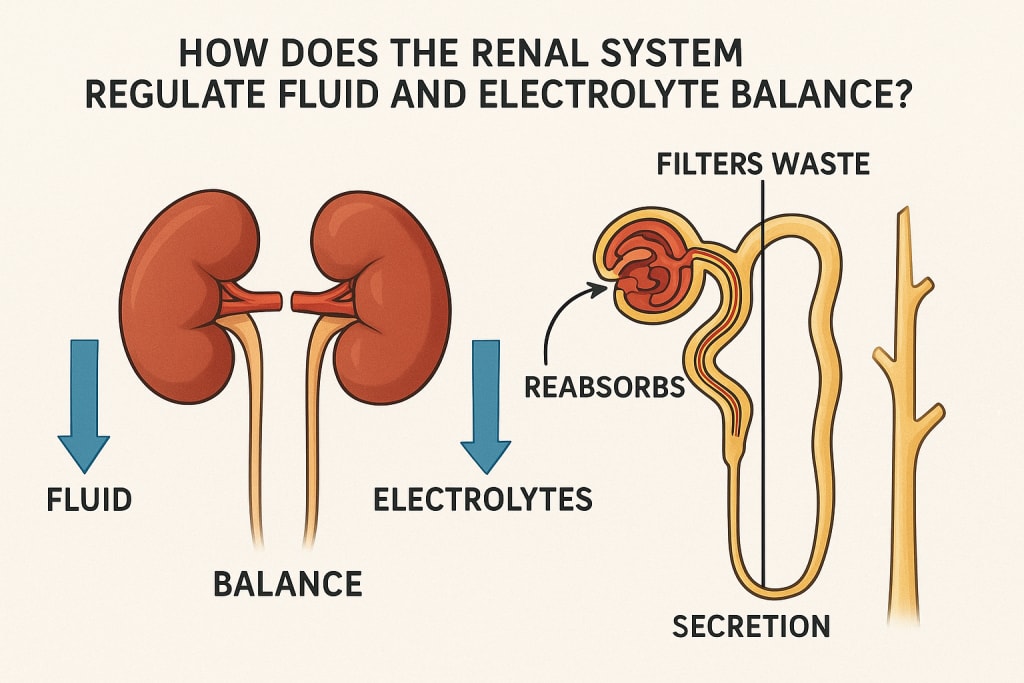
As you know, the renal system is made up of the kidneys. It plays a vital role as it maintains the body's fluid and electrolyte balance. Moreover, it keeps the body's pH level stable and enables the filtering of waste from the blood. The kidneys make sure that our internal environment stays balanced. However, this balance is vital for healthy bodily functions, for example, nerve transmission and muscle contractions.
In case, you need extra assistance related to this topic, feel free to get aid from nursing assignment writing service. Yet, the kidneys' ability to adjust to diverse conditions is what aids us in staying healthy every day. The following are various ways in which the renal system regulates fluid and electrolyte balance.
Various Ways How Renal System Controls Fluid and Electrolyte Balance
You might be aware that the renal system plays a crucial role as it maintains fluid and electrolyte balance in your body. There are various ways through which it processes. Some of them may involve like filtration, reabsorption, and secretion, all of which work together to keep our internal environment stable. Further, hormones like ADH and aldosterone enables you regulate water and sodium levels. It also ensures proper hydration and blood pressure. Through this intricate system, the kidneys help maintain vital balance. If you still find yourself stuck in this concept, get aid from services like Assignment Desk. Below are some of the diverse ways how renal system, controls fluid and electrolyte balance.
Filtration
As you are aware, filtration is the first step in urine formation, where the blood from the body enters the kidneys via the renal arteries. Do you know that there are tiny structures called nephrons? They basically filter the blood. Each nephron has a part that is known as the glomerulus, which is a network of tiny blood vessels. Besides, the glomerulus acts as the filter and allows small molecules like waste products and glucose to pass into the Bowman's capsule.
Reabsorption
Once the blood is filtered in the kidneys, the body needs to reclaim many of the substances it still wants, like water and glucose. Moreover, this process is referred to as reabsorption. You may know that the kidneys are very efficient in this process. For example, nearly all the glucose, most of the sodium, and a significant amount of water are reabsorbed. The amount of reabsorption is finely tuned and depends on the body’s needs. Besides, it happens in different parts of the nephron: the proximal tubule and the loop of Henle. This helps maintain homeostasis by balancing the levels of fluids and electrolytes in the body.
Secretion
It is a type of process that allows the kidneys to control the composition of the blood. After the filtration and reabsorption step, there may still be substances that the body needs to remove. Furthermore, secretion involves waste products that are not filtered in the first stage, which need to be removed in excess, like hydrogen ions and certain medications. Hence, this process happens in the distal convoluted tubule and collecting duct of the nephron. As you know, secretion with filtration and reabsorption is vital as it maintains proper fluid and electrolyte balance in the body.
ADH Release
Do you know what ADH means? It refers to antidiuretic hormone, which plays a crucial role in regulating the body's water balance. Besides, when your body becomes dehydrated or blood volume is low, the brain gives signals to the pituitary glands to release ADH into the bloodstream. It targets the kidneys and collects in the collecting ducts in the nephrons, where it makes the barriers of these ducts more permeable to water. Further, its release helps the body conserve water, which is crucial when you’re dehydrated. On the other hand, when you’re well-hydrated, ADH levels drop, and the kidneys allow for more water to be excreted in the urine.
Aldosterone Secretion
It is a type of hormone that is produced by the adrenal glands. It is located on the top of your kidneys. Furthermore, it aids you in regulating the balance of sodium & potassium in the body, as it is vital for maintaining blood pressure & proper fluid levels. As you know, when your blood pressure drops, the kidneys release a hormone known as renin. It starts a process that leads to the production of aldosterone. Aldosterone then behaves on the distal convoluted tubules and collecting ducts of the nephrons, where it promotes the reabsorption of sodium from the urine back into the bloodstream.
Renin-Angiotensin System
The renin-angiotensin system is a type of pathway that helps in regulating blood pressure and sodium levels in your body. It begins a cascade of reactions that leads to the production of angiotensin II, which is a powerful hormone and has several effects. Besides, it constricts blood vessels, which raises blood pressure, and it stimulates the release of aldosterone from the adrenal glands. As you know, the RAS aids in maintaining stable blood pressure and fluid levels, which prevents issues like dehydration or low blood pressure. This system is particularly vital when the body needs to quickly adjust to changes in blood volume or sodium.
Sodium Balance
You might know that sodium is one of the crucial electrolytes in the body. Here, the key plays the central role as it maintains its balance. It is also vital for nerve function and fluid balance. As you know that when there is more sodium in the body, the kidneys will pass more urine to restore balance. It helps in bringing the sodium levels back to a normal state. But if the sodium level is too low, the kidneys hold on to as much sodium as possible. It is complex to understand this process, so you can get help with assignment writing for expert assistance.
Acid-Base Balance
You may know that the kidneys are responsible for preserving the pH balance of the blood, which is vital for proper cell function. Do you know what should be the range of blood pH? It must remain within a thin range of 7.35 to 7.45 for the body to function in normal way. When the blood becomes overly acidic (low pH), the kidneys pass hydrogen ions into the urine and reabsorb bicarbonate, raising the pH back to normal. When the blood turns too alkaline (high pH), the kidneys do the contrary by reingesting more hydrogen ions and voiding bicarbonate. This process is essential as it keeps the body’s acid-base equalize. Also, it stops issues like acidosis (too much acid) or alkalosis (too much base), both of which can interfere with normal metabolic functions.
Final Thoughts
In brief, as you are aware that the renal system is vital as it helps in managing the body's fluids & waste products. As you know, with the combination of filtration, hormonal regulation, reabsorption, and secretion, the kidneys handle a delicate balance that helps many functions. It keeps the blood pressure stable to make sure that cells function properly. Moreover, without this intricate system, our bodies would suffer to survive because the kidneys act as the body's natural filter. So, it is crucial to remember how essential the kidneys are in keeping everything in check and balance. If you need further clarity, a nursing assignment writing service can provide expert guidance.
Download Now: How to Master A-Level Exams PDF Guide
About the Creator
Personal Statement Writer
Get the best personal statement writing service in UK from professional writer and express your skills and qualities. Order now and get on-time delivery & 24/7 support.
Keep reading
More stories from Personal Statement Writer and writers in Education and other communities.
How To Best Showcase One’s Marketing Skills to Recruiters?
In today's competitive market, having strong marketing is not enough; you need to know how to present it effectively to outperform your competitors. Additionally, recruiters look for candidates who not only understand marketing but also show real-world results. If you need any help regarding marketing, you can seek an assignment helper. Further, this post will discuss the top ten ways through which you can showcase your marketing skills. So without wasting any time, explore this post.
By Personal Statement Writer5 months ago in Education
Truth with Responsibility: Navigating Ethics in Documentary Filmmaking
Documentary filmmaking carries a unique power and responsibility. Unlike fictional storytelling, documentaries present real people, real events, and real consequences. Filmmakers step into the lives of individuals and communities, often during vulnerable moments, with the intention of sharing truths that inform and inspire audiences. This power demands a strong ethical foundation. Ethical considerations in documentary production are not optional guidelines but essential principles that protect subjects, preserve credibility, and uphold the integrity of storytelling.
By Nigel Sinclair5 days ago in Education
Why IT Hiring Struggles Despite Plenty of Available Talent
Companies have very well discovered that their open roles are unfilled, not because talent has suddenly vanished. It’s because their expectations have drifted away from what the available workforce can realistically deliver.
By Techreviewer6 days ago in Education




Comments
There are no comments for this story
Be the first to respond and start the conversation.