
How Bill Gates Achieved Success" (simple and direct)
How innovation, strategy, and persistence built an empire."
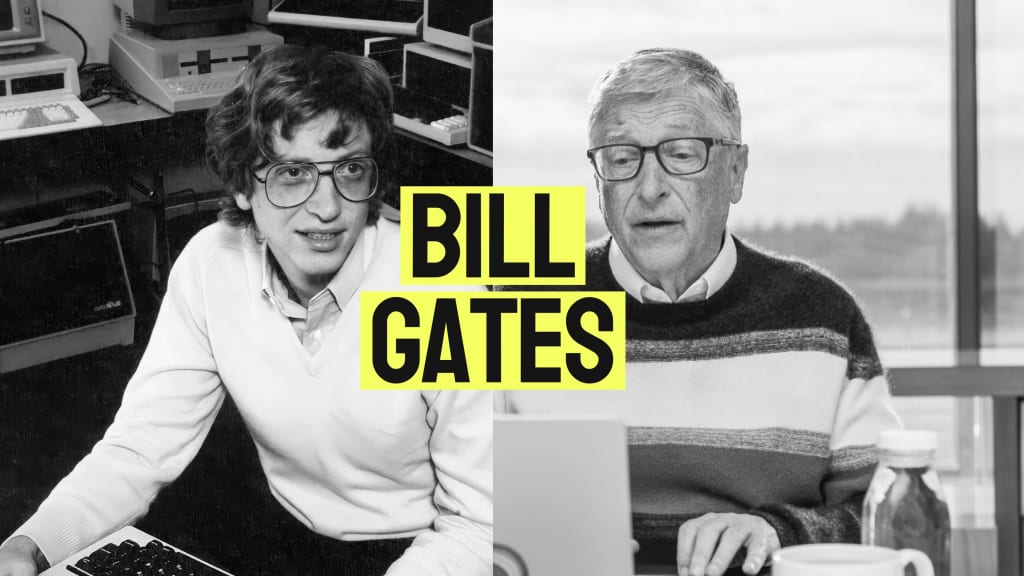
When people talk about the rise of personal computers, Bill Gates is almost always at the center of the conversation. As Microsoft’s co-founder and one of the wealthiest individuals on the planet, he symbolizes the technological revolution of the late 20th century. His achievements, however, are not just a product of fortune—they stem from curiosity, foresight, perseverance, and the courage to seize opportunities others ignored. Gates’s story demonstrates how determination paired with innovation can reshape the world.
Early Passion for Computers
Born in 1955 in Seattle, Washington, Gates grew up in a household that encouraged learning, ambition, and problem-solving. From a young age, he excelled at puzzles and mathematics. His life changed dramatically when, as a teenager at Lakeside School, he discovered the school’s computer terminal—a rarity at the time.
During the late 1960s, when computers were still expensive and uncommon, Gates and his close friend Paul Allen immersed themselves in programming. They experimented endlessly, learning by trial and error. While most teenagers were still searching for direction, Gates was already writing software and envisioning technology’s potential.
From Harvard to Microsoft
In 1973, Gates entered Harvard University to study mathematics and computer science. But the pull of technology was stronger than academics. He and Paul Allen read about the Altair 8800, one of the first personal computers, and quickly developed software to run on it.
Their program caught the attention of the Altair’s makers, and the success of that project convinced Gates to leave Harvard in 1975. That leap of faith marked the beginning of Microsoft, a company destined to change the computing industry.
Building a Software Empire
The name “Microsoft” was a blend of “microcomputer” and “software,” reflecting Gates and Allen’s belief that the personal computer market was about to explode. Their pivotal opportunity arrived in 1980, when IBM asked Microsoft to create an operating system for its new personal computer.
Instead of building one from scratch, Microsoft purchased and modified an existing system, which became MS-DOS. Importantly, the deal let Microsoft license the software to multiple hardware manufacturers—ensuring that its product could run on countless machines. This decision established Microsoft as a cornerstone of the PC revolution.
The launch of Windows in the mid-1980s, with its easy-to-use graphical interface, made computing accessible to millions worldwide. By the 1990s, Windows was the dominant operating system, and Gates had become one of the most powerful figures in technology.
Gates’s Drive and Vision
What distinguished Gates wasn’t just technical expertise, but his ability to see the bigger picture. Long before most people could imagine it, he envisioned a future where every household and office had a personal computer. His leadership style was intense and demanding, but it pushed Microsoft to achieve extraordinary results.
Gates personally reviewed code, set exacting standards, and worked tirelessly alongside his team. His mix of competitiveness, innovation, and focus on the future kept Microsoft ahead of rivals for decades.
Beyond Business: A Life of Philanthropy
In 2000, Gates stepped down as Microsoft’s CEO and redirected his energy toward philanthropy. With his then-wife Melinda, he established the Bill & Melinda Gates Foundation, which grew into one of the world’s largest charitable organizations.
The foundation works to combat diseases like malaria, improve global health and sanitation, and expand access to education. Gates’s philanthropic efforts have saved millions of lives, transforming his image from a hard-driving businessman to a humanitarian dedicated to solving global challenges.
Lessons from His Journey
Bill Gates’s career holds powerful lessons for anyone striving for success:
Pursue your passion – His love of computers fueled his path.
Take bold risks – Dropping out of Harvard was a gamble that paid off.
Recognize opportunities – The IBM partnership was a turning point.
Commit to hard work – His discipline and standards lifted Microsoft above its competitors.
Think ahead – His vision of a computer in every home shaped the digital future.
Conclusion
From a curious teenager in Seattle to the architect of a global software empire and a leader in philanthropy, Bill Gates’s story is one of ambition, innovation, and purpose. His success was built on relentless learning, strategic risks, and a deep belief in the power of technology to improve lives. Today, his influence extends beyond business into humanitarian work, proving that lasting success is measured not just by personal achievement, but by the impact one makes on humanity.
About the Creator
Keep reading
More stories from Kashif Khan and writers in Education and other communities.
Teachers vs. Society's Perception
Love them or Hate Them: Teachers are Important Members of the Community It was the late 1990s and the economy was good. Everybody had money in their pockets and felt no qualm about spending. I, on the hand, never had to pull out money at the local bar and grills. All I had to do was mention I was a public school teacher and nearly every patron was willing to buy me a drink.
By Dean Traylor3 days ago in Education
Pearl
1980 something. we all hung out at Pearl and you and i were nothing special, or so i thought. i mean we all danced, drenched in our own sweat, our own saline solution of fear, too many beers, shots, laughter, tears, fucks in the bathroom and i don't know when we began to be afraid. do you?
By ROCK aka Andrea Polla (Simmons)6 days ago in Fiction



Comments
There are no comments for this story
Be the first to respond and start the conversation.