
How AI Is Transforming Education And Communication | Future Insights
Exploring the Revolutionary Impact of AI on Learning and Interaction in the Digital Age

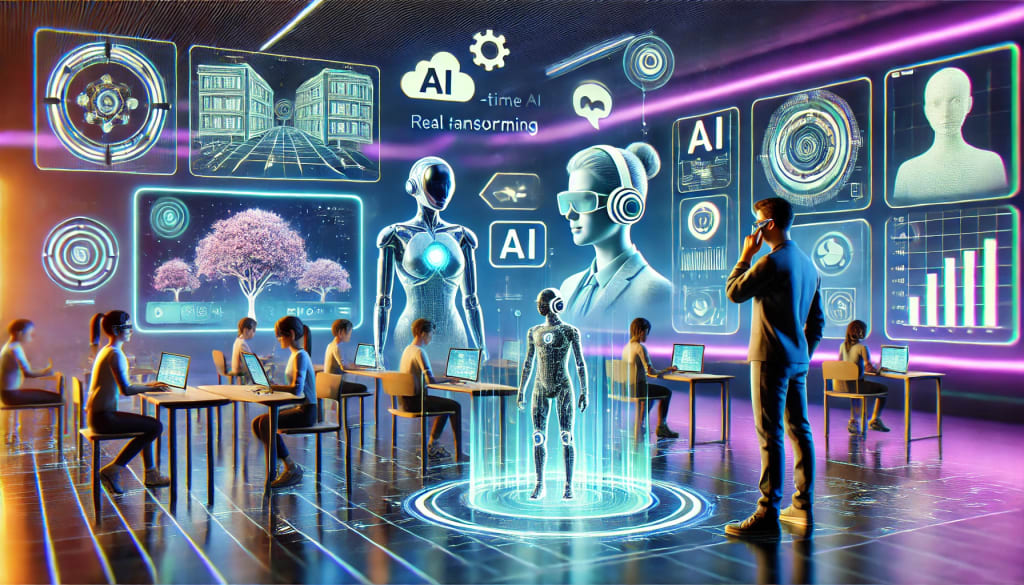
Artificial intelligence has gradually taken control and is dominating some of our major sectors. Its astonishing capabilities to break down complex tasks into simple ones leave no space for error. It has evolved from a mere grammar checker to mimicking the capabilities of an educator or a salesperson quite efficiently.
AI has gained tremendous momentum in the education or communication sector due to its personalization and efficiency. It can individually cater to a child’s learning needs and modify the syllabus to make it digestible yet insightful. In communication, it can replace human interaction and respond to multiple queries at once.
It has ensured that our repetitive yet critical tasks are accessible, saving us a lot of time and effort. To assert its importance, we should acknowledge and realize the extent of AI’s prowess in some of our major sectors. In this blog, we take a quick look at how far AI has come in this regard and where it’s heading next.
AI In Education
We don’t talk enough about how AI is changing the dynamics of education as we know it. Traditional methods of learning are often limited to grasping a concept just to replicate it on paper. This not only discourages students but also fails to ensure how well they have truly understood the concept. But, AI is slowly and gradually changing all that.
- Personalized learning experiences using AI: Relying on AI for the syllabus enables the students to access their lessons anytime. The burden to understand everything in a stipulated amount of time vanishes. Students are able to access personalized lesson plans that are specifically designed for their capabilities. Along with that, AI helps with a curriculum matching the pace of a particular student and helps them understand the lessons.
- AI tools for student assessment and feedback: A classroom setup takes away the space for the students to receive detailed feedback. The time doesn't permit a teacher to help the students in detail and specifics. However, AI-graded assessments have the entire analysis of a student’s understanding and their grasp or lack of knowledge. It helps with a detailed analysis and feedback which helps every step of the way.
- AI-powered tutoring and adaptive learning systems: AI-driven tutoring platforms offer students 24/7 access to guidance, helping them understand complex concepts. Plus, adaptive learning systems keep things just right by adjusting lesson difficulty based on progress and ensuring a student is never overwhelmed.
AI In Communication
We have always been a strong believer that nothing replaces human communication in a customer-centric domain. But AI has shattered that concept and how. It has made communication easier, and faster, and dealing with complex customer issues hassle-free.
- Role of AI in enhancing communication tools and platforms: We no longer have any major restrictions when it comes to communication. AI has ensured we cross the boundaries of language efficiently. It can transcribe video calls, convert important audio to text in multiple languages, and do so much more. Our entire communication process is now streamlined, and this is only going to get more advanced in the coming years.
- AI chatbots and virtual assistants in customer service and collaboration: Virtual assistants and chatbots have ensured you can attain all of your customers together at any given time. They leave no space for errors and cater to every customer with the same zeal. The inception of AI in this regard has also helped businesses reduce the burden and assign human experts to more complex issues.
- Real-time translation and accessibility tools: There has never been an invention that has also included the disabled in the mainstream conversation. But AI has successfully changed that lack of inclusion and has made everything easier. One can now run a business, communicate with customers, or even lure in potential buyers, all with the help of transcription and text-to-audio AI solutions.
Benefits Of AI In Education And Communication
Artificial intelligence in education and communication has optimized the entire process. We now have well-tested solutions and ideas to resort to for a particular problem. There are now high end features in operation it seemingly easy interfaces to comprehend tasks. It has completely transformed the way we learn and connect and how we can achieve more.
- Increased efficiency and productivity: AI takes care of all the mundane tasks to help you focus on what's more important. This has helped boost productivity by handling routine tasks efficiently. It also allows you to focus more time on critical areas, improving overall effectiveness
- Greater accessibility for students and users with disabilities: Anyone regardless of their disability can be part of the conversation. Tools like speech-to-text, text-to-speech, and voice assistants can assist students with visual or hearing impairments. Along with that Speech recognition and other AI technologies bridge gaps, allowing for smoother interaction. These tools benefit both parties greatly and efficiently.
- Enhanced engagement and interactivity: Interactive AI-like gamified modules or interactive videos help in better engagement with the students and potential customers. It acts as the most efficient hook to spread the message across and deliver the message.
Challenges And Ethical Concerns
Like every innovation, AI also has some black clouds looming over its head. The anti AI group believes that this dependency on AI is problematic, and it has highlighted some major concerns.
- Privacy and data security issues: AI’s personalization feature where it is capable of addressing each student or customer separately comes at a cost. It has to have access to a considerable amount of personal data and insights to understand what the user is looking at. Exposing children and in fact adults with all the credentials in this volatile environment is always frowned upon.
- Dependence on AI vs. human interaction: The machined way of learning takes the scope for human interaction. This results in the students being deprived of expertise which comes from years of exposure to a field or topic. Moreover, the level of empathy in the chatbots and assistants can never replace the assurance of a human agent.
- Addressing bias in AI algorithms: This is one of the pressing concerns raised by AI refuters. Their speed and accuracy come from processing vast amounts of similar data to predict what we need. However, if the initial dataset itself is corrupt we shall not be spared of biased answers, and it will reflect in every aspect.
Future Outlook
However, these pressing concerns have not stopped us from venturing deep into the depths of AI. We now stand at a threshold where AI is even capable of mimicking human conversation and its nuances. We are able to efficiently Humanize AI Text, keep up with the flow of the normal conversation, and so much more.
Potential innovations in AI for education and communication: We can expect Virtual reality to collaborate with artificial intelligence in the near future. It will enable a great learning experience and efficient communication for all. Along with that, AI will be able to streamline grading, scheduling, and resource management, allowing educators to focus only on teaching.
Predictions for how AI will continue to reshape these fields: The future of education with AI looks promising. Education resources will finally be accessible to all. There will be no more cultural bias in access to education. But, most importantly, every student will have access to their setup and progress in the palm of their hands.
Frequently Asked Questions:
1. Are there any ethical concerns related to AI in education?
There are some major ethical concerns with the use of AI in education. Issues like data privacy, bias in AI systems, and unequal access to technology resulting in jeopardizing academic integrity plague its use.
2. What are the challenges of using AI in communication?
A chatbot or virtual assistant will never be able to replicate the nuances of the human emotion. This lack of empathy is followed by a lack of cultural awareness and sensitivity and training bais.
3. Can AI fully replace human teachers or communicators?
No, AI can assist and revamp, but it cannot replace the empathy, creativity, and judgment of humans.
4. How does AI help with real-time translation?
It uses the power of Natural Language Processing to help understand the layers of written language instantly, enabling smoother communication and translation.
5. What does the future hold for AI in education and communication?
AI is set to make learning more personal, easier to access, and improve communication tools. It will bridge the gap between the need and access to resources efficiency. AI will be more dedicated to personalizing lessons for educators and students alike. It will break any language barrier and facilitate communication easily. Plus we can also expect some feisty innovations like automated meeting summaries, smart email responses, context-aware suggestions, and many more.
About the Creator
Vijay Singh Khatri
Graduate in Computer Science Engineering, specialized in Digital Marketing. I am very fond of writing tech articles.
Keep reading
More stories from Vijay Singh Khatri and writers in Education and other communities.
Global Payment Gateways for E-Commerce: What You Need to Know
Cashless transactions are why any small business today can seamlessly expand beyond a brick-and-mortar setup. Even the big-shot names have gone global due to the ease of secure financial transactions facilitated by the payment gateways.
By Vijay Singh Khatriabout a year ago in Education
Beyond Speed: How High-Performance Computing Is Shaping Tomorrow’s Discoveries
High-Performance Computing is changing how people explore ideas, test theories, and solve complex problems. It allows machines to work together at great speed. These systems can handle tasks that are far too large for standard computers. As a result, High-Performance Computing and the future of discovery are closely linked.
By Jason Pruetabout 5 hours ago in Education
Python vs Rust Performance: Speed, Memory Usage, and Scalability Explained
When developers compare programming languages, performance is often one of the most debated factors. Two languages that frequently come up in these discussions are Python and Rust. While both are powerful in their own ways, they approach performance, memory management, and scalability very differently. This makes the Python vs Rust comparison especially relevant for teams choosing the right technology for their next project.
By Lennox Gray3 days ago in Education



Comments
There are no comments for this story
Be the first to respond and start the conversation.