
How about been able to breath in space?
Could it be possible to breath in space? Let's find out.


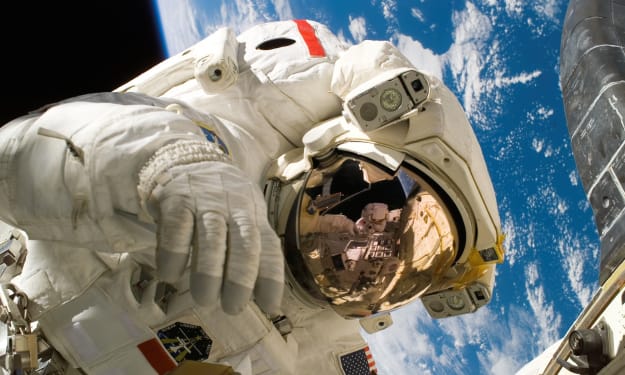
Picture yourself floating through space during a casual spacewalk when suddenly your trusty helmet decides to take a vacation. Instead of freaking out and gasping for your last breath, you take in a lung full of fresh cosmic air. Now let's dive into the mind-boggling consequences of a breathable outer space on our cozy planet Earth.
The air we breathe consists mostly of nitrogen and oxygen with a smattering of other gases to keep things interesting. But beyond our atmosphere's 6214 mile reach, molecular oxygen becomes as rare as a unicorn in a tuxedo. With an expanded atmosphere in relative space, you'd be strapping on your space boots and jetting off to any corner of the universe, all the while breathing as easy as you do back home.
Prepare your eardrums for a symphony of cosmic proportions! In the vacuum of space, sound waves can't travel because there's a serious lack of molecules to carry those groovy vibrations. Yet in our newfound space atmosphere, the sound would have a field day traveling far and wide. Get ready to tune into the sun and the other celestial crooners. The sun in all its glory would be rocking out with constant vibrations that would make your head spin. It would sound like attending a never-ending concert where the sun's tunes hit your ears at a staggering 125 decibels, which is louder than a thousand police sirens.
In the absence of friction, planets and moons gracefully orbit the sun without losing speed. However, with the introduction of all that breathable air, things would take a wild turn. Planets and moons would be zooming through the atmosphere at super high speeds, resulting in some serious collisions with those pesky air particles. Brace yourself, because Earth would suffer the same fiery fate as those ill-fated asteroids entering our planet's atmosphere. Scorched surfaces all around - that's definitely not the kind of barbecue we were hoping for.
And if that wasn't enough chaos for one day, get ready for the grand finale. Eventually, the moon would halt its celestial dance and come to a standstill, only to be pulled closer by Earth's gravitational force. This cosmic tango would lead to a catastrophic collision that could potentially kiss our beloved planet goodbye. Not to mention the rest of the solar system wouldn't be throwing a victory party either. All that air would wreak havoc, turning our peaceful solar system into a menacing black hole.
The air would bring about a hefty mass, roughly 5 billion times greater than the sun itself, spanning a mind-boggling radius of 90 astronomical units. If the sun's gravitational pull decided to play tug of war with this colossal mass, the solar system would start to feel the squeeze - compression madness. In the end, we might witness the birth of a black hole, a monstrous entity 1,200 times more massive than the supermassive black hole sitting in the heart of the Milky Way.
By this point, you and I would have to bid farewell to the mortal realm, long ago and it's probably for the best. The showdown between these two gravitational behemoths would be the stuff of legends, but alas, that's a tale for another day.
In our hypothetical situation, there's more than one option when we introduce matter or atmosphere into the equation. The delicate balance between Earth's surface temperature and its surroundings gets a good shaker. We have some air to breathe right here on good old planet Earth, thanks to our trusty atmosphere. However, due to the greenhouse effect, this era of ours actually warms things up a bit compared to a hypothetical scenario without an atmosphere, on average that is. You see, planets without an atmosphere might have lower average temperatures, but their temperature roller coaster is wilder, resulting in higher maximum temperatures.
Okay, let's step away from our cozy Earth for a moment and ponder what would happen if the entire solar system was filled with air. We'll temporarily ignore the small detail that Earth's movement would slow down and we'd end up having a toasty rendezvous with the sun. It's a hypothetical scenario that would surely test the limits of our cosmic understanding.
About the Creator
Jude Cipher
Passionate about writing fascinating things on life, nature and how to explore a lot in everyday.
Keep reading
More stories from Jude Cipher and writers in Education and other communities.
The space visitor that came from another star
The very first known Interstellar Object (ISO) to visit our Solar System was a rocky, elongated interloper with a slightly reddish hue. Spotted in 2017, it was dubbed with a Hawaiian name and was almost 10 times as long as it was wide, an extremely unusual shape for objects in our Solar System. Astronomers hoped it could provide some clues into how other star systems form and function.
By Jude Cipher3 years ago in Education
Failing forward: An Integral Part of Self-Growth
« Freedom is not worth having if it does not include the freedom to make mistakes. » - Mahatma Gandhi We live in a world dominated by the dogma of endless progress - a belief deeply embedded in modernist ideology. It fuels a culture of performance, consumption, and overproduction. In this environment, failure is relatively unwelcome and often stigmatized, as though making mistakes were systematically interpreted as a sign of gross negligence or personal weakness that doesn't align with the standards.
By Walid Yamed3 days ago in Education
10 Times Rotten Tomatoes And I Disagreed
***Disclaimer*** I will be ranking these movies in the following manner: The greater the divide between Rotten Tomatoes and I, the higher up on the list (and I am referring to the critic's score, not the audience score). I will also show Rotten Tomatoes' score on each one in addition to my score. I am curious to know what everyone thinks, please let me know in the comments below!
By Madison "Maddy" Newtonabout 16 hours ago in Geeks



Comments
There are no comments for this story
Be the first to respond and start the conversation.