
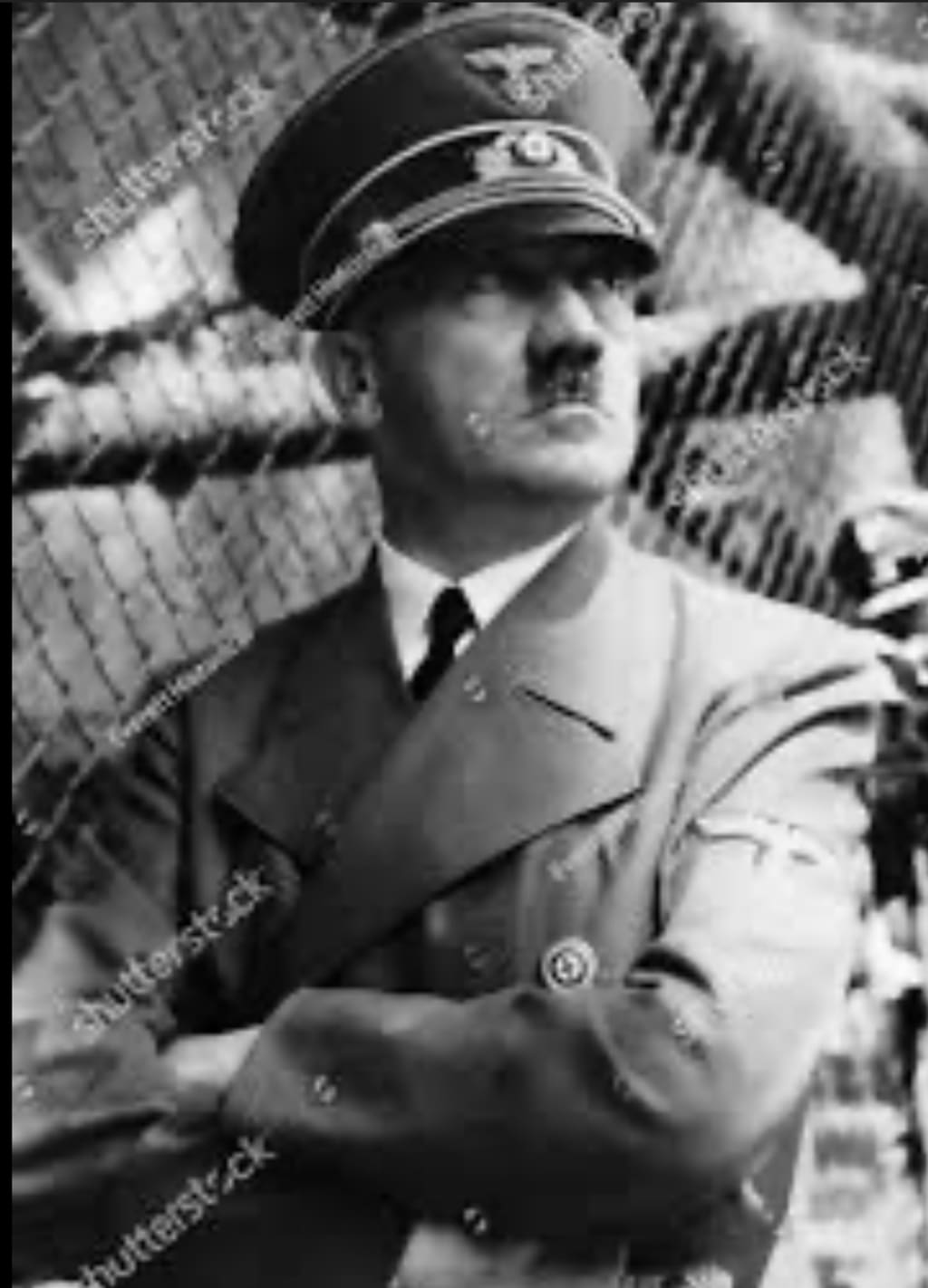
Adolf Hitler was a German politician and leader of the Nazi Party. He rose to power as Chancellor of Germany in 1933 and later Führer in 1934. During his dictatorship from 1933 to 1945, he initiated World War II in Europe by invading Poland in September 1939. He was closely involved in military operations throughout the war and was central to the perpetration of the Holocaust.
Hitler was born in Austria in 1889 and moved to Germany in 1913. He served in the German army during World War I and was injured several times. After the war, he became involved in politics and joined the German Workers' Party, which later became the Nazi Party. In the early 1920s, Hitler took on a leading role in the party and began to espouse his extremist ideas, which included anti-Semitism, anti-communism, and German national pride.
In 1923, Hitler attempted to overthrow the German government in a failed coup attempt known as the Beer Hall Putsch. He was arrested and sentenced to prison for treason, but he only served a little over a year. After his release, he worked to rebuild the Nazi Party and gain political power.
By the 1930s, the Nazi Party had become the largest political party in Germany, and Hitler was appointed Chancellor in 1933. Once in power, Hitler quickly consolidated control and established a totalitarian regime. He used propaganda to control the media and suppress opposition, and he also began to implement policies that targeted Jews and other minority groups. These policies eventually led to the Holocaust, in which millions of Jews, as well as other minority groups such as homosexuals, disabled, and romani people were murdered in concentration and extermination camps during the war.
As Chancellor, Hitler also pursued aggressive territorial expansion, leading to the annexation of Austria and the invasion of Czechoslovakia. He then initiated World War II in 1939 with the invasion of Poland, which led to declarations of war from the United Kingdom and France.
Despite early military successes, the tide of the war began to turn against Germany. Hitler's decision to invade the Soviet Union in 1941 proved to be a major mistake, and the German army was eventually pushed back on both the Eastern and Western fronts. By 1944, the Allies had landed in Normandy and were pushing their way into Germany. Hitler's military advisors had urged him to seek peace, but Hitler refused and even ordered scorched earth tactics to be used to destroy the German economy and infrastructure.
As the Allies closed in on Berlin, Hitler realized that the war was lost, and he committed suicide in his bunker on April 30, 1945. With his death, the Nazi regime collapsed, and Germany surrendered on May 8, bringing an end to World War II in Europe.
In short, Hitler was a dictator who rose to power in Germany in the 1930s and orchestrated the Holocaust, the systematic extermination of millions of Jews and other minority groups. He also initiated World War II, and his aggressive territorial expansion and persecution of minority groups resulted in loss of lives and devastation in Europe and the world. His reign ended with the fall of Nazi Germany and his own suicide in 1945After Hitler's death, the Allies launched a series of war crimes trials to prosecute those who had been involved in the Holocaust and other war crimes. The most famous of these trials was the Nuremberg Trials, which were held in the German city of Nuremberg in 1945 and 1946. Several high-ranking Nazi officials, including Heinrich Himmler and Hermann Göring, were put on trial for crimes against humanity and other war crimes. Many of them were convicted and sentenced to prison or death.
The Allied powers also set about the process of de-Nazification in Germany, which was aimed at removing the influence of the Nazi party and removing Nazi sympathizers from positions of power in government, the military, and other institutions. The process of denazification was not without controversy and was met with varying degree of success.
Hitler's legacy remains a highly debated topic and is still a source of controversy. The atrocities committed under his regime and the devastation caused by the war continues to be remembered as one of the darkest period of human history. He is still considered by many as one of the greatest villains in history. His ideas, particularly his racist and nationalist ideologies, have been widely discredited, but his methods and tactics continue to be studied as a cautionary tale of how easily a society can be manipulated and led into tragedy.
In the present day, there are laws in some countries that prohibit the display of Nazi symbols, the denial of Holocaust and other war crimes, and the glorification of Hitler and the Nazi regime, as it is considered as hate speech and incitement of racial or national hatred. Despite this, some extremist groups continue to admire and attempt to emulate Hitler's ideas and tacticsOne special aspect of Hitler's legacy is the way in which his ideas and tactics continue to be studied and analyzed in order to better understand how a leader can rise to power by manipulating and exploiting the fears and prejudices of a population. His use of propaganda and control of the media, along with his charisma and ability to tap into nationalistic sentiment, are considered by many experts to be key factors in his rise to power.
Another special aspect of Hitler's legacy is the way that his ideas and actions have been condemned and rejected by the international community, and how efforts have been made to make sure that such atrocities are never repeated. As I previously mentioned, many countries have laws that prohibit the display of Nazi symbols and the denial of the Holocaust, and many organizations have been established to promote tolerance and education about the dangers of fascism and totalitarianism.
Additionally, the Holocaust has become a symbol of the atrocities that can be committed when hate is allowed to go unchecked, and it serves as a reminder of the importance of speaking out against genocide and other forms of persecution. Holocaust education and the study of the genocide of the Jewish people, among other minority groups, has become an important aspect of modern education in many countries.
Overall, Hitler's legacy is not only a historical matter but also a source for contemporary reflection, research and instruction for prevention of similar atrocities in the future
About the Creator
Keep reading
More stories from Mahendrarajah Mithusharan and writers in Education and other communities.
World war 2
World War II was a global war that lasted from 1939 to 1945. It was the deadliest conflict in human history, with an estimated 50 million to 85 million fatalities worldwide. The war was fought primarily in Europe, but it also involved countries in Africa, Asia, and the Americas. The primary axis powers were Germany, Japan, and Italy, while the primary allied powers were the United States, the United Kingdom, and the Soviet Union. The war began with the invasion of Poland by Germany in September 1939, and it eventually led to the use of nuclear weapons on the Japanese cities of Hiroshima and Nagasaki in August 1945. The war also marked the rise of the Soviet Union and the United States as superpowers, and it resulted in the formation of the United NationsThe events leading up to World War II were complex, but one of the main causes of the war was the aggressive expansion of Germany under its leader, Adolf Hitler. Hitler's goal was to create a "New Order" in Europe, which would be dominated by the German people. He began by annexing Austria in 1938, and then he moved on to invade Czechoslovakia and Poland in 1939. This led to declarations of war from the United Kingdom and France, which marked the official beginning of the war.
By Mahendrarajah Mithusharan3 years ago in Education
Misplaced Optimism: A Year of Accountability Promised — and Withheld at LAUSD
“We must hold the Superintendent accountable” – Karla Griego (2024) Ten years ago, I ran for a seat on the LAUSD Board of Education to change the district I believed was failing its students, especially those with Special Education needs. My opponent was Tamar Galatzan, an entrenched incumbent who was backed by the charter school industry. I achieved the lowest cost per vote, just 69 cents, in the entire city during that election cycle. While it wasn’t enough to win the seat, our campaign helped knock Galatzan out of office. This helped to clear a pathway for change and raised expectations that accountability might finally follow.
By Carl J. Petersen6 days ago in Education



Comments
There are no comments for this story
Be the first to respond and start the conversation.