

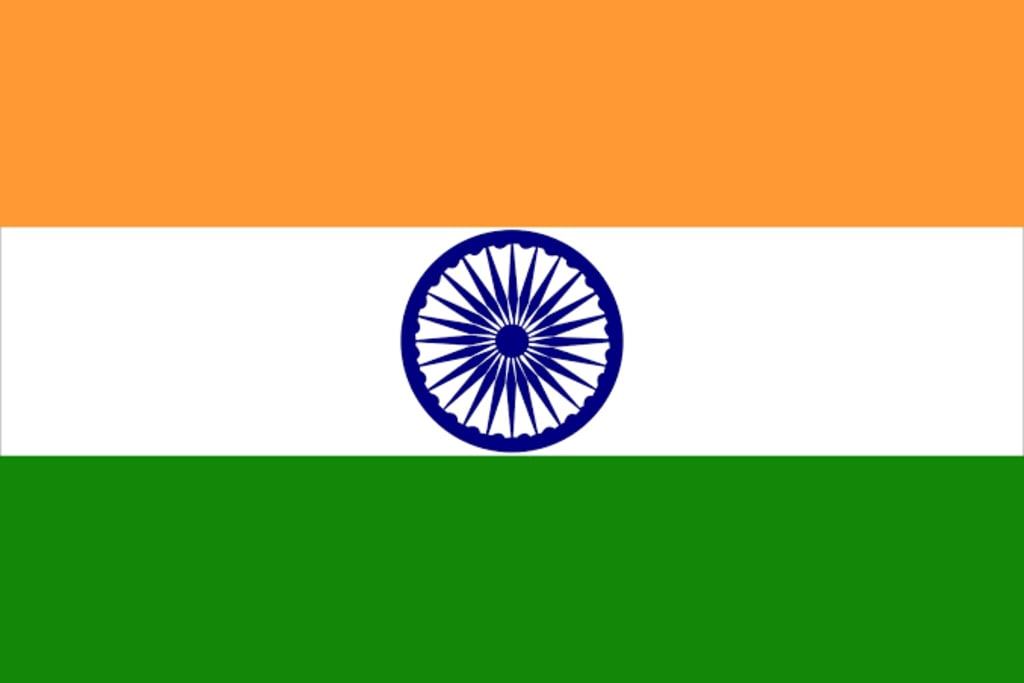
India has a rich and complex history that spans thousands of years. Here is a brief overview of some of the key events and periods in Indian history:
Indus Valley Civilization (c. 2600 BCE - c. 1900 BCE): The Indus Valley Civilization was an ancient civilization that existed in the northwestern region of the Indian subcontinent. It is known for its advanced urban planning, sophisticated drainage systems, and distinctive artifacts, such as the famous Harappan seals.
Vedic Period (c. 1500 BCE - c. 500 BCE): The Vedic Period is characterized by the composition of the Vedas, the oldest sacred texts of Hinduism. It was a time of pastoral and agricultural life, as well as the emergence of various philosophical and religious schools of thought.
Mauryan Empire (c. 322 BCE - c. 185 BCE): The Mauryan Empire was one of the largest and most powerful empires in ancient India. It was founded by Chandragupta Maurya and reached its peak under the reign of Ashoka, who is known for his conversion to Buddhism and his promotion of nonviolence.
Gupta Empire (c. 320 CE - c. 550 CE): The Gupta Empire is often referred to as the "Golden Age" of India. It was a time of great cultural and intellectual achievement, with notable contributions in the fields of science, mathematics, literature, and art.
Mughal Empire (c. 1526 CE - c. 1857 CE): The Mughal Empire was founded by Babur, a descendant of Genghis Khan and Timur. It was a time of great architectural and artistic achievement, as well as religious and cultural tolerance. The Mughals were known for their opulent lifestyle, as well as their attempts to create a centralized, bureaucratic state.
British Raj (1858-1947): The British Raj was a period of British colonial rule in India. It was marked by a complex relationship between the colonizers and the colonized, with India experiencing both economic development and political oppression under British rule.
Independence (1947): India gained its independence from British rule on August 15, 1947, following a long and often violent struggle for independence led by figures such as Mahatma Gandhi and Jawaharlal Nehru. The country was partitioned into India and Pakistan, leading to massive population exchanges and violence.
Since independence, India has experienced significant political and economic changes, including the adoption of a new constitution, the Green Revolution, and economic liberalization. Today, India is a rapidly developing nation with a diverse culture and a thriving economy.
The history of independent India began when the country became an independent nation within the British Commonwealth on 15 August 1947. Direct administration by the British, which began in 1858, affected a political and economic unification of the subcontinent. When British rule came to an end in 1947, the subcontinent was partitioned along religious lines into two separate countries—India, with a majority of Hindus, and Pakistan, with a majority of Muslims. Concurrently the Muslim-majority northwest and east of British India was separated into the Dominion of Pakistan, by the Partition of India. The partition led to a population transfer of more than 10 million people between India and Pakistan and the death of about one million people. Indian National Congress leader Jawaharlal Nehru became the first Prime Minister of India, but the leader most associated with the independence struggle, Mahatma Gandhi, accepted no office. The constitution adopted in 1950 made India a democratic country, and this democracy has been sustained since then. India's sustained democratic freedoms are unique among the world's newly independent states.
The nation has faced religious violence, naxalism, terrorism and regional separatist insurgencies. India has unresolved territorial disputes with China which in 1962 escalated into the Sino-Indian War, and with Pakistan which resulted in wars in 1947, 1965, 1971 and 1999. India was neutral in the Cold War, and was a leader in the Non-Aligned Movement. However, it made a loose alliance with the Soviet Union from 1971, when Pakistan was allied with the United States and the People's Republic of China.
India is a nuclear-weapon state, having conducted its first nuclear test in 1974, followed by another five tests in 1998. From the 1950s to the 1980s, India followed socialist-inspired policies. The economy was influenced by extensive regulation, protectionism and public ownership, leading to pervasive corruption and slow economic growth. Beginning in 1991, economic liberalisation in India has transformed India into the third largest and one of the fastest-growing economies in the world despite following Dirigisme economic system.[unbalanced opinion?] From being a relatively destitute country in its formative years,the Republic of India has emerged as a fast growing G20 major economy with high military spending,and is seeking a permanent seat in the United Nations Security Council.
India has sometimes been referred to as a great power and a potential superpower given its large and growing economy, military and population.
About the Creator
Gnanaprakash
Welcome to our knowledge world... My content looking for knowledge wise focus some reviews,entertainment, poet and story's
Keep reading
More stories from Gnanaprakash and writers in Education and other communities.
Rethinking Math Education in the 21st Century: Lessons from the Casie Hynes Perspective
Mathematics has long been considered a fundamental pillar of education. It develops critical thinking, nurtures problem-solving abilities, and plays an essential role in science, technology, engineering, and finance. Yet despite its importance, math remains one of the most challenging and misunderstood subjects for students worldwide. As we step deeper into a data-driven era, reforming how we approach math education is more urgent than ever.
By Casie Hynes2 days ago in Education
Smart Ways to Prevent AI From Taking Your Job
Artificial intelligence is changing the workplace faster than almost any technology before it. From automated customer service to AI-generated reports, images, and code, it’s natural to wonder: Will AI take my job?
By Anthony Bahamondea day ago in Education
So You Decided To Become a Nurse Practitioner:
So you decided to become an "Advanced Practice" nurse. Congratulations!... is what I would say if this was a good idea. Grad school? In this economy? What were you thinking? Likely it was something along the lines of either 1) “I've seen these other chucklefucks do it— Why can't I?” or even 2) “I've got a nice career, I should shake it up. I miss feeling like I have no clue what I'm doing.”
By Sandor Szabo4 days ago in Fiction




Comments
There are no comments for this story
Be the first to respond and start the conversation.