
Here are 5 fun facts about space:
The vastness and mysteries of space, combined with human achievements like the ISS, make for an endless source of wonder and fascinating facts!

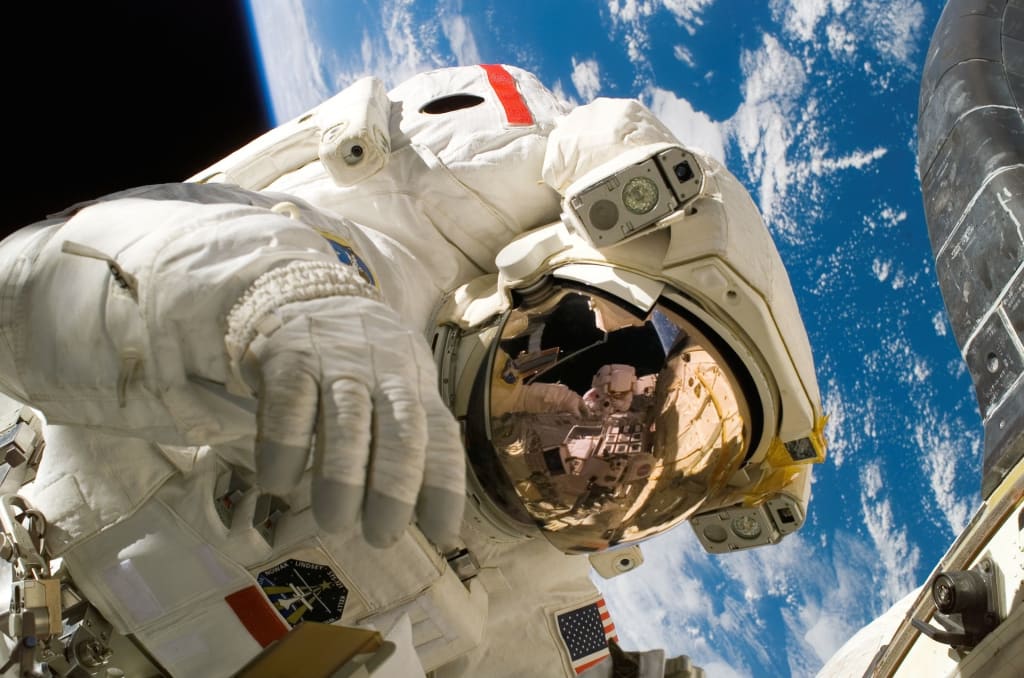
1.Expanding Universe: Edwin Hubble made the groundbreaking discovery in the 1920s that the universe is expanding. This means that galaxies are moving away from each other, and the space between them is getting larger.
2.Sun's Weight: The Sun contains 99.86% of the mass in our solar system. Despite this, it's considered a relatively average-sized star!
3.Footprints on the Moon: The footprints left by astronauts on the moon will remain there for millions of years because there is no wind or water on the Moon to erode them away.
4.Space Speed: Astronauts on the ISS travel at a speed of about 28,000 kilometers (17,500 miles) per hour. This means they see a sunrise and sunset every 90 minutes!
5.Water Recycling on ISS: Due to the expense and difficulty of getting water to the International Space Station, it's crucial to recycle as much as possible. Astronauts have systems that recycle about 93% of the water they use, including their own urine!
#Bonus Fact: International Collaboration: The ISS is perhaps the most politically complex space exploration program ever undertaken. Its modules and components were manufactured in various countries around the world and then assembled in orbit. It's a collaboration between NASA (United States), Roscosmos (Russia), JAXA (Japan), ESA (Europe), and CSA (Canada).
Little bit about international space station (ISS):
The International Space Station (ISS) stands as a testament to what can be achieved when nations work together towards common scientific and exploratory goals.
Overview:
The ISS orbits approximately 408 kilometers (about 253 miles) above the Earth and serves as a microgravity and space environment research laboratory, where scientific research is conducted in astrobiology, astronomy, meteorology, physics, and other fields.
International Collaboration:
The ISS is a joint project involving five participating space agencies: NASA (United States), Roscosmos (Russia), JAXA (Japan), ESA (Europe), and CSA (Canada). Its modular structure consists of multiple interconnected modules, each contributed by different countries.
Construction and Operation:
Launched and assembled in space in multiple stages starting in 1998, the ISS has been continuously inhabited since the year 2000. It travels at an average speed of 28,000 kilometers (17,500 miles) per hour, completing an orbit around Earth approximately every 90 minutes. This high velocity means that astronauts aboard the ISS experience 16 sunrises and sunsets every day!
Research and Discoveries:
On the ISS, researchers study the effects of long-term spaceflight on the human body, which is vital for potential future missions to distant planets. Additionally, the microgravity environment of the ISS allows for experiments that would be impossible on Earth. These experiments encompass a range of fields, from studying crystalline growth to observing the behavior of fluids.
Benefits for Humanity:
Research aboard the ISS has resulted in numerous advancements in medicine, environmental systems, and our understanding of the universe. Moreover, technologies developed for the ISS have found applications on Earth, including water purification systems and improvements in telemedicine.
Future of ISS:
While the ISS has been an iconic presence in low Earth orbit for over two decades, its operational future is a topic of discussion among the partner nations. Various proposals suggest its use until at least 2030, after which its modules might be repurposed, or the station might be succeeded by newer commercial or international platforms.
The ISS remains one of humanity's most significant achievements in space exploration and international cooperation. Its continued operation promises further advancements in science and technology that benefit all of humankind.
China built its own space station after it was excluded from the International Space Station, largely due to U.S. concerns over the Chinese space programs' intimate ties with the People's Liberation Army.China is seeking to enhance its capacity for scientific and technological innovation by building a large modular space station. Chinese leaders also hope that research conducted on the Chinese Space Station (CSS) will support their long-term goals for space exploration, including missions to the Moon and Mars.
About the Creator
Can You Really Earn Money With Transcription? The Real Income Reality
The short answer is yes—you can earn money with transcription. But the more honest, useful answer is this: transcription only becomes worthwhile when you understand how the income actually works, not how it’s often presented online.
By Mahesh Kumar3 days ago in Education
Beyond the Transcript: What Extracurriculars and Essays Reveal That Grades Cannot
Colleges today look far beyond GPAs and test scores to understand who applicants truly are. While academic metrics indicate preparedness for coursework, they fail to capture personality, resilience, passion, and potential contributions to campus life. This is why essays, extracurricular activities, and other non-academic elements of an application hold significant power. They offer admissions officers a fuller, richer, more human version of the student—one that no number can represent.
By Carmen Reid6 days ago in Education
Ludacris and Nelly draw backlash over bookings at MAGA-coded music festival
Ludacris and Nelly headlining a mostly right-wing event is good for them. It’s also great for the genre of hip hop. The two rap veterans have showcased their talents on other stages. Why can’t they perform for mostly MAGA folks and grab that bag?
By Skyler Saunders3 days ago in Beat


Comments
There are no comments for this story
Be the first to respond and start the conversation.